The Wiert Corner – irregular stream of stuff

Jeroen W. Pluimers on .NET, C#, Delphi, databases, and personal interests

  • My badges

  • Twitter Updates

  • My Flickr Stream

  • Pages

  • All categories

  • Enter your email address to subscribe to this blog and receive notifications of new posts by email.

    Join 1,860 other subscribers

Archive for the ‘SQL Server’ Category

SQL server: getting database names and IDs

Posted by jpluimers on 2021/06/29

A few statements go get database names and IDs based on these functions or system tables:

Part of it has the assumption that a master database always exists.

-- gets current database name
select db_name() as name
;
name
--------------------------------------------------------------------------------------------------------------------------------
acc

(1 row affected)
-- gets current database ID
select db_id() as dbid
;
dbid
------
5

(1 row affected)
-- gets all database IDs and names
select dbid,name from sys.sysdatabases
;
dbid   name
------ --------------------------------------------------------------------------------------------------------------------------------
1      master
5      acc

(2 rows affected)
-- gets current database name by ID
select db_name(db_id()) as name
;
name
--------------------------------------------------------------------------------------------------------------------------------
acc

(1 row affected)
-- gets case corrected database name for sys.sysdatabases.name having a case insensitive collation sequence
select dbid,name from sys.sysdatabases 
where name='Master'
;
dbid   name
------ --------------------------------------------------------------------------------------------------------------------------------
1      master

(1 row affected)
-- gets case corrected database name for sys.sysdatabases.name having a case sensitive collation sequence
select dbid,name from sys.sysdatabases 
where name = 'Master' collate Latin1_General_100_CI_AI
;
dbid   name
------ --------------------------------------------------------------------------------------------------------------------------------
1      master

(1 row affected)

Note that:

  • even though by default the SQL server collation sequence is case insensitive, it can make sense to do a case insensitive search, for example by using the upper function, specifying a collation, or casting to binary. I like upper the most, because  – though less efficient – it is a more neutral SQL idiom.
  • the most neutral case insensitive collation seems to be Latin1_General_100_CI_AI

Related:

  • [WayBack] SQL server ignore case in a where expression – Stack Overflow answered by Solomon Rutzky, summarised as:
    • Do not use upper as upper with lower does not always round-trip.
    • Do not use varbinary as it is not case insensitive.
    • Neither the = or like operators are case sensitive by default: both need a collate clause.
    • Find the collation of the column(s) involved; if it contains _CI, then you are done (it is already case insensitive); if it contains _CS, then replace that with _CI (case insensitive) and add that in a collate clause.
    • Collations are per predicate, so not per query, per table, per column nor per database. This means you have to specify them if you want to use a different one than the default.
  • [WayBack] What is Collation in Databases? | Database.Guide
    Latin1_General_100_CI_AI Latin1-General-100, case-insensitive, accent-insensitive, kanatype-insensitive, width-insensitive
  • [WayBack] Collation Info: Information about Collations and Encodings for SQL Server
  • [WayBack] SQL Instance Collation – Language Neutral Required:

    I recommend using Latin1_General_100_CI_AI. I recommend this because:

    1. If Latin1_General_CI_AI is supported, then there’s almost no chance thatLatin1_General_100_CI_AI (which is a far better choice) isn’t also supported. The version 100 collation has about 15,400 more sort weight definitions, plus 438 more uppercase/lowercase mappings. Not having those sort weights means that 15,400 more characters in the non-100 version equate to space, an empty string, and to each other. Not having those case mappings means that 438 more characters in the non-100 version return the character passed in (i.e. no change) for the UPPER() and LOWER() functions. There is no reason at all to want Latin1_General_CI_AI instead of Latin1_General_100_CI_AI. There might be a need if code was put into place to work around these deficiencies, and that code would behave incorrectly under the newer, better version of that collation. However, it’s highly unlikely that code was put into place to account for this, and extremely unlikely that if such code did exist, that it would error or doing things incorrectly due to the newer collation.
  • [WayBack] Differences Between the Various Binary Collations (Cultures, Versions, and BIN vs BIN2) – Sql Quantum Leap
  • [WayBack] How to do a case sensitive search in WHERE clause (I’m using SQL Server)? – Stack Overflow answered by Jonas Lincoln:

    By using collation or casting to binary, like this:

    SELECT *
    FROM Users
    WHERE   
        Username = @Username COLLATE SQL_Latin1_General_CP1_CS_AS
        AND Password = @Password COLLATE SQL_Latin1_General_CP1_CS_AS
        AND Username = @Username 
        AND Password = @Password 

    The duplication of username/password exists to give the engine the possibility of using indexes. The collation above is a Case Sensitive collation, change to the one you need if necessary.

    The second, casting to binary, could be done like this:

    SELECT *
    FROM Users
    WHERE   
        CAST(Username as varbinary(100)) = CAST(@Username as varbinary))
        AND CAST(Password as varbinary(100)) = CAST(@Password as varbinary(100))
        AND Username = @Username 
        AND Password = @Password 
  • [WayBack] sql – How to get Database name of sqlserver – Stack Overflow

–jeroen

Posted in Database Development, Development, Encoding, internatiolanization (i18n) and localization (l10), SQL Server | Leave a Comment »

(nullable) rowversion (Transact-SQL) – SQL Server | Microsoft Docs

Posted by jpluimers on 2021/06/09

I was not aware there could be a nullable [WayBack] rowversion (Transact-SQL) – SQL Server | Microsoft Docs, but it is possible:

Duplicate rowversion values can be generated by using the SELECT INTO statement in which a rowversioncolumn is in the SELECT list. We do not recommend using rowversion in this manner.

A nonnullable rowversion column is semantically equivalent to a binary(8) column. A nullable rowversion column is semantically equivalent to a varbinary(8) column.

You can use the rowversion column of a row to easily determine whether the row has had an update statement ran against it since the last time it was read. If an update statement is ran against the row, the rowversion value is updated. If no update statements are ran against the row, the rowversion value is the same as when it was previously read. To return the current rowversion value for a database, use @@DBTS.

You can add a rowversion column to a table to help maintain the integrity of the database when multiple users are updating rows at the same time. You may also want to know how many rows and which rows were updated without re-querying the table.

For example, assume that you create a table named MyTest. You populate some data in the table by running the following Transact-SQL statements.

–jeroen

Posted in Database Development, Development, Software Development, SQL, SQL Server | Leave a Comment »

SQL Server: RowVersion is not the same format as BigInt

Posted by jpluimers on 2021/05/18

A while ago, I needed to get RowVersion binary data out of SQL Server. People around me told me it is stored as BigInt.

I luckily bumped into [WayBack] sql server – Cast rowversion to bigint – Stack Overflow.

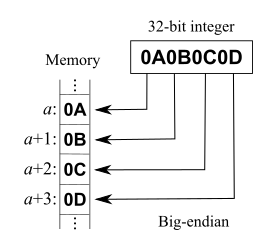
That post explains RowVersion is not stored as BigInt. Both RowVersion and BigInt take up 8 bytes of storage, but RowVersion is big-endian and unsigned, whereas BigInt is little-endian and signed.

A few quotes from it:

In my C# program I don’t want to work with byte array, therefore I cast rowversion data type to bigint:

SELECT CAST([version] AS BIGINT) FROM [dbo].[mytable]

So I receive a number instead of byte array. Is this conversion always successful and are there any possible problems with it? If so, in which data type should I cast rowversion instead?

and

You can convert in C# also, but if you want to compare them you should be aware that rowversion is apparently stored big-endian, so you need to do something like:

byte[] timestampByteArray = ... // from datareader/linq2sql etc...
var timestampInt = BitConverter.ToInt64(timestampByteArray, 0);
timestampInt = IPAddress.NetworkToHostOrder(timestampInt);

It’d probably be more correct to convert it as ToUInt64, but then you’d have to write your own endian conversion as there’s no overload on NetworkToHostOrder that takes uint64. Or just borrow one from Jon Skeet (search page for ‘endian’).

Code: [WayBack] Jon Skeet: Miscellaneous Utility Library

Related:

--jeroen

Posted in .NET, Database Development, Delphi, Development, Jon Skeet, Software Development, SQL Server | Leave a Comment »

MSSQL – searching in DDL metadata comments

Posted by jpluimers on 2021/04/14

Some interesting queries at [WayBack] www.nlaak.com • Просмотр темы – Полезные скрипты (English translation by Google)

I have put them in the [WayBack] gist below, and expect that they should be solvable without depending on deprecated sys.sysobjects.

Related: [WayBack] sql server – Making sense of sys.objects, sys.system_objects, and sys.sysobjects? – Database Administrators Stack Exchange

–jeroen

Read the rest of this entry »

Posted in Database Development, Development, Software Development, SQL, SQL Server | Leave a Comment »

UUID/GUID as primary keys in databases; generating them from a .NET assembly

Posted by jpluimers on 2021/04/08

Some links for my archive:

–jeroen

Posted in .NET, Database Development, Development, PostgreSQL, Software Development, SQL Server | Leave a Comment »

ApexSQL Refactor – Free SQL formatter | ApexSQL

Posted by jpluimers on 2021/02/09

The below configuration file haves [WayBack] ApexSQL Refactor – Free SQL formatter | ApexSQL produce quite OK formatted SQL, even for complex queries, not just for SQL Server.

So this is the second free tool I use from ApexSQL. The first one was ApexSQL, a free tool (SSMS add-in) for analyzing the execution plan of a SQL server query…

–jeroen

Read the rest of this entry »

Posted in Database Development, Development, Software Development, SQL, SQL Server | Leave a Comment »

A choco install list

Posted by jpluimers on 2021/02/03

Sometimes I forget the choco install mnemonics for various tools, so here is a small list below.

Of course you have to start with an administrative command prompt, and have a basic Chocolatey Installation in place.

If you want to clean cruft:

choco install --yes choco-cleaner

Basic install:

choco install --yes 7zip
choco install --yes everything
choco install --yes notepadplusplus
choco install --yes beyondcompare
choco install --yes git.install --params "/GitAndUnixToolsOnPath /NoGitLfs /SChannel /NoAutoCrlf /WindowsTerminal"
choco install --yes hg
choco install --yes sourcetree
choco install --yes sysinternals

For VMs (pic one):

choco install --yes vmware-tools
choco install --yes virtio-drivers

For browsing (not sure yet about Chrome as that one has a non-admin installer as well):

choco install --yes firefox

For file transfer (though be aware that some versions of Filezilla contained adware):

choco install --yes filezilla
choco install --yes winscp

For coding:

choco install --yes vscode
choco install --yes atom

For SQL server:

choco install --yes sql-server-management-studio

For web development / power user:

choco install --yes fiddler

For SOAP and REST:

choco install --yes soapui

If you don’t like manually downloading SequoiaView at gist.github.com/jpluimers/b0df9c2dba49010454ca6df406bc5f3d (e8efd031d667de8a1808d6ea73548d77949e7864.zip):

choco install --yes windirstat

For drawing, image manipulation (paint.net last, as it needs a UI action):

choco install --yes gimp
choco install --yes imagemagick
choco install --yes paint.net

For ISO image mounting in pre Windows 10:

choco install --yes wincdemu

For hard disk management:

choco install --yes hdtune
choco install --yes seatools
choco install --yes speedfan

For Fujitsu ScanSnap scanners (not sure yet this includes PDF support):

choco install --yes scansnapmanager

–jeroen

Posted in 7zip, atom editor, Beyond Compare, Chocolatey, Compression, Database Development, Development, DVCS - Distributed Version Control, Everything by VoidTools, Fiddler, Firefox, Fujitsu ScanSnap, git, Hardware, Mercurial/Hg, Power User, Scanners, SOAP/WebServices, Software Development, Source Code Management, SQL Server, SSMS SQL Server Management Studio, SysInternals, Text Editors, Versioning, Virtualization, VMware, VMware ESXi, vscode Visual Studio Code, Web Browsers, Web Development, Windows | Leave a Comment »

Find a Table on a SQL Server across all Databases – TechNet Articles – United States (English) – TechNet Wiki

Posted by jpluimers on 2020/10/13

Neither solution on [WayBackFind a Table on a SQL Server across all Databases – TechNet Articles – United States (English) – TechNet Wiki is nice, but the most readable (though undocumented) works:

sp_MSforeachdb'SELECT "?" AS DB, * FROM [?].sys.tables WHERE name like ''%your_table_name%'''

Similar solutions at:

–jeroen

Posted in Database Development, Development, SQL Server | Leave a Comment »

Configure IntelliSense (SQL Server Management Studio) | Microsoft Docs

Posted by jpluimers on 2020/10/08

Not sure why, but all of a sudden, SSMS did not code-complete any table or column names any more.

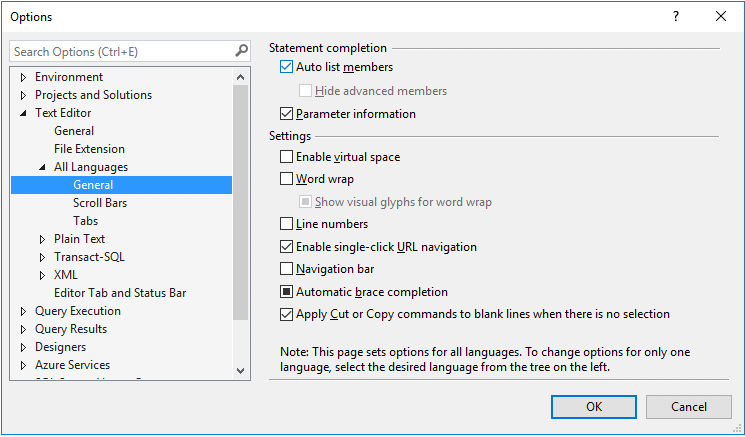
This shows where that setting is [WayBack] Configure IntelliSense (SQL Server Management Studio) | Microsoft Docs.

The odd thing: updating to a more fresh 17.x version solved the problem all by itself.

Anyway, you can change the settings under the section “All Languages”, “Transact-SQL” or “XML”, each in the “General” sub-section:

–jeroen

Posted in Database Development, Development, SQL, SQL Server, SSMS SQL Server Management Studio | Leave a Comment »

sql server – Index Seek vs Index Scan – Database Administrators Stack Exchange

Posted by jpluimers on 2020/10/01

Below some links I used to get a feel for the different query execution plan entries I observed.

The first one was the most important for me, so hopefully this post helps bump it up in the search engine results.

–jeroen

Posted in Database Development, Development, SQL, SQL Server | Leave a Comment »