The Wiert Corner – irregular stream of stuff

Jeroen W. Pluimers on .NET, C#, Delphi, databases, and personal interests

  • My badges

  • Twitter Updates

  • Pages

  • All categories

  • Enter your email address to subscribe to this blog and receive notifications of new posts by email.

    Join 1,839 other subscribers

Archive for the ‘Development’ Category

Need to revisit: Grep search crashes with `Invalid class typecast.` · Issue #1 · jpluimers/GExperts · GitHub

Posted by jpluimers on 2019/01/29

One day I need to resivit [WayBackGrep search crashes with Invalid class typecast. · Issue #1 · jpluimers/GExperts · GitHub.

The reason is that I want to be able to:

  • bind shortcut keys for deleting entries in the list of grep searches
  • performing a search while watching the results of a different one

Via [WayBack] Small initial fix for a race condition https://github.com/jpluimers/GExperts/issues/1 in commit https://github.com/jpluimers/GExperts/commit/bcc365911ab… – Jeroen Wiert Pluimers – Google+

–jeroen

Posted in Delphi, Development, GExperts, Software Development | Leave a Comment »

linux – Test if a port on a remote system is reachable (without telnet) – Super User

Posted by jpluimers on 2019/01/29

Just learned that bash can do TCP and UDP itself:

Bash has been able to access TCP and UDP ports for a while. From the man page:

/dev/tcp/host/port
    If host is a valid hostname or Internet address, and port is an integer port number
    or service name, bash attempts to open a TCP connection to the corresponding socket.
/dev/udp/host/port
    If host is a valid hostname or Internet address, and port is an integer port number
    or service name, bash attempts to open a UDP connection to the corresponding socket.

So you could use something like this:

xenon-lornix:~> cat < /dev/tcp/127.0.0.1/22
SSH-2.0-OpenSSH_6.2p2 Debian-6
^C pressed here

Taa Daa!

This for systems that do not have telnet installed (Windows stopped using this a long time ago, many Linux distributions followed suit) and you cannot to use nc (also known as netcat).

–jeroen: [WayBacklinux – Test if a port on a remote system is reachable (without telnet) – Super User

Posted in *nix, *nix-tools, bash, bash, Development, Power User, Scripting, Software Development | Leave a Comment »

Twitter so: Testing in Production – The Isoblog.

Posted by jpluimers on 2019/01/29

From 2017, a still relevant edited twitter conversation on testing in production, why you need it: [WayBackTwitter so: Testing in Production – The Isoblog.

–jeroen

Posted in Development, Testing | Leave a Comment »

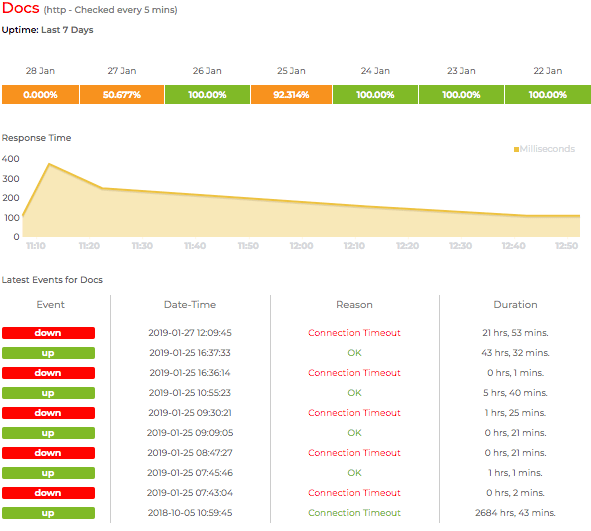
docs.embarcadero.com unreachable – via Docs – EmbarcaderoMonitoring

Posted by jpluimers on 2019/01/29

One reason to monitor your infrastructure is to signal longer outages, or even better review past outages and prevent longer ones.

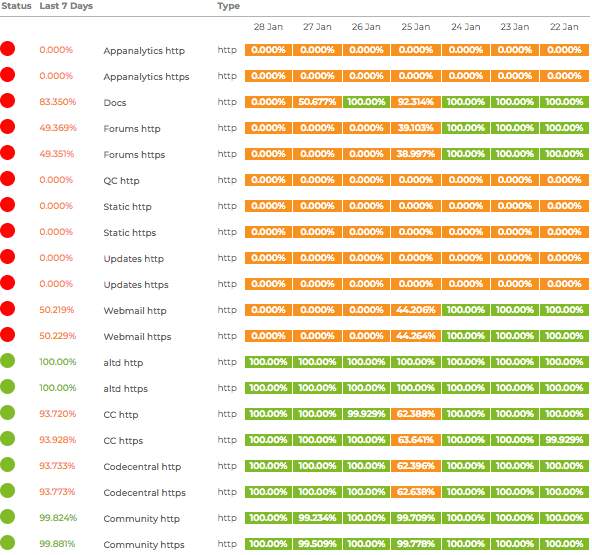
It is not the reason I created [Archive.is] EmbarcaderoMonitoring (it was to rule out problems between my systems and the Embarcadero sites), but it does help me gain insight in their infrastructure.

In this case, the [Archive.is] Docs – EmbarcaderoMonitoring shows that after months of OK operation, it suddenly started failing, at the same day parts of the other infrastructure also failed. It recovered, just like the other parts, but unlike the other parts, it was now down for almost a day when I took the screenshots:

Hopefully someone at Embarcadero realises the downtime too.

Read the rest of this entry »

Posted in Delphi, Development, Software Development | 1 Comment »

[RSP-10484] GetIt shouldn’t block the IDE – Embarcadero Technologies

Posted by jpluimers on 2019/01/24

I was amazed that this was marked as “Closed; won’t fix” as every respectable IDE I use but Delphi has a package manager that by now can download and update packages in the background without blocking the IDE [RSP-10484] GetIt shouldn’t block the IDE – Embarcadero Technologies.

–jeroen

Read the rest of this entry »

Posted in Delphi, Development, Software Development | 1 Comment »

Fast inverse square root – Wikipedia

Posted by jpluimers on 2019/01/24

Cult code via [WayBack] Fast inverse square root – Wikipedia part of [WayBack] Quake-III-Arena/blob/master/code/game/q_math.c:

float Q_rsqrt( float number )
{
    long i;
    float x2, y;
    const float threehalfs = 1.5F;

    x2 = number * 0.5F;
    y  = number;
    i  = * ( long * ) &y;                       // evil floating point bit level hacking
    i  = 0x5f3759df - ( i >> 1 );               // what the fuck? 
    y  = * ( float * ) &i;
    y  = y * ( threehalfs - ( x2 * y * y ) );   // 1st iteration
// y  = y * ( threehalfs - ( x2 * y * y ) );   // 2nd iteration, this can be removed

    return y;
}

It is a really fast way to approximate the square root for 32-bit IEEE754 calculations having origins around 1986:

  • [WayBackSymplectic Spacewar » Cleve’s Corner: Cleve Moler on Mathematics and Computing:

    Cleve Moler replied on June 27th, 2012 9:35 pm UTC :

    Jotaf — Thanks very much for your comment, and for reminding me about the fast inverse square root hack. I didn’t realize that the trick had attained a kind of cult status in the graphics community. The trick uses bit-fiddling integer operations on a floating point number to get a good starting approximation for Newton’s iteration. The Wikipedia article that you link to describes the trick in great detail, and also links to an article by Rys Sommefeldt about its origins. Sommefeldt goes back to the late ’80s and to me and my colleague Greg Walsh at Ardent Computer. I actually learned about trick from code written by Velvel Kahan and K.C. Ng at Berkeley around 1986. Here is a link to their description, in comments at the end of the fdlibm code for sqrt. http://www.netlib.org/fdlibm/e_sqrt.c . — Cleve

  • [WayBack] http://www.netlib.org/fdlibm/e_sqrt.c 

By now there is also a constant for 64-bit IEEE754 calculations 0x5fe6ec85e7de30da by [WayBack] 2003 research from Chris Lomont who also found a better 32-bit constant 0x5f375a86.

Note you need to be careful with boundary values like zero and infinity. This holds for approximations in general: [WayBackperformance – Why is SSE scalar sqrt(x) slower than rsqrt(x) * x? – Stack Overflow

–jeroen

Posted in Algorithms, C, Development, History, Software Development | Leave a Comment »

Chuck Jazdzewski links (ex co-architect of the Delphi VCL architecture)

Posted by jpluimers on 2019/01/24

While doing some research, I bumped into Chuck Jazdzewski on Twitter: “Doing some historical posts to resurrect my blog. http://t.co/kSXy3ARUhR” so I decided to archive a few more links about Chuck because few of the early Delphi R&D team on-line history is slowly fading away into bit-heaven.

Back in the Delphi days, together with Anders Hejlsberg, Chuck Jazdzweski he has co-architected the the Delphi VCL component architecture and the foundations of the Delphi IDE.

Nowadays he’s working at Google and even speaking on conferences, grown far beyond his “be at conferences, but just chat with people” in the Delphi days: [WayBackChuck Jazdzewski – NG-Conf April 18–20th 2018 – The World’s Original Angular Conference

Chuck is a Software Engineer on the Angular team at Google. He is a programming language geek, UI framework and component library veteran, and has a passion for simplifying the task of programming. Before Google, he worked at Microsoft and Borland.

–jeroen

Posted in Delphi, Development, Software Development | 2 Comments »

On my research list: Delphi; automatically generate class body from interface definition

Posted by jpluimers on 2019/01/23

Still need to research this: [WayBack] I search for way to automatically generate class body from interface definition… – Jacek Laskowski – Google+

–jeroen

Posted in Conference Topics, Conferences, Delphi, Development, Event, ModelMaker Code Explorer, Software Development | 2 Comments »

Don’t forget your padding… playing with the APK format of a sample “Hello world” Android app

Posted by jpluimers on 2019/01/23

Don’t forget your padding: Hello,I’m playing with the APK format of a sample “Hello world” Android application.my (first) goal is to be able to rebuild an APK from a unzipped one… – Paul TOTH – Google+

References: RSA Algorithm

–jeroen

Posted in Android, Development, Encryption, Mobile Development, Power User, Security, Software Development | Leave a Comment »

CDATA inside JavaScript or style section of HTML? They are for backward compatibility. Sometimes compatibility with ancient browsers.

Posted by jpluimers on 2019/01/23

As a back-end person, sometimes I wondered about CDATA in front-end HTML code was for, especially in JavaScript and CSS style elements.

[WayBackHTML vs. XHTML – WHATWG Wiki explains how to be compatible with XHTML, HTML, XML based tools and older browsers:

The following code with escaping can ensure script and style elements will work in both XHTML and HTML, including older browsers.

In both cases, XML ignores the first comment and then uses the CDATA section to avoid the need for escaping special characters < and & within the rest of the contents (with subsequent JavaScript comments added within to ensure the HTML-oriented code is ignored by JavaScript).

In HTML, older browsers might display the content without the content being within a comment, so comments are used to hide this from them (while modern HTML browsers will run code inside the comments). The subsequent JavaScript comment is added to negate the text added for the sake of XHTML.

The <style> requires the /**/ comments since CSS does not support the single line ones.

   <!---->
       ...
   //-->
   <style type="text/css"><!--/*--><![CDATA[/*><!--*/
       ...
   /*]]>*/--></style>

If not concerned about much older browsers (from which one is hiding the HTML) one can use the simpler:

   //
   <style>/*<![CDATA[*/
   
   /*]]>*/</style>

Also note that the sequence “]]>” is not allowed within a CDATA section, so it cannot be used in true XHTML-embedded JavaScript without escaping.

–jeroen

via:

Posted in CSS, Development, HTML, HTML5, JavaScript/ECMAScript, Scripting, Software Development, Web Development | Leave a Comment »