


Calling C libraries from bash with virtual automatic data conversion based on symbol info in the .so files.
Source: Tavis Ormandy: Just when you thought we couldn’t take this any further…
–jeroen
Posted by jpluimers on 2016/11/12
Calling C libraries from bash with virtual automatic data conversion based on symbol info in the .so files.
Source: Tavis Ormandy: Just when you thought we couldn’t take this any further…
–jeroen

Posted in bash, C, Development, gcc, Scripting, Software Development | Leave a Comment »
Posted by jpluimers on 2016/11/11
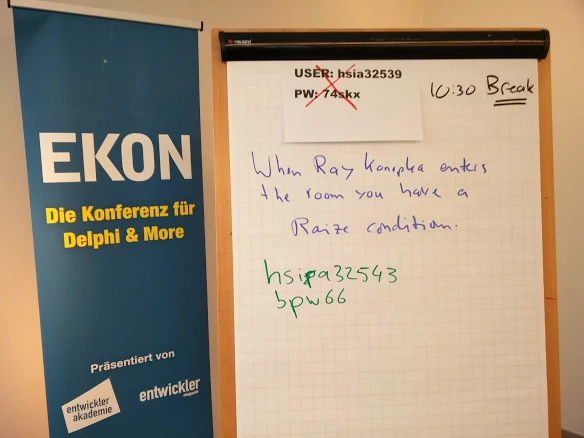
When Ray Konopka enters the room you have a Raize condition.
Via the EKON20 sessions, it made its way into the workshop If you thought you could do multi-threading, then play “The Deadlock Empire” games – Entwickler Konferenz
–jeroen

Posted in Conferences, Delphi, Development, EKON, Event, Software Development | Leave a Comment »
Posted by jpluimers on 2016/11/10
Like many Delphi 3rd party product, new ModelMaker Code Explorer (often abbreviated as MMX) releases have not been as thick as in the heydays (look at the history for versions 7, 8 , 9, 10, 11 and 12).
Unlike a lot of products it is still there, still very stable and hasn’t been acquired which it means it is available for a wide range of Delphi versions. So I still use it, but know certain issues will likely be never solved.
One of these issues is running ModelMaker Code Explorer as a different user than the installing user. In the authors words:
You need to install MMX as the same user that will run MMX.
MMX does not support running as a different user than the one installed.
This requirement becomes increasingly difficult to satisfy. This especially happens in more security conscious organisations where there is a clear distinction in rights between users that can install software and the ones that use the software. But it can also happen when you switch users because of infrastructure changes (new Windows domain, no Windows domain, etc).
Delphi itself copes reasonably well with that, as does GExperts, but MMX doesn’t. Despite the writeup on How to verify a Code Explorer installation? it lacks two things:
As I roam a lot, I’ve spent about a day fiddling and writing up the below information:
Posted in Delphi, Development, ModelMaker Code Explorer, Software Development | Leave a Comment »
Posted by jpluimers on 2016/11/10
While mocking the ScaleMM documentation, I bumped into a chart that I thought was an image, but is in fact generated by the (now deprecated) Image Charts API from Google.
In fact it is generated on the fly from a URL: http://chart.apis.google.com/chart?chxr=0,0,16|1,0,14682…&nonsense=something_that_ends_with.png
Compare the two below. They are identical (:
 Static ScaleMM1 comparison chart |
 URL based ScaleMM1 comparison chart |
Even though the API is deprecated Google has no plans to turn it of, so it still works and is the easiest way to get charts into a Markdown or reStructuredText document.
In practice, it doesn’t matter if you use the chart.apis.google.com or chart.googleapis.com domain: they give the same results the same.
As I wanted to convert the results.txt to a chart, I dissected the above URL, looked up the definitions of the URL parameters (the trickiest: cds for lxy graphs and the combination of chds and chxr, easier: chls) and created a new URL for the chart below.
Posted in Delphi, Development, Google, Power User, Software Development | Leave a Comment »
Posted by jpluimers on 2016/11/09
Summary of the Locking Is there a good open source MREW lock object out there thread:
Don’t use MREW. Too many bugs in any implementation, and too easy to make deadlocks.
Use other locking mechanisms that are lighter, easier to understand and therefor less prone to mistakes.
–jeroen
Posted in Delphi, Development, Software Development | Leave a Comment »
Posted by jpluimers on 2016/11/08
This post is a reminder to myself that this plugin exists at all.
Hopefully by this time it supports more recent Delphi versions as well; when scheduling this post, it supported from XE to 10.1:
My SelectiveDebugging plug-in now supports Delphi 10.1 Berlin. The updated download can be found at the end of the corresponding blog post:… – Uwe Raabe – Google+ [WayBack]
–jeroen
via:
Posted in Delphi, Delphi 10 Seattle, Delphi 10.1 Berlin (BigBen), Delphi XE, Delphi XE2, Delphi XE3, Delphi XE4, Delphi XE5, Delphi XE6, Delphi XE7, Delphi XE8, Development, Software Development | Leave a Comment »
Posted by jpluimers on 2016/11/08
If when setting up Continuous Integration (CI) with Delphi and you get errors like E2202 "Required package 'rtl' not found" or F1027 "Unit not found: 'System.pas'", then something is wrong with your library path on the CI server.
Before going into the details of why, the quick solution is to set either of these environment variables in your build script
Win32LibraryPathDelphiLibraryPathNow back to the details of why these might not be set, most information is from my Delphi build automation workshop.
Posted in Delphi, Delphi 10 Seattle, Delphi 2007, Delphi 2009, Delphi 2010, Delphi XE, Delphi XE2, Delphi XE3, Delphi XE4, Delphi XE5, Delphi XE6, Delphi XE7, Delphi XE8, Development, Software Development | 1 Comment »
Posted by jpluimers on 2016/11/03
–jeroen
Posted in Development, Fiddler, Software Development, Web Development | Leave a Comment »
Posted by jpluimers on 2016/11/03
My EKON20 link archive so I can refer to it through web.archive.org:
–jeroen
Posted in Conferences, Delphi, Development, EKON, Event, Software Development | Leave a Comment »
Posted by jpluimers on 2016/11/03
The #Fellows | Unity IoC container: tips, tricks and dirty hacks post is a very readable and to-the-point introduction to Unity IoC focussing on Dependency Injection. Implementation details of various IoC/DI frameworks differ, so some keywords:
–jeroen
Posted in .NET, .NET 2.0, .NET 3.0, .NET 3.5, .NET 4.0, .NET 4.5, C#, C# 3.0, C# 4.0, C# 5.0, C# 6 (Roslyn), Development, Software Development | Leave a Comment »
 The Wiert Corner - irregular stream of stuff