


| Below is a dump of links about FidoNet links with a few remarks so I won’t forget as it was 25+ years ago that I stopped hosting the FidoNet node that had been on-line for almost 10 years (I was a FidoNet point for a few years before that).
See also my other FidoNet posts. |
                    __
                   /  \
                  /|oo \
                 (_|  /_)
                  _`@/_ \    _
                 |     | \   \\
                 | (*) |  \   ))
    ______       |__U__| /  \//
   / FIDO \       _//|| _\   /
  (________)     (_/(_|(____/
 (c) John Madill
FidoNet logo by John Madill
|
Archive for the ‘BBS’ Category
Moar FidoNet memories
Posted by jpluimers on 2026/03/27

Posted in BBS, FidoNet, History | Leave a Comment »
Found back some emails and links from way back when promoting/helping ThunderByte AntiVirus (hi Frans Veldman)
Posted by jpluimers on 2026/01/20
Nice memories of the TBAV/ThunderByte Anti-Virus story.
Together with Jeroen Smulders, I was sort of on the sideline in the early days as we both were at the university had access to FidoNet (I as host, other Jeroen as point), Internet, mailing lists and newsgroups.
I used it because it was the fastest Virus Scanner around and a need when scanning all incoming FidoNet data for viruses (I had seen at university what damage a spread could do).
Some VIRUS-L, comp.virus and book links from that past:
Share this:
Posted in 8086, 8088, Antivirus, BBS, Compuserve, FidoNet, History, Internet, Power User, SearchEngines, Security | Tagged: 96 | Leave a Comment »
The circle of online interaction life (yes, before social media there was online interaction): Nick Wright on – Mastodon.ART
Posted by jpluimers on 2023/11/29
Low-tech beats hi-tech. It always does.
Oh, and it so much reminds me of BITNET relay, early internet and BBS/Fidonet days.
[Wayback/Archive] Nick Wright: “1993: I use BBSes for online i…” – Mastodon.ART
1993: I use BBSes for online interaction. Each BBS is run by some random person. They connect to a federated worldwide network. I keep my notes in .TXT files.
2008-2022: I use social networks like Facebook and Twitter for online interaction. They’re huge and popular. I use Evernote for my notes, which is full of features.
2023: I use Mastodon for online interaction. Each instance is run by some random person. They connect to a federated worldwide network. I keep my notes in .TXT files.
--jeroen
Share this:
Posted in About, BBS, History, Personal, SocialMedia | Leave a Comment »
Running BBS Door Games on Windows 10 with GameSrv, DOSBox, plus telnet fun with WSL – Scott Hanselman
Posted by jpluimers on 2020/12/07
Reminder to self: see if I ever can resurrect my old BBS and FidoNet node that was based on at least:
- FrontDoor (by Joaquim Homrighausen)
- RemoteAccess (by Andrew Milner)
- GoldED (by Odinn Sørensen)
- A FOSSIL driver (forgot the name)
- A Fidonet NodeList Compiler
- a Message Tosser
Maybe a good place to start: [WayBack] Running BBS Door Games on Windows 10 with GameSrv, DOSBox, plus telnet fun with WSL – Scott Hanselman
I already wrote a few times about me being on Fidonet, and BITNET in the late 1980s:
- Going to try PowerLine (next to CAT5, and having used 10Base2, 10Base-T, 100Base-TX and 1000Base-T)
- Nostalgie: KPN zet inbelplatform uit en laat Xs4all inbelverkeer afhandelen – IT Pro – Nieuws – Tweakers
- xyzzy, Relay Conferencing before IRC even existed « The Wiert Corner – irregular stream of stuff
- “You would make for a great computer programmer” « The Wiert Corner – irregular stream of stuff
- CompuServe’s forums, which still exist, are finally shutting down on 20171215
A few email addresses I have been using in that era:
- BITNET: PLUIMERS@HLERUL5
- BITNET: PCHPAPL@HLERUL52 and pchpapl@hlerul52.bitnet
- Compuserve: 100013,1443
- UUCP: jeroenp@dragons.nest.nl
- Fidonet: as point on 2:281/515.3 and as host on 2:281/521, The White House, Jeroen Pluimers
- Internet: jeroenp@rulfc1.leidenuniv.nl
A tag-line from me in that era (I blanked out the phone number as it now belongs to someone else):
    o _   _  _   _   _             voice:  +31-2522-XXXXX (19:00-22:00 UTC)
   / (_' |  (_) (_' | |            snail:  P.S.O.
__/                                        attn. Jeroen W. Pluimers
                                           P.O. Box 266
jeroenp@rulfc1.LeidenUniv.nl               2170 AG Sassenheim
jeroen_pluimers@f521.n281.z2.fidonet.org   The Netherlands
Related:
- FidoNet – Wikipedia
- Gerard van der Land (GEcho)
- Erick van Emmerik (FileMGR)
- Arjen Lentz (Xenia)
- Ron Huiskes (RemoteAccess)
- Frans Veldman (ThunderByte Anti-Virus)
- [Archive.is] Info-IBMPC Digest V89 #31 – Google Groups
- [WayBack] 1991 section of SIMTEL20 in the info-ibmpc mailing list
- [WayBack] VIRUS-L Digest Monday, 3 Jun 1991 Volume 4 : Issue 96
- [WayBack] Ralf Brown’s Interrupt List Release 34 Last change 4/3/93
- [WayBack] Information on WinSite package gif2bmp.zip (it looks like I wrote a GIF to BMP converter <g>)
- [WayBack] Kelly Sommers on Twitter: “I ran a PCBoard BBS on my parents spare phone line at night.”
- BBS: The Documentary Archive : Free Movies : Free Download, Borrow and Streaming : Internet Archive
- [WayBack] Scott Hanselman on Twitter: “Awesome. I ran a Wildcat BBS on Desqview and a digiboard, and was a Fidonet node. Such a hopeful time. You can still run door games and BBSs today. (Go explore if you aren’t from this generation! Great historical fun.) https://t.co/WhudTNrwCG… https://t.co/tqhWtyllBj”
- [WayBack] Jeroen Pluimers on Twitter: “I paid their phone bill (for outdoing at night) and got an extra line (for incoming) to run a Dutch DFF fidonet node called The White House (now not so proud of that name any more) with frontdoor, remote access, golded, a fossil, a tosser (message processor), all on 1/…”
- [WayBack] Jeroen Pluimers on Twitter: “an pair of i286 PCs with null network, later i386 (with DESQview 386 that included QEMM 386) with Novell Netware 3.x LAN and a bunch of batch files that were multi-tasking aware so I could offload message processing to different instances/systems. Later made this work 2/…”
- [WayBack] Jeroen Pluimers on Twitter: “On Windows 3.x and Windows 95 that had slightly different command. com versions. This because I wanted to stay up to date on Turbo Pascal related stuff (which I learned slightly earlier). So I posted a lot on the groups Pascal.028, Pascal, and others. Later also hooked 3/…”
- [WayBack] Jeroen Pluimers on Twitter: “up to compuserve (where I learned to know @JohnKaster, @danny_thorpe, and many TeamB members) and laid the foundation of startingy own business in software development. Being a student, I was glad university licenses were affordable (: That era has formed me. Will never forget.”
- [WayBack] Jeroen Pluimers on Twitter: “A few more names from back then: @RolandGuijt, @joho68, @arjenlentz . I will probably remember more names later (:”
- [WayBack] Maarten van Stam on Twitter: “2:280/112 Softwareboard two lines on ISDN with USRobotics HST modems some dudes imported from the US, not easy back then … #fidonet”
- [WayBack] Danny Thorpe on Twitter: “Compuserve: 76646,1035”
- [WayBack] John Kaster on Twitter: “71510,3321” and [WayBack] FoxPro Tool Producers Directory
- [WayBack] Danny Thorpe on Twitter: “Hey! PC Magazine issues circa 1990’s are available in Google Books! Whoda thunkit? (new to me, anyway) A Blast from the Past: Cross-Platform DLLS for DOS and Windows, PC Mag Feb 22, 1994: @jpluimers @ahejlsberg @JohnKaster”
- [WayBack] John Kaster on Twitter: “I ran the fidonet relay for Clipper via PCBoard on KWIBBLE in Rosslyn, VA in the late 80s… “
- [WayBack] waldo ‘not @ any .*con’ kitty on Twitter: “Have run Waldo’s Place USA on RemoteAccess since ’89… Just started over completely with Synchronet thanks to Hurricane Florence. Now known as The SouthEast Star, a fidonet mail hub (still)…… https://t.co/1QlcFKAgvP”
- [WayBack] Kelly Sommers on Twitter: “Fidonet omg… “
- [WayBack] purana on Twitter: “Fidonet is still going alright. Pretty impressed by that. Most BBS systems running now are telnet connectable.… “
- [WayBack] Jeroen Pluimers on Twitter: “I might want to resurrect mine in the future. Where should I start getting some information on that?… “
- [WayBack] purana on Twitter: “I might setup synchronet – wiki.synchro.net as others have done. Might be a challenge since I am new to it.”
–jeroen
Share this:
Posted in BBS, dial-up modems, FidoNet, History, MS-DOS, Power User, Windows | Leave a Comment »
Level 29: The BBS
Posted by jpluimers on 2020/07/13
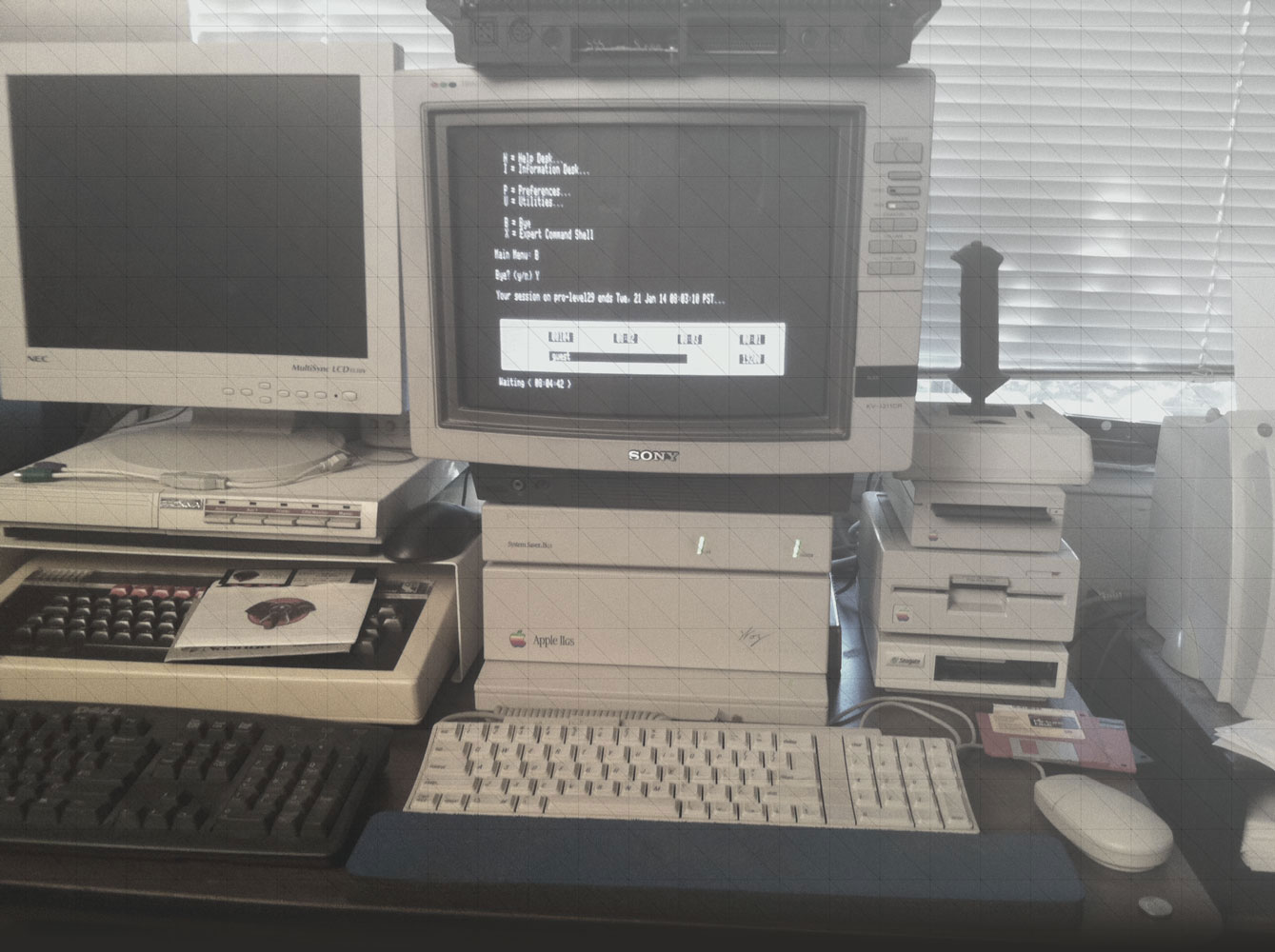
How retro can you get? [WayBack] Level 29: The BBS gets very far: it runs on an Apple IIgs and provides access via modem (via a landline!), telnet or web to the same text interface.
Web access via [WayBack] Shell In A Box
Welcome to the *NEW* Level 29 BBS!
916 965 1701 - bbs.fozztexx.com

 .             .   _,  _,
 |    _ .  , _ |  '_) (_)
 |___(/, \/ (/,|  /_.   |

The official BBS of
RetroBattlestations.com

Enter your username or NEW or VISITOR
User:
It
- logs access to [WayBack] Level 29 BBS (@Level29_BBS) | Twitter.
- is run by [WayBack] FozzTexx (@FozzTexx). Embedded Linux IoT DevOps Maker with expertise in multiple disciplines. Available for FT, PT, & contract work. Sacramento
- allows members of [WayBack] Retro Battlestations (Show off your old-school computer rig! Dig out your retro computers and set them up, or dig out your vintage photos from when your computer was new!) to connect.
Related:
- [WayBack] Relive the BBS dream (nightmare?) with Level 29
- [WayBack] Level 29 Brings Old-school BBS to the Modern World on an Apple IIGS – The Mac Observer Before the days of Web browsers and broadband Internet, online communities were hosted by single computers you connected to by dialing in over a traditional phone line via a modem. If you miss the old days — or never had the chance to experience a BBS — now you can, thanks to Level 29. The system runs on an Apple
Via: [WayBack] Got this TV yesterday at a garage sale and hooked up the Apple II through the Sup R Mod and installed the Hayes Micromodem IIe to call Level 29 BBS. No … – Chris Osborn – Google+
–jeroen
Share this:

Posted in 6502, BBS, History | Leave a Comment »
Computing History – The UK Computer Museum – Cambridge
Posted by jpluimers on 2020/06/19
 On my places to visit:
The Centre for Computing History is a computer museum based in Cambridge, UK. With a collection of vintage computers and game consoles, many of the exhibits are hands on and interactive.
[WayBack] Computing History – The UK Computer Museum – Cambridge.
When I bumped into it, this was their collection size, ranging from the 1960s until recent history:
Archive Statistics :
- Computers = 993
- Peripherals = 1446
- Mobile Devices = 31
- Game Consoles = 213
- Video Games = 10259
- Software Packages = 2605
- Books = 2045
- Manuals = 4106
- Magazines = 9057
Looking at their archived brands (having [WayBack] MITS – Altair and [WayBack] Raspberry Pi in the collection) is such a joy.
Archiving the older parts is a tough job, as they stem from way before the web era, so information has been lost, parts are hard to source, a lot of hardware got thrown away or is hard to find at all, people have died. More on that at [WayBack] About – Computing History.
Without a physical visit, you can find what they have at [WayBack] Search Our Archive – Computing History.
The video below on their archive is impressive.
–jeroen
Share this:

Posted in 6502, 68k, Apple I, BBC Micro B, BBS, C64, Commodore, CP/M, dial-up modems, FidoNet, History, IBM SAA CUA, PowerPC, Tesseract, VIC-20, Z80 | Leave a Comment »
“You would make for a great computer programmer”
Posted by jpluimers on 2017/10/20
A while ago, Joe C. Hecht mentioned for the second time about his family joke along the lines that he had bad grades at school despite being good at the topics. He got tested which resulted in “You would make for a great computer programmer”.
I wonder how this happened with other people in the IT. Did you get yourself a degree in that direction, or teach yourself programming and such?
The reason is that I recognise what Joe wrote: I’m still a bad learner from books or theory as I learn by doing. I specifically didn’t try to get a Computer Science degree as in the late 1980s in The Netherlands it basically was a heavy math degree plus Computer Science topics. So it was basically doing two studies at once and I was only interested in the Computer Science parts.
So I chose studying Chemistry (one of the science topics I really liked at high school) at the closest university to my home so I kept living with my parents.
In 20-20 hindsight this was not the right choice. But at that time I didn’t know about the right choice.
In about 4 years, I finished like 2.5 years of studying, was a geek-prototype (good at computers, bad at people skills) and still did a lot of Computer Science topics (even though the exams would be worthless as back then individual exams didn’t count unless they were part of the main direction of your study). The last year was prepping for practice and advanced topics. I slowly attended less and less sessions and did more and more programming gigs as somehow that was way more fun before slowly bailing out. I also sold network equipment to the university department helping them to connect to the internet and helped a lot of co-students with their computing issues and assignments, learned my way in DOS/3com/Novell/EARN/BITNET/DECNet/SunOS and VAX/VMS based technologies.
I only found out why I bailed out more than a decade later: I was a pragmatic guy learning by doing, not suited for a university that tried educating theorists. Besides that the department I wanted to finish my studies has two four camps: a very theoretic camp (with nice guys: they were the ones wanting internet access very early on), two less theoretic camps fighting each other and a lazy camp filling their days basically with doing as little as possible. A very unproductive and depressing situation. I had worked at the research labs of the paint factory doing research close to my studies, but there was no way the university would allow me to do my research phase there. Even more depressing.
Now (as always, hindsight is 20/20 vision) I know I should have bailed out early on and go for a more pragmatic study maybe not even a university but a polytechnic. On the other hand it helped doing a truckload of Turbo Pascal work (which I started at High School with Turbo Pascal 1 on CP/M with Apple ][+ and //e machines), programming in assembler/prolog/FORTRAN/C, getting connected to the internet (BITNET RELAY chat, mailing lists, early newsgroups, uucp, TCP/IP basics, thick/thin ethernet converters, serial and modem communication with Kermit and FidoNET, gopher, FTP and truckloads more stuff).
It got me into the Delphi, .NET and open source worlds, doing a lot of travel and conference speaking and being an early adopter of many technologies and concepts (some even so early that they only got way popular decades later – like the 1980s “the network is the computer” mantra – or making sense – like the lock semantics topics really became useful when around the century turn single processor machines got multi-processor siblings and a lustrum later multi-core and multi-threading processors became available and ubiquitous around 2010) and taught me that being able to search and find things is way more important than knowing things.
So I wonder about all my followers:
How did your education go and how did you end up in computing?
–jeroen
References via Joe C. Hecht:
- [WayBack] Nduka Tagbo Charles on Twitter: “There is a big difference between people who are smart and the people who got good grades…”
- [Archive.is] Are Programmer Brains Different? – JavaScript Scene – Medium: What can neuroscience teach us about the brains of software developers? A lot.
- it is true Family joke: Back in the 1960’s, my parents had me analyzed – I was a kid bored in school, I made bad grades (especially in math), yet had read the World Book encyclopedia covers to covers many times (and had memorized a good deal of it) and was good with math. The report came back saying “I would make for a great computer programmer”, and that became the family joke… for about a decade. They were right. – via +John Nedoroscik Jr
Share this:
Posted in About, BBS, BITNET Relay, Chat, FidoNet, History, Opinions, Personal, SocialMedia | Leave a Comment »
FrontDoor is being resurrected…
Posted by jpluimers on 2017/08/29
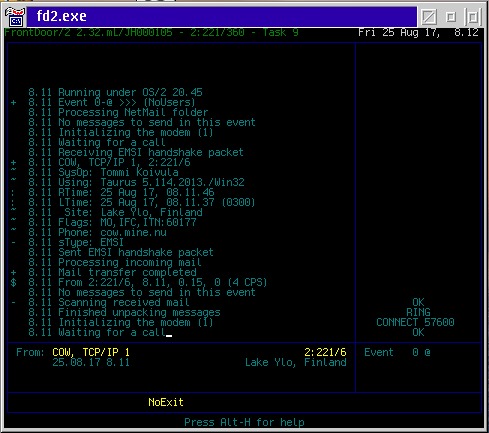
After 3 years silence, JoHo has managed to resurrect the DOS version of FrontDoor and blogs about it at [A] reboot . defsol . com | Waiting for a call or event.
Found out via [WayBack] So, after having been asleep for some 15 years, it appears this is actually happening #frontdoor #fidonet <ht… – Joaquim Homrighausen – Google+
So I had a private chat with JoHo, where he wrote me this:
After three years of “silence”, and some 15+ years since the last code update, JoHo has appeared on the FidoNet scene once again. Having relased FrontDoor in 1986, I guess it’s safe to say he’s been around (FidoNet) longer than most people.
The biggest issue(s) seem to have been finding all the bits and pieces required to make/update FrontDoor, its utilities, as well as the long dead license key/code generator. Another issue is, of course, to find a suitable operating environment to put the pieces together in.
JoHo has stated that what used to be called the “Commercial/MultiLine” version of FrontDoor is what every future of version will be, except not so “Commercial”. You can get a free license by simply sending him an e-mail. Look at https://www.defsol.com for more details.
The “Reboot” project, as JoHo calls it, will have some details released at https://reboot.defsol.com. There is also a Facebook group available for FrontDoor users.
When asked “Why are you doing this now?”, JoHo responds with “Have you ever seen ‘Finnish Swamp Wrestling’ on YouTube? There is no ‘Why’, there is only ‘Because’.”
JoHo can be reached at defsol@defsol.se, seen on Twitter at @joho68. He has also applied for a new FTN-address in Zone 2. Details will follow.
Here are some more links and pictures:
- [WayBack] FidoNet – Wikipedia still exists got a new logo
- Get a license via [WayBack] Home of FrontDoor, FrontDoor APX/w, TosScan, XRobot: products, updates to FrontDoor, XRobot, FrontDoor APX, TosScan, recent versions of our Shareware products. You will also find some third-party utilities

- [WayBack] FrontDoor – Wikipedia needs an update
- [WayBack] FrontDoor announcement in FidoNews 1986 | joho.se feels like yesterday.
- [WayBack] May | 2014 | reboot . defsol . com – when JoHo got a brain wave…
- [WayBack] There’s something going on … | reboot . defsol . com on getting FreeDOS, Turbo Pascal and other vintage tools working.
- [WayBack] Visual feedback | reboot . defsol . com Tommi Koivula screnshot of FrontDoor/2 2.32.mL (on the right)
- Some of my early Fidonet memories pre-date my first email message on the internet: Ancient history – found back one of my earliest email messages dated in februari 1989! They include FrontDoor, RemoteAccess, GEcho, GoldEd and FileMGR.

Good old FidoNet logo:
Share this:

Posted in BBS, History | 1 Comment »
Nostalgie: KPN zet inbelplatform uit en laat Xs4all inbelverkeer afhandelen – IT Pro – Nieuws – Tweakers
Posted by jpluimers on 2016/01/17
This Dutch caught my eye: “Dutch telecom operator KPN has turned off the inbound internet dial-up equipment. It keeps possible to dial the number, as dial-up traffic is now handled by provider xs4all”:
KPN heeft de apparatuur van zijn inbelplatform voor internet uitgezet. Het blijft nog wel mogelijk om in te bellen via het nummer 06760-12321, maar het inbelverkeer wordt voortaan afgehandeld door provider Xs4all.
Source: KPN zet inbelplatform uit en laat Xs4all inbelverkeer afhandelen – IT Pro – Nieuws – Tweakers
The thread is full of nostalgia on Dial-up Internet access, like:
- EUR 500+ monthly phone bills
- KPN owning both Telfort and xs4all (and explaining the differences between them)
- CompuServe (they laugh at it in the thread, as over here it never caught on, but for me it was a life-line for the beta-test and tech forums that were there. The TeamB forum was quite famous)
- xs4all (my first ISP where I still have a fiber and a DSL connection) and xs4all dial-up instructions
- Early technically stable ISPs like DDS and Demon internet.
- dial-up via university (before xs4all was there)
- modem handshakes:
- dial-up numbers I haven’t used for a very long time (xs4all:020-5350535 or 06760-97400, KPN: 06760-12321, Zonnet/Tele2: 06760-75030)
- ISP dial-in equipment: http://tweakers.net/nieuws/107363/kpn-zet-inbelplatform-uit-en-laat-xs4all-inbelverkeer-afhandelen.html?showReaction=8128340#r_8128340
- kerktelefoon (a way to listen to church services from home; one of the people in my network used to create equipment for that)
- “free” dial-up ISPs like 12move, zonnet, wannadoo, freeler, flevonet, raketnet, myweb, superweb, wish, etc.
Yes, the Dutch are cheap indeed, so plenty of them keep changing their main email address when they switch to yet another ISP. - mxstream (the first DSL you could get here) which got me 4 IP addresses at first which they later retracted to 1.
- funet.fi en sunet.se
- i-mode and WAP
- XMODEM, YMODEM and ZMODEM
I still have my original Courier HST Dual Standard modem from USRobotics I got around 1987. It’s looks like the second from the bottom at (image via: Do Modems Still Matter?) the picture below (one day I will make a picture when I’ve cleaned out the glass cabinet it is in; there are some more USRobotics, ZyXEL and DrayTek modems in it too).
There is a very interesting piece of USRobotics (in Russian, but Google Translate does a nice job on it): The history of the US Robotics.
I wrote mentioned the Courier HST Dual Standard before in Going to try PowerLine (next to CAT5, and having used 10Base2, 10Base-T, 100Base-TX and 1000Base-T), but never about the why, so here it is:
The Courier HST standard would train faster and at better speeds over Intercontinental lines than the Trailblazer and Hayes and later V.32bis technologies. In addition, they were also faster with firmware upgrades to support faster speeds than competing brands.
This mattered a lot to me, as initially CompuServe was only accessible by dial-up to the USA. The same for a lot of BBS and FidoNet uplinks.
For me, they weren’t any cheaper buying them (as the BBS discounts for them were not valid in Europe; I bought mine for a more than DM 1000 in Germany) but it was cheaper gaining knowledge (my motto always has been “a life long learning”).
Since the above article,
- the Sportster magic string entry on Wikipedia vanished, but the info is still at USRobotics Sportster magic string – WOW.com,
- I stopped using PowerLine as it wasn’t stable enough, so during the replacement of our solar panels with more modern equipment a few years ago, had CAT-6 pulled up to the utility closed on the bedroom floor.
More info about modem training and standards in this 1998 article:
Everything you wanted to know about modem and fax standards and software, but were afraid to ask is covered in this great overview article by Frank Gao from Gao Research. This article discusses all the functions that go into today’s modem products, but is not tied to any particular hardware implementation.
–jeroen
Share this:

Posted in BBS, FidoNet, History, Power User | 1 Comment »
Blast from the past: the digital highway as imagined circa 1995.
Posted by jpluimers on 2015/08/07
Blast from the past: the digital highway as imagined circa 1995 (thanks Kristian Köhntopp for sharing this a while ago).
Learned a new phrase too (handfeste Datenträger) for something a marching band friend of mine was involved in: before he suddenly passed away at 39 he was a “high bandwidth courier” giving meaning to the phrase by Tanenbaum “Never underestimate the bandwidth of a station wagon full of tapes hurtling down the highway” by driving around magnetic tapes and optical media between various locations for about 600+ km a day.
Who could imagine in the age where ISDN at home (@ 64 kibit/s) was fast, that 20 years later you could have fiber (@ 500 Mibit/s) at home both for like EUR 50/month.
Like Steve Streeting posted: having high bandwidth (relative to the time you live in) makes you stop thinking about your internet speed
It allows you to find new usage patterns. Which is good for imagination, work, etc.
–jeroen
PS:
I lied a little. EUR 50/month is for the subscription only. Nowadays that means a permanent connection. In the ISDN days having a permanent connection to an ISP would set you down another EUR 50/month for the ISP, and about EUR 600/month of data usage to the telecom provider.
I did that for a couple of years until cable and ADSL became available. Why? Because it was the fastest way to stay informed (gopher, newsgroups, mailing lists, early forums and web-sites) and get the latest software (mainly over FTP).
Imagine this was only years after not even HCC being able to sustain the costs of a Fidonet transatlantic link, and now two decades later. I’ve posted about Fidonet before, and back-then it was the most affordable way to access information from across the world.
Now less than a century after the first transatlantic phone service was established in 1927, world wide communication is almost free (and there is even internet in space).
PPS:
Swets – where my friend worked for filed for bankruptcy last year. No more high bandwidth couriers…
via:
- Vor 20 Jahren: »Telekom – Digitalisierung der Netze: Die Datenautobahn«.
- SteveStreeting.com » Hands on with JT’s fibre to the home.
Share this:
Posted in BBS, FidoNet, History, Infrastructure | Leave a Comment »
 The Wiert Corner - irregular stream of stuff