Interesting tiny battery powered remote Lavalier microphone with USB-C receiver: [Wayback/Archive] It’s Practically Invisible…
The video covers the Hollyland LARKM2S.
I wonder about other devices like it.
--jeroen
Posted by jpluimers on 2025/12/01
Interesting tiny battery powered remote Lavalier microphone with USB-C receiver: [Wayback/Archive] It’s Practically Invisible…
The video covers the Hollyland LARKM2S.
I wonder about other devices like it.
--jeroen
Posted in Audio, Media, Power User | Leave a Comment »
Posted by jpluimers on 2025/09/12
From a while ago. I wonder what the current state is.
[Wayback/Archive] DeCENC is yet another way to beat Amazon, Netflix video DRM • The Register
--jeroen
Posted in Development, Encryption, Media, Media Streaming, Power User, Security, Software Development | Leave a Comment »
Posted by jpluimers on 2025/03/27
It has been a very long time since I played around with ripping audio from audio CDs and wrote software for audio handling. I lost access to that source code some 20 years ago, so part of this post is from memory. Hopefully that is still good memory (:
Yes, I am one of those old farts that still has computing equipment with optical drives (:
Much has improved since then, so one needs to write far less code nowadays as a of tooling is now open source or has been open source for quite some time. The hardest part was finding back CDex (which I think is still very useful especially as it handles not-so-well-handled audio CDs quite OK).
Anyway: I didn’t document much of my audio history. The only post I mentioned CDex in was Streaming your mp3 collection through an Icecast server using ezstream, which does not does it justice as back then it had been reliable for such a long time.
That web-site was horrible, especially as it was picky on audio formats. In the end, it handled 128-bit fixed bit-rate MP3 files best.
Posted in Audacity, Audio, Development, Media, Normalisation of audio, Power User, Software Development | Tagged: 1 | Leave a Comment »
Posted by jpluimers on 2025/01/11
Weekend, so catching up on CES 2025 news.
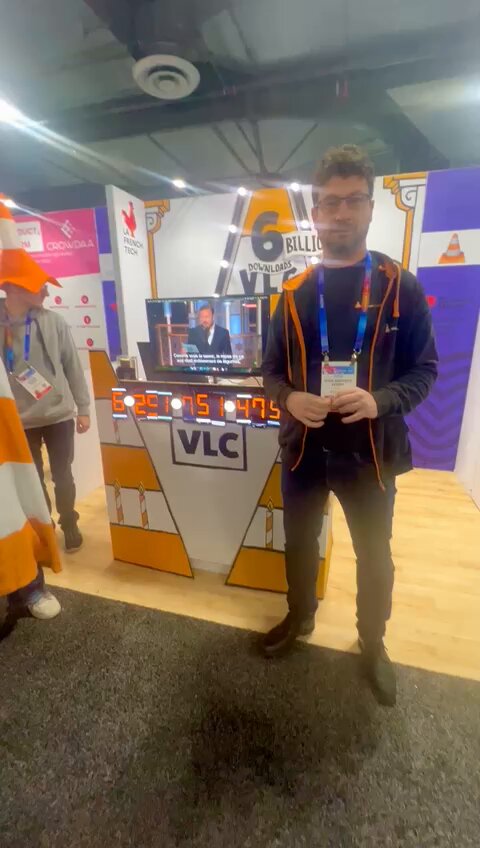
If you are at CES, be sure to go visit the VideoLAN booth in Eureka Park to witness what I think is likely the most important CES 2025 AI news:
[Wayback/Archive] VideoLAN on X: “VLC automatic subtitles generation and translation based on local and open source AI models running on your machine working offline, and supporting numerous languages! Demo can be found on our #CES2025 booth in Eureka Park.”
In my opinion, though a remarkable statistic, their 6-billion downloads gimmick is just a teaser for the way more important news what this AI LLM is:
Whisper already ran circles around the YouTube automatic subtitle generator, and their automatic translations are far below par (see video below), so having new contender is great!
VideoLAN tremendously raises the bar for all commercial vendors, and at the same time makes:
Posted in AI and ML; Artificial Intelligence & Machine Learning, Development, LLM, Media, Software Development, Video | Tagged: CES2025 | Leave a Comment »
Posted by jpluimers on 2024/12/27
De enige Radio 10 live video stream die ik kon vinden was [Wayback/Archive] Radio 10 Webcam – Radio 10 Live beeld – MyOnlineRadio.
Zijn er meer?
De reden was dat ik Matijn ook weer eens live wilde zien na zijn vertrek bij Radio 2 (alleen luisteren is soms ook wat saai).
Gerelateerd:
Posted in LifeHacker, Media, Media Streaming, Power User, Video | Leave a Comment »
Posted by jpluimers on 2024/11/19
A while ago, within a week time, I got reminded of a project I did some 15 years ago involving low-latency audio using the .NET platform on Windows XP Embedded.
For that I used the BASS.NET wrapper classes and P/Invoke methods around the Un4seen BASS Audio Library.
Back in those days there was not much documentation about this, but now there is more.
Some starting points are:
BASS.NET is a .Net wrapper for the BASS Audio Library and all it’s Add-Ons – available @ http://www.un4seen.com. The Bass.Net.dll release version is installed in the specified ‘install-directory’ and will be registered to the .NET Framework as a standard component (if you left all the installation options checked). Note, that there are various Bass.Net assemblies available (side-by-side): one targeting the .Net v4.8 Full Framework and one targeting the .Net v6.0 Core Framework.
The native BASS libraries (e.g. bass.dll) are NOT included and need to be downloaded seperately – so make sure to download the BASS library and the needed add-on libraries and place them to your project executable directory (e.g. place the bass.dll to .\bin\Debug).
…
followed by an elaborate list of the Bass.net namespaces.
Via:
Maart 2021
Momenteel repeteer ik wekelijks met mijn muziekverenigingen realtime via internet. We kunnen echt samen muziek maken en dat is heerlijk!
Om succesvol samen te kunnen spelen via internet begruiken we 2 programma’s:
- Zoom – dit gebruiken we voor het beeld, de video.
- Jamulus – dit gebruiken we voor het geluid, de audio.
Op deze pagina vindt u een handleiding die ik schreef voor de installatie en het instellen van deze 2 programma’s.
Let op: Er is een aparte handleiding voor Windows en een aparte handleiding voor MacOS.
Verder kun je via deze pagina de installatieprogramma’s downloaden die nodig zijn om Jamulus en ASIO4ALL te installeren.
Dit is Open Source software die je ook kunt downloaden van www.jamulus.io en www.asio4all.org.
Related:
…
Among other things, this makes it possible to emulate a typical Windows application that opens an audio device in shared mode. This means other applications can use the same audio devices at the same time, with the Windows audio engine mixing the various audio streams. Other universal ASIO drivers do not offer this functionality as they always open audio devices in exclusive mode.
…
--jeroen
Posted in .NET, Audio, Conference Topics, Conferences, Development, Event, LifeHacker, Media, Power User, Software Development, Windows Development | Leave a Comment »
Posted by jpluimers on 2024/09/10

Cover of “LaTeX: A Document Preparation System, 2nd edition”, Published by Addison-Wesley Professional (June 30, 1994) © 1994, authored by Leslie Lamport
LaTeX was slightly later than the 1992 Turbo Pascal 7.0 Language Guide having both entry in the manual about Recursion (“recursive loop, see recursive loop”) which of course is similar to “infinite loop” and entries for “infinite loop See loop, infinite” and “loop, infinite See infinite loop”.
So what is LaTeX?
Where Donald Knuth created the typesetting program TeX (visually TeX), Leslie created a set of macros for it, later named LaTeX (visually LaTeX) and wrote the first (still famous) book – cover on the right – on it: [Wayback/Archive] LaTeX: A Document Preparation System by Leslie Lamport, second edition, printed in 1994 back then by Addison-Wesley (now Pearson Education, subsidiary of Pearson plc) with ISBN 9780201529838.
It’s gimmick was at page 252, inside the index referring “infinite loop” to page 252 itself.
Many people keep posting screenshots of the page without referencing where it is from. That’s a bit sad, as these gimmicks are an important part of history where programming books were as much about explaining features of computing environment, as well as explaining underlying concepts like recursion.
So this 2024 post finally made me write this blog post: [Wayback/Archive] vx-underground on X: “HELP!”
Posted in *nix, *nix-tools, ffmpeg, History, ImageMagick, LaTeX, pandoc document converter, Power User, Typesetting | Leave a Comment »
Posted by jpluimers on 2024/03/30
[Wayback/Archive] FemFM – 〝50% vrouw in je oor, of we zappen door!〞 werd in 2024 gelanceerd vlak voor de Women’s History Month en Internationale Vrouwendag door Felienne Hermans.
Felienne is bekend van bijvoorbeeld haar promotieonderzoek naar de impact van Excel op de samenleving, maar vooral van haar drive te onderzoeken hoe zo veel mogelijk mensen – ongeacht hun achtergrond – kunnen leren programmeren), Joy of Coding, de Hedy programmeertaal (met veel support voor andere alfabetten dan wat we in de westerse wereld gebruiken) en haar boek The Programmer’s Brain: What every programmer needs to know about cognition.
Ze is enorm goed in haar werk, en komt daarmee regelmatig in aanraking met vooringenomenheid over vrouwen. Daar verbaast ze zich terecht over, en ook dat het lastig om content (op allerlei soorten gebieden) te consumeren gemaakt door vrouwen. Dat overkwam haar bijvoorbeeld bij het luisteren naar muziek op de Nederlandse radio: daar kwamen veel meer mannelijke artiesten aan bod dan vrouwelijke.
Vandaar FemFM, en Felienne zou Felienne niet zijn als de source code niet openbaar was, dus hier wat linkjes:
Posted in Audio, Awareness, Development, IceCast, Inclusion / inclusive society, Java, Java Platform, Media, Power User, Python, Scripting, Software Development, Web Development | Leave a Comment »
Posted by jpluimers on 2023/12/20
Ik ga Stefan Stasse en Tim Daemen missen op NPO Radio 2.
Hier voor mijn linkarchief een site met herineringen: [Wayback/Archive] Kortepodcast.nl: Onderdeel van De Staat van Stasse en Audiocollectief Stereotiek
En natuurlijk de pagina De Staat van Stasse – Wikipedia
Ook om niet te vergeten: de all-time-classic [Wayback/Archive] Enjoy and Fuck The System Ringtone [Wayback] https://kortepodcast.nl/wp-content/uploads/2022/05/enjoy-and-fuck-the-system-harder.mp3
--jeroen
Posted in Audio, Media, Power User | Comments Off on Kortepodcast.nl: Onderdeel van De Staat van Stasse en Audiocollectief Stereotiek