The Wiert Corner – irregular stream of stuff

Jeroen W. Pluimers on .NET, C#, Delphi, databases, and personal interests

  • My badges

  • Twitter Updates

  • My Flickr Stream

  • Pages

  • All categories

  • Enter your email address to subscribe to this blog and receive notifications of new posts by email.

    Join 1,860 other subscribers

Archive for the ‘Windows Server 2008’ Category

version v3.3.4.14431 of Beyond Compare released by Scooter Software

Posted by jpluimers on 2012/03/02

About a week ago, version v3.3.4.14431 of Beyond Compare was release by Scooter Software.

For me, this is the ultimate comparison tool as it runs on Windows and Linux natively or under WINE on Mac OS.

It has a massive change list:

-----------------------------------
v3.3.4.14431      February 24, 2012
-----------------------------------

- Notable Changes
  - Fixed context menus on newer versions of Konqueror, Thunar, and Nautilus.
  - FILE-REPORT (and TEXT-REPORT, etc.) commands will now accept a saved file
    compare session name instead of a pair of files.  E.g., "file-report
    layout:side-by-side output-to:printer MySession".

- Archives
  - Fixed extracting files where a single deflate block contains more than 1MB
    of data.
  - Fixed zips showing non-existent files if a zip contained another zip and
    the outer one had additional data after the archive comment.
  - Attempting to extract a file from a zip using an unsupported compression
    algorithm now shows that as an error.
  - Split up zip error messages for "Error during extraction" and "Unsupported
    compression algorithm".

- Data Compare
  - Fixed "Extract HTML table(s)" handling of UTF-16 files.

- File Formats
  - OpenOffice default character encoding is now UTF-8.
  - Fixed "COBOL Source" format to include "Identifier" definition.
  - "Picture Files" format added CUT, GED, MSK, PFR, and TUB to mask, removed
    PAL.

- File Views
  - Fixed saving files with paths between 247-259 characters long.
  - Fixed foreground selection coloring when using white on blue system colors.
  - Added key accelerators to "Save changes" dialog.

- Folder Compare
  - Long file operations will now keep Windows from going to sleep due to
    inactivity.
  - Using "Compare to" to open a file view and then using "Next/Previous
    Difference Files" now closes the file view.

- FTP
  - Fixed support for FTP listings with filenames containing Chinese
    month/year characters.
  - Fixed parsing Comau C5G FTP listings.

- Home View
  - When editing a session, dropped files/folders are ignored unless they're
    on a path edit.
  - Expand All and Collapse All commands now affect the shared and auto-saved
    sessions nodes.
  - Fixed behavior when using "Collapse All" hides the currently selected
    session.

- Linux
  - Fixed context menus on newer versions of Konqueror, Thunar, and Nautilus.
  - Fixed Folder Compare crash when performing rules-based comparisons.
  - Fixed clicking the "Next Difference Files" link on the message panel when
    using "Next Difference" at the end of a comparison.
  - Fixed various comboboxes incorrectly allowing editing.

- Misc
  - Fixed menu checkboxes not showing on Vista and Windows 7 when using the
    Classic Theme.
  - Dropping files/folders onto a path edit no longer changes the edit if the
    drop results in a new view.
  - Added "RE Examples" buttons to Grammar Item dialog.
  - Improved Open/Save dialog handling of file type options.

- Options
  - "Customize Commands" dialog's "Default" command now checks to see if
    shortcut is already in use.

- Picture Compare
  - "Difference Offset", "Flip", and "Rotate" are now persistent session
    settings.
  - Fixed handling of DIB, MSK, and RLE bitmap files.

- Registry Compare
  - Fixed loading .reg files with a '\' before hex data.
  - Fixed loading .reg files with a ']' in a key name.

- Scripting
  - FILE-REPORT (and TEXT-REPORT, etc.) commands will now accept a saved file
    compare session name instead of a pair of files.  E.g., "file-report
    layout:side-by-side output-to:printer MySession".
  - LOG command will now create the target folder if it doesn't exist.
  - Fixed support for STRIKEOUT-RIGHT-ORPHANS in TEXT-REPORT command.

–jeroen

via: Beyond Compare ChangeLog

Posted in *nix, Power User, Windows, Windows 7, Windows 8, Windows Server 2003, Windows Server 2008, Windows Vista, Windows XP | Leave a Comment »

automatic logon in Windows 2003

Posted by jpluimers on 2012/01/27

At a client that still runs Windows Server 2003 (despite the fact that it is in the extended support phase now), I needed to enable automatic logon (one of the tools they run sometimes fails when nobody is logged on).

This was a bit more tricky than just reading [WayBack] How to turn on automatic logon in Windows (now at How to turn on automatic logon in Windows) and following these steps:

To use Registry Editor (Regedt32.exe) to turn on automatic logon, follow these steps:

  1. Click Start, and then click Run.
  2. In the Open box, type Regedt32.exe, and then press ENTER.
  3. Locate the following subkey in the registry:
    HKEY_LOCAL_MACHINE\SOFTWARE\Microsoft\Windows NT\CurrentVersion\Winlogon
  4. Double-click the DefaultUserName entry, type your user name, and then click OK.
  5. Double-click the DefaultPassword entry, type your password, and then click OK.NOTE: If the DefaultPassword value does not exist, it must be added. To add the value, follow these steps:
    1. On the Edit menu, click New, and then point to String Value.
    2. Type DefaultPassword, and then press ENTER.
    3. Double-click DefaultPassword.
    4. In the Edit String dialog, type your password and then click OK.

    NOTE: If no DefaultPassword string is specified, Windows automatically changes the value of the AutoAdminLogon key from 1 (true) to 0 (false), disabling the AutoAdminLogon feature.

  6. On the Edit menu, click New, and then point to String Value.
  7. Type AutoAdminLogon, and then press ENTER.
  8. Double-click AutoAdminLogon.
  9. In the Edit String dialog box, type 1 and then click OK.
  10. Quit Registry Editor.
  11. Click Start, click Shutdown, and then type a reason in the Comment text box.
  12. Click OK to turn off your computer.
  13. Restart your computer. You can now log on automatically.

Since this depends on some registry settings, you need to make sure they are actually set.
And logging on as someone else will reset the DefaultUserName registry setting.

The article points to another article on “AutoAdminLogon looses DefaultUserName” to solve this using REGINI (and optionally REGDMP which can provide sample output for REGINI), but there is a much easier solution using RegEdit which – as Rob van der Woude points out – can be used unattended as well (besides: REGDMP cannot be downloaded any more, and REGINI requires an additional download).

This is how to do force the DefaultUserName to be reset after logon using RegEdit:

  1. Open an explorer Window in “%ALLUSERSPROFILE%\Start Menu\Programs\Startup
  2. Create a batch file “run-RegEdit-DefaultUserName.bat” there with this content:
    regedit /s Administrator-DefaultUserName.reg
  3. Create a text file “Administrator-DefaultUserName.reg” in the same directory with content like this:
    Windows Registry Editor Version 5.00
    
    [HKEY_LOCAL_MACHINE\SOFTWARE\Microsoft\Windows NT\CurrentVersion\Winlogon]
    "DefaultUserName"="Administrator"

Replace “Administrator” with the username you are actually using.

–jeroen

Via: How to turn on automatic logon in Windows.

Read the rest of this entry »

Posted in Power User, Windows, Windows 10, Windows 7, Windows 8, Windows 8.1, Windows 9, Windows Server 2003, Windows Server 2003 R2, Windows Server 2008, Windows Server 2008 R2, Windows Server 2012, Windows Server 2012 R2, Windows Server 2016, Windows Vista | 2 Comments »

Why can’t I move the Program Files directory via the unattend file? – via: The Old New Thing – Site Home – MSDN Blogs

Posted by jpluimers on 2011/10/07

You cannot move the C:\Program Files directory to another volume without installing Windows on that volume.

A small abstract from the explanation by Raymond Chen: The symbiotic relation between C:\Windows\WinSxS and C:\Program Files through NTFS hard links prevents you to move C:\Program Files (nor WinSxS) to a different disk volume. Both directories need to be on the same volume because of the NTFS hard link limitation.

NTFS hardlinks do save a ton of diskspace, even though WinSxS will keep growing over time, which means you need to do some careful disk volume planning, especially on SSD drives.

–jeroen

via: Why can’t I move the Program Files directory via the unattend file? – The Old New Thing – Site Home – MSDN Blogs.

Posted in Microsoft Surface on Windows 7, Power User, Windows, Windows 7, Windows 8, Windows Server 2000, Windows Server 2003, Windows Server 2003 R2, Windows Server 2008, Windows Server 2008 R2, Windows Vista, Windows XP | Leave a Comment »

Windows “Device Manager” – expand all nodes

Posted by jpluimers on 2011/09/23


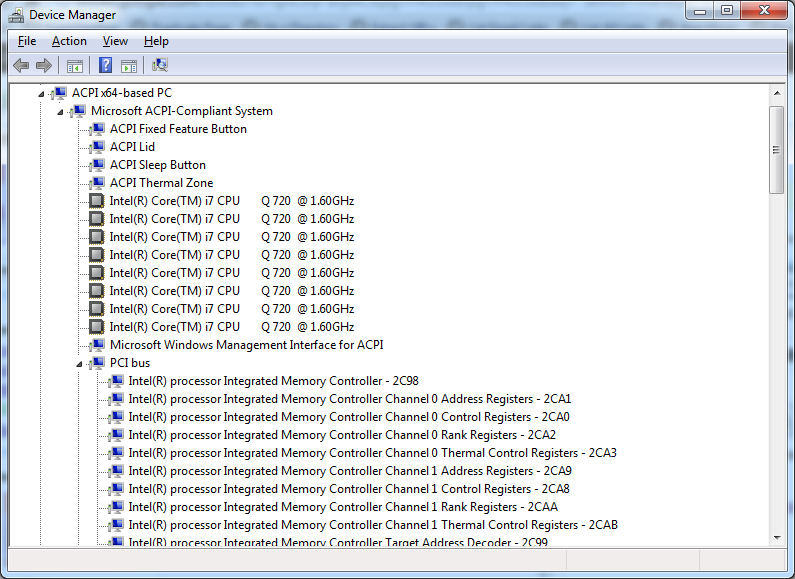
Expanded Windows Device Manager


With the increasing number of devices, it really helps to expand all nodes in the Device Manager’s tree view.

You cannot do this with the mouse, as none of the menu options contain an “Expand All” option.

But since the treeview, is the built-in Windows treeview (used in many places, like Windows explorer), you can use these shortcuts to expand/collapse nodes:

  • Numeric Keypad *: Expands everything under the current selection
  • Numeric Keypad +: Expands the current selection
  • Numeric Keypad -: Collapses the current selection.
  • RIGHT ARROW: Expands the current selection if it is not expanded, otherwise goes to the first child
  • LEFT ARROW: Collapses the current selection if it is expanded, otherwise goes to the parent

This not only works in Microsoft Windows 7: Visual … – Google Books, I think it has been introduced as far back as Windows 95.

–jeroen

Posted in Keyboards and Keyboard Shortcuts, Power User, Windows, Windows 10, Windows 7, Windows 8, Windows 8.1, Windows 9, Windows Server 2003, Windows Server 2003 R2, Windows Server 2008, Windows Server 2008 R2, Windows Server 2012, Windows Server 2012 R2, Windows Vista, Windows XP | 1 Comment »

batch-file trick: Starting Windows Explorer and selecting a file (“explorer” commandline parameters “/n” “/e” “/select” “/root” “/start” site:microsoft.com)

Posted by jpluimers on 2010/09/01

From a batch-file I recently had to start Windows Explorer, at the same time select a specific file or directory.

This turned out pretty easy: use the /select command-line switch from Windows Explorer.

In fact, Windows Explorer has a few command-line switches, and the “explorer” commandline parameters “/n” “/e” “/select” “/root” “/start” site:microsoft.com query will find quite a few topics about it: Read the rest of this entry »

Posted in Power User, Windows, Windows 10, Windows 7, Windows 8, Windows 8.1, Windows 9, Windows 95, Windows 98, Windows ME, Windows NT, Windows Server 2000, Windows Server 2003, Windows Server 2003 R2, Windows Server 2008, Windows Server 2008 R2, Windows Server 2012, Windows Server 2012 R2, Windows Server 2016, Windows Vista, Windows XP | 1 Comment »

Reminder to self: what to do if RDP (MSTSC) or VMware clipboard sharing is broken

Posted by jpluimers on 2009/09/18

Some things to check when clipboard sharing for Remote Desktop (RDP/MSTSC) or VMware is broken. Read the rest of this entry »

Posted in Fusion, Power User, Remote Desktop Protocol/MSTSC/Terminal Services, View, VMware, VMware Workstation, Windows, Windows 7, Windows Server 2000, Windows Server 2003, Windows Server 2003 R2, Windows Server 2008, Windows Server 2008 R2, Windows Vista, Windows XP | Leave a Comment »