The Wiert Corner – irregular stream of stuff

Jeroen W. Pluimers on .NET, C#, Delphi, databases, and personal interests

  • My badges

  • Twitter Updates

  • Pages

  • All categories

  • Enter your email address to subscribe to this blog and receive notifications of new posts by email.

    Join 1,854 other subscribers

Reminder to self: check if @NS_online finally accepts email addresses having a plus sign in them

Posted by jpluimers on 2021/05/12

Quite a while back, @NS_Online (Dutch railroads) did not accept plus signs in email addresses. I verified a few times over the years and not much progress.

This is a reminder to myself to re-check.

Edit 20230418: it has started working, see further below.

Below the fold the Twitter thread that started with [WayBack] Jeroen Pluimers on Twitter: “Toch jammer dat @NS_online valide email adressen met een plus-teken erin weigert.… “

Hopefully by now they retraced themselves from the bad company of many other parties failing to adhere to clear and long existing internet standards: [WayBack] User:Me at work/plushaters | Mozilla Community | FANDOM powered by Wikia.

Their web care team and their developers made some very inexcusable assumptions there:

  • questioning the use of a + in email addresses
  • questioning the email address used
  • diminishing the popularity of using a + inside email addresses
  • when you never heard of something, it does not exist
  • you can validate an email address without actually trying to deliver it

Some links on email addresses and their validity:

Read the rest of this entry »

Posted in Development, Power User, Software Development, Web Development | Leave a Comment »

FastMM4: turn warnings W1047 and W1048 off

Posted by jpluimers on 2021/05/12

(Tagged FastMM4 as that’s the first code I saw these warnings to be turned off)

Delphi 7 introduced introduced warnings for unsafe constructs like W1047 and W1048 so you could prepare your code for the first Delphi .NET compilers .

The oldest online documentation on this is in Delphi 2007:

After Delphi 2007, the .NET compiler got shelved, but the errors and warning stayed as they serve a good purpose for native code as well.

Delphi 2007 did not document any of the other directives.

Unlike the D2007 documentation, however, the UNSAFECODE should be written UNSAFE_CODE as with using {$WARN UNSAFECODE ON}, you will get this error:

E1030 Invalid compiler directive: 'UNSAFECODE'

Looking at the library code and example code that ships with Delphi, these are the valid $WARN compiler directives having to do with UNSAFE:

  • UNSAFE_CAST (since Delphi 7, but only used in Vcl.WinXPanels.pas introduced in Delphi 10.2 Tokyo and up)
  • UNSAFE_CODE (since Delphi 7, but still documented as UNSAFECODE)
  • UNSAFE_TYPE (since Delphi 7)
  • UNSAFE_VOID_POINTER (since Delphi XE3, as precursor to the NEXTGEN compilers)

The ultimate source for these is the file DCCStrs.pas that has shipped since Delphi 2009: [WayBack] warnings – Identifiers for Delphi’s $WARN compiler directive – Stack Overflow.

A problem is that current documentation still lists the wrong name in many places:

This one finally got it right: [WayBack] Warning messages (Delphi) – RAD Studio

UNSAFE_TYPE W1046
UNSAFE_CODE W1047
UNSAFE_CAST W1048

Note it also documented UNSAFE_VOID_POINTER:

UNSAFE_VOID_POINTER W1070

[WayBack] W1070 Use of untype pointer can disrupt instance reference counts (Delphi) – RAD Studio

And these warning messages still do not contain the directives, but do explain the underlying code construct better:

You have to use these directives:

// Get rid of "W1047 Unsafe code 'ASM'", "W1047 Unsafe code '^ operator'", "W1047 Unsafe code '@ operator'" and similar

{$WARN UNSAFE_CODE OFF}

// Get rid of "W1048 Unsafe typecast of 'TFreedObject' to 'PByte'" and similar

{$WARN UNSAFE_CAST OFF}

Back in the days, some people were not amused and disabled the warnings, for instance in [Archive.is] Re: How can I eliminate these warnings in Delphi 7 which did not appear in Delphi 5. – Google Groups:

Dennis Passmore:
I have one include file that I usually include in all projects as follows—– WarningsOff.inc —————-
{$IFDEF CONDITIONALEXPRESSIONS}
  {$IF CompilerVersion >= 14}
{$WARN SYMBOL_PLATFORM OFF}
{$WARN SYMBOL_DEPRECATED OFF}
{$WARN SYMBOL_LIBRARY OFF}
{$WARN UNIT_DEPRECATED OFF}
{$WARN UNIT_LIBRARY OFF}
{$WARN UNIT_PLATFORM OFF}

{$WARN UNSAFE_TYPE OFF}
{$WARN UNSAFE_CODE OFF}
{$WARN UNSAFE_CAST OFF}

  {$IFEND}
{$ENDIF}
———————and it gets ride of all unwanted warnings in the IDE or even DCC32.exe when compiling the project
from the command line.

I just add the following line to the project .dpr file and do not worry about the rest.

{$I WarningsOff.inc}

Dennis Passmore

“If you cannot conceive the idea you
will never achieve the desired results”

I disagree with such an approach, as those warnings have their purpose.

Knowing how to selectively disable/enable them however, is important.

–jeroen

Posted in Conference Topics, Conferences, Delphi, Development, Event, Software Development | Leave a Comment »

Solved: Very slow speed on SSD |VMware Communities (via “Building a lab with ESXI and Vagrant – DarthSidious”)

Posted by jpluimers on 2021/05/11

Via [WayBack] Building a lab with ESXI and Vagrant – DarthSidious while researching the possibility of running Vagrant (software) – Wikipedia on VMware ESXi – Wikipedia for building and distributing development environments:

[WayBack] Solved: Very slow speed on SSD |VMware Communities “solution” that seems to work for ESXi 6.5 and 6.7:

ESXi 6.5 includes a new native driver (vmw_ahci) for SATA AHCI controllers, but that introduces performance problems with a lot of controllers and/or disks.

Try to disable the native driver and revert to the older sata-ahci driver by running

esxcli system module set --enabled=false --module=vmw_ahci

in an ESXi shell.

Reboot the host to make the change effective.

which solves it for some who now get much faster results:

Your suggestion worked for me, now i am getting avg speed 250Mbps from SATA III SSD .

ssd.jpg

Hope will get the full I/Ops from SSD.

However:

One issue I still have is that my 4 port Syba PCIe controller card now vanishes after disabling vmw_ahci and I am restricted to using the SATA ports on the motherboard.

and you need backups:

WARNING: Doing this at least for me erases all the VMs on the aforementioned drive. Migrate as needed.

There was no response for a more permanent fix:

What is the permanent fix for this issue, should we expect a corrected native driver from VMware, or will this require a firmware upgrade on the part of the drive vendors?

and there seem to be other bottle-necks:

tried the command on a 6.7.

Deploying an OVA and I am getting 22.82….

I have a Samsung 860 EVO mSATA 1Tb SSD.

i re-enabled it, I got max 11.81.

Kind of crappy either way. Not SSD speeds IMO.

–jeroen
 

Posted in Development, ESXi6.5, ESXi6.7, Power User, Software Development, Testing, Virtualization, VMware, VMware ESXi | Leave a Comment »

Gasexplosie en grote brand aan Westestraat in Sassenheim

Posted by jpluimers on 2021/05/11

De buurt was tot laat afgesloten (veiligheid, onderzoek, genoeg redenen), dus voor nachtopvang van mijn verstandelijk beperkte broer moeten zorgen omdat Wlz zorginstelling geen crisiszorg kon leveren en op WSW werk geen leidinggevende beschikbaar was om zorg af te stemmen.

Voor mijn off-line geheugen (bijna allemaal via [Archive.is] #sassenheim hashtag on Twitter):

–jeroen

Read the rest of this entry »

Posted in About, Personal | Leave a Comment »

Chrome supported extension IDs

Posted by jpluimers on 2021/05/11

I wonder how you can programmatically open a Hangouts link from Chrome?

These dit not help:

So did some more digging.

TL;DR: did not find a solution; so any help is appreciated.

I found the IDs of then in [WayBack] extensions/common/constants.cc – chromium/src.git – Git at Google

namespace extension_misc {
const char kPdfExtensionId[] = "mhjfbmdgcfjbbpaeojofohoefgiehjai";
const char kQuickOfficeComponentExtensionId[] =
    "bpmcpldpdmajfigpchkicefoigmkfalc";
const char kQuickOfficeInternalExtensionId[] =
    "ehibbfinohgbchlgdbfpikodjaojhccn";
const char kQuickOfficeExtensionId[] = "gbkeegbaiigmenfmjfclcdgdpimamgkj";
const char kMimeHandlerPrivateTestExtensionId[] =
    "oickdpebdnfbgkcaoklfcdhjniefkcji";
const char kProdHangoutsExtensionId[] = "nckgahadagoaajjgafhacjanaoiihapd";
const char* const kHangoutsExtensionIds[6] = {
    kProdHangoutsExtensionId,
    "ljclpkphhpbpinifbeabbhlfddcpfdde",  // Debug.
    "ppleadejekpmccmnpjdimmlfljlkdfej",  // Alpha.
    "eggnbpckecmjlblplehfpjjdhhidfdoj",  // Beta.
    "jfjjdfefebklmdbmenmlehlopoocnoeh",  // Packaged App Debug.
    "knipolnnllmklapflnccelgolnpehhpl"   // Packaged App Prod.
    // Keep in sync with _api_features.json and _manifest_features.json.
};
// Error returned when scripting of a page is denied due to enterprise policy.
const char kPolicyBlockedScripting[] =
    "This page cannot be scripted due to an ExtensionsSettings policy.";
}  // namespace extension_misc

The odd thing is that the source does not match the Chrome web store designation:

Hangouts ExtensionId Source name Web store name
nckgahadagoaajjgafhacjanaoiihapd kProdHangoutsExtensionId Google Hangouts
ljclpkphhpbpinifbeabbhlfddcpfdde Debug Google Hangouts (Extension, Beta); GOOGLE CONFIDENTIAL – FOR INTERNAL USE ONLY
ppleadejekpmccmnpjdimmlfljlkdfej Alpha Google Hangouts (Extension, Debug)
eggnbpckecmjlblplehfpjjdhhidfdoj Beta Google Hangouts (Extension, Alpha)
jfjjdfefebklmdbmenmlehlopoocnoeh Packaged App Debug 404 error
knipolnnllmklapflnccelgolnpehhpl Packaged App Prod Google Hangouts; Hangouts Chrome App is deprecated. Please switch to the Hangouts Chrome Extension.

You can not start the extensions in a tab; they need to start their view through the extension.

So these links do not work:

  • chrome-extension://nckgahadagoaajjgafhacjanaoiihapd/mainapp.html?uv_main_window
  • chrome-extension://ljclpkphhpbpinifbeabbhlfddcpfdde/mainapp.html?uv_main_window
  • chrome-extension://ppleadejekpmccmnpjdimmlfljlkdfej/mainapp.html?uv_main_window
  • chrome-extension://eggnbpckecmjlblplehfpjjdhhidfdoj/mainapp.html?uv_main_window
  • chrome-extension://jfjjdfefebklmdbmenmlehlopoocnoeh/mainapp.html?uv_main_window
  • chrome-extension://knipolnnllmklapflnccelgolnpehhpl/mainapp.html?uv_main_window

–jeroen

Read the rest of this entry »

Posted in Chrome, Development, Google, GoogleHangouts, Power User, Software Development, Web Development | Leave a Comment »

file – String format procedure similar to writeln – Stack Overflow

Posted by jpluimers on 2021/05/11

Cool Format feature from [WayBack] file – String format procedure similar to writeln – Stack Overflow:

The cool thing about using Format is that you use for Format Strings not only to parameterize things like width and precision inside that Format String, but also as parameters like you normally would provide values.

You can get very close to using a width of 8 and a precision of 2, like the example in your question.

For instance, to quote the documentation:

Format ('%*.*f', [8, 2, 123.456]);

is equivalent to:

Format ('%8.2f', [123.456]);

That is a much overlooked feature of Format and Format Strings.

Edit 20250910:

This was part of my answer¹ there to mimic WriteLn formatting behaviour which was not even documented at the now deleted [Wayback/Archive] Standard Routines and I/O.

Normally deleted information like above results in worse information at their current documentation site.

This time however was an exception: the current documentation is better².

¹ the start of my answer:

Read the rest of this entry »

Posted in Conference Topics, Conferences, Delphi, Development, Event, Software Development, Undocumented Delphi | Leave a Comment »

Connectors/cables for Serial Attached SCSI and SATA – Wikipedia

Posted by jpluimers on 2021/05/10

Since I always get confused with SAS and SATA connectors, some tables from Wikipedia:

  • Serial Attached SCSI Connectors- Wikipedia
    Codename Other names Ext./int. Pins No of devices / lanes Comment Image
    SFF-8086 Internal mini-SAS, internal mSAS Internal 26 4 This is a less common implementation of SFF-8087 than the 36-circuit version. The fewer positions is enabled by it not supporting sidebands. SFF 8086.jpg
    SFF-8087 Internal mini-SAS, internal mSAS, internal iSAS, internal iPass Internal 36 4 Unshielded 36-circuit implementation of SFF-8086. Molex iPass reduced width internal 4× connector, 12 Gbit/s capability. SFF-8087 SMC.jpg
    SFF-8088 External mini-SAS, external mSAS, external iSAS, external iPass External 26 4 Shielded 26-circuit implementation of SFF-8086. Molex iPass reduced width external 4× connector, 12 Gbit/s capability. SFF 8088.jpg
    SFF-8470 InfiniBandCX4 connector, Molex LaneLink External 34 4 High-density external connector (also used as an internal connector). SFF 8470.jpg
    SFF-8482 Internal 29 2 lanes This form factor is designed for compatibility with SATA but can drive a SAS device. A SAS controller can control SATA drives, but a SATA controller cannot control SAS drives. SFF-8482 SAS Plug - Bokeh at f22.jpg
    SFF-8484 Internal 32 or 19 4 or 2 High-density internal connector, 2 and 4 lane versions are defined by the SFF standard. SFF-8484 straight connector.jpg
    SFF-8485 Defines SGPIO (extension of SFF 8484), a serial link protocol used usually for LED indicators.
    SFF-8613 (SFF-8643) Internal 36 4 or 8 with dual connector Mini-SAS HD (introduced with SAS 12 Gbit/s) SFF-8643 SMC.jpg
    SFF-8614 (SFF-8644) External 4 or 8 with dual connector Mini-SAS HD (introduced with SAS 12 Gbit/s) SFF-8644 cable.jpg
    Sideband connector Internal Often seen with 1× SFF-8643 or 1× SFF-8087 on the other end – internal fan-out for 4× SATA drives. Connects the controller to drives without backplane or to the (SATA) backplane and optionally, to the status LEDs. Sideband.jpg
    SFF-8680 Internal
    • 1
    • (2 ports)
    SAS 12 Gbit/s backplane connector
    SFF-8639 Internal 68
    • 1
    • (2 ports)
    • SAS 12 Gbit/s backplane connector;
    • revision of the SFF-8680.
    • Also known as “U.2”.[17]
    SFF-8639.jpg
    SFF-8638
    • Four 1x ports at up to 24 Gb/s each;
    • two 2x ports at up to 48 Gb/s each;
    • one 4x port at up to 96 Gb/s.
    SFF-8640
    • Four 1x ports at up to 24 Gb/s each;
    • two 2x ports at up to 48 Gb/s each;
    • one 4x port at up to 96 Gb/s.[18]
    SFF-8681
    • Two 1x ports at up to 24 Gb/s each;
    • one 2x ports at up to 48 Gb/s each.
  • Serial ATA: Cables, connectors, and ports – Wikipedia

    Data

    Standard connector, data segment[42]
    Pin # Mating Function
    1 1st Ground
    2 2nd A+ (transmit)
    3 2nd A− (transmit)
    4 1st Ground
    5 2nd B− (receive)
    6 2nd B+ (receive)
    7 1st Ground
     — Coding notch


    • A seven-pin SATA data cable (left-angled version of the connector)

    • SATA connector on a 3.5-inch hard drive, with data pins on the left and power pins on the right. The two different pin lengths ensure a specific mating order; the longer lengths are ground pins and make contact first.

    Power

    Standard

    Standard connector, power segment
    Pin # Mating Function
     — Coding notch
    1 3rd 3.3 V Power
    2 3rd
    3 2nd Enter/exit Power Disable (PWDIS) mode
    (3.3 V Power, Pre-charge prior to SATA 3.3)
    4 1st Ground
    5 2nd
    6 2nd
    7 2nd 5 V Power, Pre-charge
    8 3rd 5 V Power
    9 3rd
    10 2nd Ground
    11 3rd Staggered spinup/activity
    12 1st Ground
    13 2nd 12 V Power, Pre-charge
    14 3rd 12 V Power
    15 3rd

    A fifteen-pin SATA power connector (this particular connector is missing the orange 3.3 V wire)

    Slimline

    Slimline connector, power segment
    Pin # Mating Function
     — Coding notch
    1 3rd Device presence
    2 2nd 5 V Power
    3 2nd
    4 2nd Manufacturing diagnostic
    5 1st Ground
    6 1st

    Micro

    Micro connector, power segment
    Pin # Mating Function
    1 3rd 3.3 V Power
    2 2nd
    3 1st Ground
    4 1st
    5 2nd 5 V Power
    6 3rd
    7 3rd Reserved
     — Coding notch
    8 3rd Vendor specific
    9 2nd

    A 1.8-inch (46 mm) micro SATA hard drive with numbered data and power pins on the connector.

–jeroen

Posted in Hardware, Power User, SAS/SATA, SFF-8087 | Leave a Comment »

SC732D4-500B | Mid-tower | Chassis | Products | Super Micro Computer, Inc.

Posted by jpluimers on 2021/05/10

The [WayBack] SC732D4-500B | Mid-tower | Chassis | Products | Super Micro Computer, Inc. is a nice tower case, but remember that it has 2 USB 3.0 ports on the outside.

If you have a motherboard without onboard USB 3.0 pin headers, or one with incompatible pin headers, then you cannot use these ports with this standard cable that comes with the case:

Cable(S) CBL-0453L 1 USB 3.0,INT,19 PIN/F TO 19PIN/F,60CM,CONNECT TO CBL-0454L

Most of the X9 motherboards have no compatible pin headers.

These boards are an exception:

Too bad my boards are X9SRI-F and X9SRI-3F (do NOT get the bare X9SRI: it has no iPMI) with C6xx Dual processor Sandy Bridge-based Xeon chipsets (List of Intel Xeon chipsets) – Wikipedia:

This cable might fix this, though there is very little documentation on either of these cables:

Adapter Cable CBL-0454L USB3.0 to 2.0 adapter cable – 30cm(19pin male to 9pin female)

I could find no site with a picture of the first cable, and only newegg had pictures of the last one.

[WayBack] Supermicro CBL-0454L Supermicro CBL-0454L USB 3.0 to USB 2.0 Adapter Cable – Newegg.com

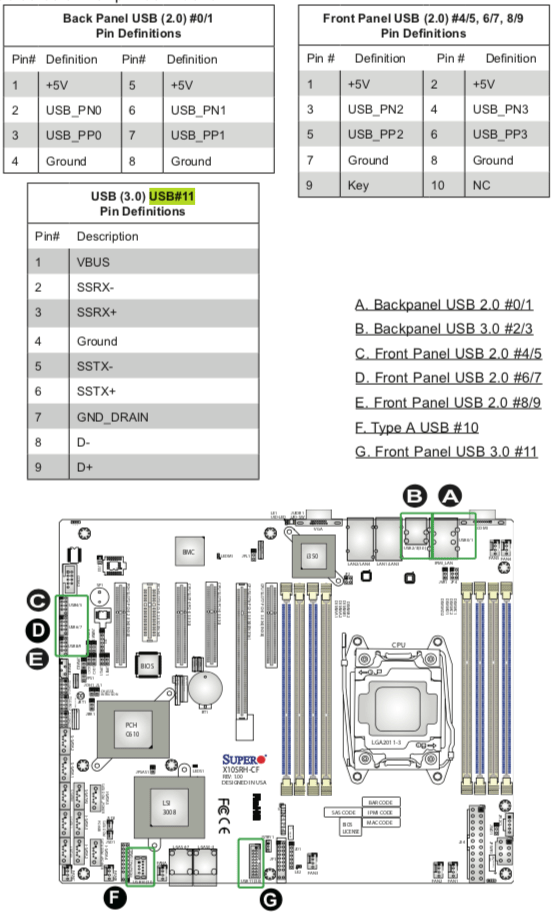
Luckily I had an X10 manual at hand, so here you can see the various pin-outs.

One end of the CBL-0454L has the same pin out as “USB (3.0) USB#11 Pin Definitions” (actually you need to double the rows) so CBL-0453L fits into it.

The other end of CBL-0454L fits into “Front Panel USB (2.0) #4/5, 6/7, 8/9” headers.

Fitting 2.5 inch drives in it

Another interesting aspect is part:

2.5″ HDD Bracket MCP-220-73201-0N HDD Cage (4x Internal 2.5″ fixed HDD bays)

Again hard to find pictures. There is only one at the whole supermicro site:

[WayBack] Supermicro | Products | SuperWorkstation | Mid-Tower | 5039C-T with Part List

[WayBack] 5039C-T_side.jpg

The part is [WayBack] Supermicro MCP-220-73201-0N Accessories with 0091016_2-5in-hdd-cage-4x-internal-2-5in-hdd.jpg (500×500)

–jeroen

Posted in Hardware, Mainboards, Power User, SuperMicro, X9SRi-3F, X9SRi-F | Leave a Comment »

Supermicro X9SRi-F Mainboard with SCU – Motherboards and CPUs – Unraid

Posted by jpluimers on 2021/05/10

Passthrough should work with these: [WayBack] Supermicro X9SRi-F Mainboard with SCU – Motherboards and CPUs – Unraid

Both unRaid and eESXi success in that thread.

–jeroen
Posted in Hardware, Mainboards, Power User, SuperMicro, X9SRi-F | Leave a Comment »

Alternatives to VMware ESXi: working around “[Errno 28] No space left on device” when updating (especially when booting from USB-stick)

Posted by jpluimers on 2021/05/07

Yesterday I talked about VMware ESXi: working around “[Errno 28] No space left on device” when updating (especially when booting from USB-stick).

There are some alternative workarounds mentioned on the interwebz. Below are a the ones I found. I discuss which ones won’t work, and why I dislike others.

Alternative workarounds that failed

Configuring host-swap

This was suggested by:

Host swap was already configured, and it still failed.

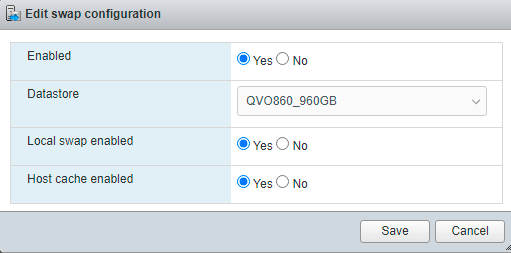
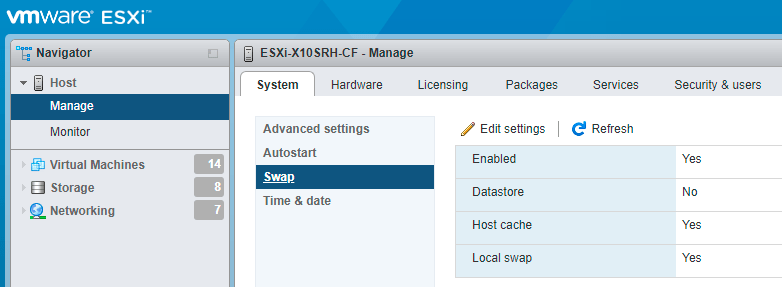
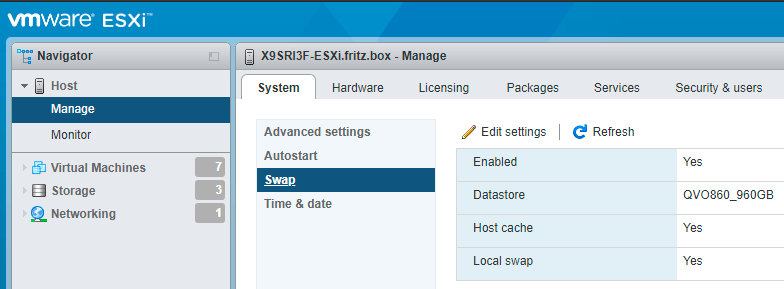
Just in case you ever want to configure host swap, it is under an URL like https://esxi67.example.org/ui/#/host/manage/system/swap and looks like this:

ESXi 6.7: configuring host swap

ESXi 6.7: configuring host swap

You get there by:

  1. logging on to the web UI
  2. clicking Host
  3. clicking Manage under Host
  4. clicking Swap under the System tab
  5. clicking Edit settings when you want to change them
    ESXi 6.7: edit host swap settings

    ESXi 6.7: edit host swap settings

More information about host swap:

Alternative workarounds I like less

Below are a few alternative workarounds. I will include them as they gained me more knowledge, but I will also describe why I like them less.

  • [Wayback] ESXI 6.7 update: No space left on device | eknori.de after explaining that directing the swap space to a datastore fails, also mentions alternative this:

    Unfortunately, in this situation, host swap already was enabled.

    There is though, a workaround. You can use an image that doesn’t have the tools vib included with this command:

    esxcli software profile update -p ESXi-6.7.0-20190802001-no-tools -d https://hostupdate.vmware.com/software/VUM/PRODUCTION/main/vmw-depot-index.xml

    You can then manually install the troublesome vib (if you have a need for tools) with this command:

    esxcli software vib install -v https://hostupdate.vmware.com/software/VUM/PRODUCTION/main/esx/vmw/vib20/tools-light/VMware_locker_tools-light_10.3.10.12406962-14141615.vib

    I had to edit it as the post itself shows the filename as

    vmw-depot
     -index.xml

    Yup: bitching again, as markup issues make code unreliable. It also allows me to explain why I do not like the solution, which is because of two reasons:

    1. It doesn’t explain why this solution works and if it is future proof. Does a future upgrade that includes changed VMware_locker_tools-light also fail? If it does not fail, does it update the VMware_locker_tools-light?
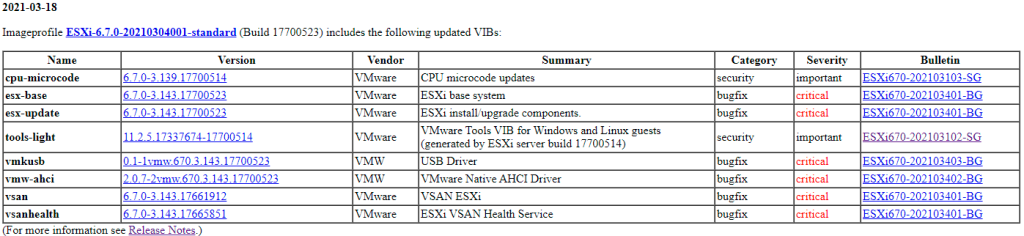
    2. It does not explain how to get the path of https://hostupdate.vmware.com/software/VUM/PRODUCTION/main/esx/vmw/vib20/tools-light/VMware_locker_tools-light_10.3.10.12406962-14141615.vib.  I did some mor research on this, and it is actually pretty straightforward: the [Wayback] VMware ESXi 6.7 Patch History has it in the table
      ESXi-6.7.0-20210304001-standard patch table

      ESXi-6.7.0-20210304001-standard patch table

      The “Version” link for “tools-light” [Wayback] 11.2.5.17337674-17700514 actually links to the VMware_locker_tools-light_11.1.1.16303738-16701467.vib file.

  • [Wayback] ESXi 6.7.0 – [Errno 28] No space left on devicevibs = VMware_locker_tools-light_11.1.1.16303738-16701467 does not explain where to get the VMware_locker_tools-light_11.1.1.16303738-16701467.vib link from, does not have the code formatted as such (so I did that below), but does actually answers part of the above questions, but not if a future upgrade will also fail. In short: re-running the upgrade after manually installing the VMware_locker_tools-light_11.1.1.16303738-16701467.vib will succeed:

    Unfortunately swap was already enabled to I had to manually install the tools-light with this command:

    esxcli software vib install -v https://hostupdate.vmware.com/software/VUM/PRODUCTION/main/esx/vmw/vib20/tools-light/VMware_locker_tools-light_11.1.1.16303738-16701467.vib

    Then re-ran the upgrade and it was successful.

  • [Wayback] ESXi 6 Update error – No Space left on device /locker which suggests to delete “find all big files in /locker and remove it”. I think that is a bad idea, as the /locker directory is maintained by your ESXi system and you should not remove any big file without knowing if it is relied upon by ESXi.
  • While updating VMware ESXi servers, VMware vSphere users may encounter the “No space left on device” error that pops up while executing “esxcli software vib update” command. Interestingly, the problem occurs even though disks are doing well and have enough free space and df -h command proves that.[Wayback] No Space Left on Device? Updating VMware ESXi | StarWind Blog has bad code markup, but explains
    • how to get disk usage with df -h where the vfat volumes usually indicate the ones on USB or SD-card media.
    • that hardly the number of inodes is a problem, and that stat -f / can help you figure out if that is the case on the volume where the upgrade files are stored
    • how to find large files not in data stores; I have changed added -h to the ls command so it becomes human readable:
      find / -path "/vmfs" -prune -o -type f -size +50000k -exec ls -lh '{}' \;
    • suggests how to put the swap space on a data store (which doesn’t work on ESXi 6.7 systems any more)
  •  

    [Wayback] Intel NUC Kit NUC5i3RYH met ESXi 6.0 updaten naar 6.7 – Gahan Zwart’s Blog

    • I like the upgrade copying the ISO to an USB stick with Rufus
    • I do not like the VMware_locker_tools-light... intermediate step, as the last step (download the full depot to a datastore, then update from there)
    • ESXi 7.0 has the same ErrNo 28 update problem as ESXi 6.7 and 6.5, so I will default to the depot download.

–jeroen
Posted in ESXi6, ESXi6.5, ESXi6.7, ESXi7, Power User, Virtualization, VMware, VMware ESXi | Leave a Comment »