The Wiert Corner – irregular stream of stuff

Jeroen W. Pluimers on .NET, C#, Delphi, databases, and personal interests

  • My badges

  • Twitter Updates

  • My Flickr Stream

  • Pages

  • All categories

  • Enter your email address to subscribe to this blog and receive notifications of new posts by email.

    Join 1,835 other subscribers

Archive for the ‘Development’ Category

ODAC undocumented exception ‘Need Oracle 8 Call Interface’

Posted by jpluimers on 2021/06/16

I got this when taking over maintenance of some legacy code that called a stored procedure in a :

---------------------------
Debugger Exception Notification
---------------------------
Project LegacyProject.exe raised exception class Exception with message 'Need Oracle 8 Call Interface'.
---------------------------
Break   Continue   Help   
---------------------------

The problem with finding more information about this, is that there are virtual no hits on Oracle 8 Call Interface, OCI 8 or Oracle Call Interface 8.

A good document is [WayBack] OCI: Introduction and Upgrading (found via [Archive.is] “OCI 7” – Google Search), but it never mentions 8, only these terms occur:

  • release 7.x OCI
  • OCI release 7
  • OCI version 7
  • Oracle release 7 OCI
  • Release 8.0 of the OCI
  • 7.x OCI
  • Later OCI
  • Post-release 7.x OCI

The error happens on the first instance of at least an [Archive.is] TOraStoredProc Class or [Archive.is] TOraPackage Class that prepares or executes a stored procedure.

One problem is that this is an instance of a plain [WayBack] Exception Class , not a [WayBack] EDatabaseError Class or [Archive.is] EDAError Class.

What it means is that the UseOCI7 sub-property was set to True in your TOraSession property Options:

var
  MainOraSession: TOraSession;
begin
  MainOraSession := TOraSession.Create(Self);

  MainOraSession.Name := 'MainOraSession';
  MainOraSession.Username := 'ExammpleUser';
  MainOraSession.Server := 'ExampleTnsName';
  MainOraSession.LoginPrompt := False;
  MainOraSession.Options.UseOCI7 := True;

One thing to remember is that an TOraSession instance does not allow you to get to the underlying TOCIConnection instance, which does allow setting NLS information directly; see for instance the error at [WayBack] Not connected to oracle error – Devart Forums and old code at [WayBack] OraClasses.pas … | source code search engine and [WayBack] Ora.pas in … | source code search engine; UniDac is relatively similar [WayBack] UniDAC v3.7 …:OraClassesUni.pas (another explanation is in [WayBack] Setting the Client Info for the TOraAlerter extra session – Devart Forums).

This is because the underlying connection can be both OCI and Direct depending on the TOraSession.Options.Direct value: [WayBack] About Connection.Ping method when Direct Mode – Devart Forums.

After the first occurrence, you will not get this error again, you get way more spurious errors, especially on stored procedures in packages, where the stored procedure has 2 or more parameters. There you get errors like this one for TOraStoredProc:

ORA-06550: line 2, column 36:
PLS-00103: Encountered the symbol ":" when expecting one of the following:

   ( - + case mod new not null <an identifier>
   <a double-quoted delimited-identifier> <a bind variable>
   continue avg count current exists max min prior sql stddev
   sum variance execute forall merge time timestamp interval
   date <a string literal with character set specification>
   <a number> <a single-quoted SQL string> pipe
   <an alternatively-quoted string literal with character set speci.

When logging using a [Archive.is] TOraSQLMonitor Class instance (use the [Archive.is] TCustomDASQLMonitor.OnSQL Event with the [Archive.is] TOnSQLEvent Procedure Reference signature) you can get the underlying information of the TOraStoredProc (see the example code below that raises this):

Class:Ora.TOraStoredProc;Component:sprSetNls;Flag:tfQPrepare,Text:Prepare: begin
  SYS.DBMS_SESSION.SET_NLS(:PARAM, :VALUE);
end;
:PARAM(VARCHAR[22],IN)='NLS_NUMERIC_CHARACTERS' 
:VALUE(VARCHAR[4],IN)=''.,''

It fails equally when doing any DBMS_APPLICATION_INFO calls, for which the .NET version of ODAC has a special [WayBack] SetDbmsApplicationInfo Method in the [WayBack] OracleConnection Class. Too bad the Delphi version omits that.

When using TOraPackage, you can get different errors, like for instance this EDatabaseError:

Exception class EDatabaseError with message 'Parameter 'VALUE' not found'.

It basically means that through OCI, the parameter list could not be obtained, so the error is caught on the Delphi side instead of the Oracle side.

Using a TOraPackage is easier at design time, as it allows you to select the [Archive.is] TOraPackage.PackageName Property property using the underlying TOraSession. Somehow a TOraStoredProc does not allow you to select the [Archive.is] TOraStoredProc.StoredProcName Property at design time.

Related:

–jeroen

Read the rest of this entry »

Posted in Database Development, Delphi, Development, OracleDB, Software Development | Leave a Comment »

PlasticSCM: delete a changeset

Posted by jpluimers on 2021/06/15

Every now and then you really goof up the final changeset in a series of changesets that are in a branch.

I have yet to figure out how to delete that changeset, other than keeping the branch stale and merge from the last good changeset to a new branch.

This seems hard to do given these from [Archive.is] plasticscm delete changeset – Google Search:

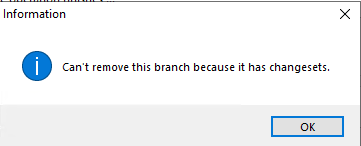
Deleting the branch fails because there is still a changeset on it:

Deleting the changeset fails because the option is greyed out:

It does not happen that often, though there are now about a few % of the branches stale because of this.

–jeroen

Posted in Development, PlasticSCM, Source Code Management | Leave a Comment »

Delphi Basics : FindCmdLineSwitch command07

Posted by jpluimers on 2021/06/15

Since I keep forgetting about this, and there is the Embarcadero documentation for it has had no examples added in Delphi 2007 or later: [WayBack] Delphi Basics : FindCmdLineSwitch command

Example code : Saerch the program parameters for 3 switches
begin
// Before running this code, use the Run/parameters menu option
// to set the following command line parameters : /def abc /ghi
ShowMessage(CmdLine);     // Show the execution command + parameters

// How many parameters were passed?
ShowMessage(‘There are ‘+IntToStr(ParamCount)+’ parameters’);

// Scan for parm1, parm2 and parm3 parameters
if FindCmdLineSwitch(‘abc’)
then ShowMessage(‘abc found’)
else ShowMessage(‘abc NOT found’);

if FindCmdLineSwitch(‘def’)
then ShowMessage(‘def found’)
else ShowMessage(‘def NOT found’);

if FindCmdLineSwitch(‘ghi’)
then ShowMessage(‘ghi found’)
else ShowMessage(‘ghi NOT found’);
end;
Show full unit code
   “C:\Program files\Borland\Delphi7\Projects\Project1.exe” /def abc /ghi
There are 3 parameters
abc NOT found
def found
ghi found

Related: [WayBack] delphi – How to read value of ParamStr with different deliminators? – Stack Overflow

Unchanged Embarcadero Delphi 2007 documentation:

For comparison, the Delphi 10.2 Rio documentation:

The really odd thing? The really versatile TCommandParser class got ditched after Delphi XE6: On the Delphi TCommandParser class for parsing command-lines and arguments (via: Suggestions for how to define command line parameters – Stack Overflow).

–jeroen

Posted in Delphi, Development, Software Development | Leave a Comment »

Keyboard Shortcuts, Markdown, and Autocomplete – Atlassian Documentation

Posted by jpluimers on 2021/06/14

Details at [WayBack] Keyboard Shortcuts, Markdown, and Autocomplete – Atlassian Documentation; summary:

To view all Confluence keyboard shortcuts, do any of the following:

  • Choose the help icon  from the universal sidebar, then choose Keyboard Shortcuts.
  • When viewing a page, press shift+?
  • While editing a page, choose the question mark icon from the editor toolbar.

a list of some of the most common shortcuts:

Markdown

Use markdown shortcuts to format text from the comfort of your keyboard.

  1. Either:
    • Type [ and then the first few characters of the page title, user’s name, image name or file name.
    • Type the first few characters of the page title, user’s name, image name, or file name (or select relevant text) and then press ctrl+shift+k.
  2. Click the relevant link from the list of suggestions.

If the item you need is not in the list, either choose Search for ‘xxx’ to continue looking for the page within Confluence, or Insert Web Link to link to an external page.

When a Windows shortcut has Ctrl in it, the MacOS shortcut uses Command.

–jeroen

Posted in Development, Keyboards and Keyboard Shortcuts, Lightweight markup language, MarkDown, Power User, Software Development | Leave a Comment »

string – Change backslash to forward slash in windows batch file – Stack Overflow

Posted by jpluimers on 2021/06/10

One of the situations where setlocal enabledelayedexpansion comes on handy to replace \ with / which some unix based tools like better: [WayBack] string – Change backslash to forward slash in windows batch file – Stack Overflow

echo off

setlocal enabledelayedexpansion

for %%f IN ("C:\tools\workspace\*") DO (
  set old=%%f
  echo !old!
  set new=!old:\=/!
  echo !new!  
  echo.                 
)

Related, as it explains when the source and target replacements are in variables themselves: [WayBack] command line – String replacement in batch file – Stack Overflow, thanks Joey and Tom Warfield!

You can use the following little trick:

set word=table
set str="jump over the chair"
call set str=%%str:chair=%word%%%
echo %str%

The call there causes another layer of variable expansion, making it necessary to quote the original % signs but it all works out in the end.

Upvoting this answer because it works both ways, with the environment variable in either position, or in both the “before” and “after” positions:

set word=table
set str="jump over the chair"
call set str=%%str:chair=%word%%%
echo %str%
set word1=chair
set word2=desk
set str="jump over the chair"
call set str=%%str:%word1%=%word2%%%
echo %str%'

–jeroen

Posted in Batch-Files, Development, Scripting, Software Development | Leave a Comment »

Delphi: When porting really old code from versions that did not have .dproj files, watch your .dfg and .dof files

Posted by jpluimers on 2021/06/10

I have been bitten by this a few times too much, so time to write it down:

When porting old Delphi code from the Delphi 7 and older era, the options were stored .dof (options) and .cfg (configuration) files.

More modern Delphi versions try to translate these files when generating the .dproj file, in a similar way as they try to upgrade older .dproj files to newer formats.

Many things can go wrong, including these ones I have bumped into multiple times:

  • DCC_DebugInformation having a 0 or false value, but not handling these values correctly (I remember problems around the Delphi XE5 era with this: When the Delphi XE5 commandline compiler fails with error F1026: File not found: ‘False.dpr’)
  • DCC_OutputDependencies not being adhered to (no .d file is being emitted by the compiler), though for the .drc files, DCC_OutputDRCFile works fine)
  • DCC_DebugInformation having a 1 value (Limited Debug information) instead of being absent (Debug information)
  • DCC_SymbolReferenceInfo having a 1 value (Definitions Only) instead of being absent (Reference info)

–jeroen

Posted in Delphi, Development, Software Development | 1 Comment »

(nullable) rowversion (Transact-SQL) – SQL Server | Microsoft Docs

Posted by jpluimers on 2021/06/09

I was not aware there could be a nullable [WayBack] rowversion (Transact-SQL) – SQL Server | Microsoft Docs, but it is possible:

Duplicate rowversion values can be generated by using the SELECT INTO statement in which a rowversioncolumn is in the SELECT list. We do not recommend using rowversion in this manner.

A nonnullable rowversion column is semantically equivalent to a binary(8) column. A nullable rowversion column is semantically equivalent to a varbinary(8) column.

You can use the rowversion column of a row to easily determine whether the row has had an update statement ran against it since the last time it was read. If an update statement is ran against the row, the rowversion value is updated. If no update statements are ran against the row, the rowversion value is the same as when it was previously read. To return the current rowversion value for a database, use @@DBTS.

You can add a rowversion column to a table to help maintain the integrity of the database when multiple users are updating rows at the same time. You may also want to know how many rows and which rows were updated without re-querying the table.

For example, assume that you create a table named MyTest. You populate some data in the table by running the following Transact-SQL statements.

–jeroen

Posted in Database Development, Development, Software Development, SQL, SQL Server | Leave a Comment »

The state of text reading robots a few years back; I doubt it has improved much since: AI often still is Algorithmic Irresponsibility

Posted by jpluimers on 2021/06/09

The state of text reading robots and AI a few years back; I doubt it has improved much since: [WayBack] Thread by @JFBonnefon: “It’s a big day today: I had a scientific manuscript rejected by a robot. Thread. The bot detected ❝a high level of textual overlap with previous literature […]”.

Basically, it detected all duplicates to be in non-relevant pieces.

Via: [WayBack] Michael Bolton on Twitter: “Thread. Machines read strings. They don’t understand context or intentions. This is how AI comes to stand for Anti-Intellectualism and Algorithmic Irresponsibility (the latter coined by @jamesmarcusbach).… “

Although I could not find that reference through [Archive.is] “Algorithmic Irresponsibility” – Google Search. I could only find two:

–jeroen

Read the rest of this entry »

Posted in AI and ML; Artificial Intelligence & Machine Learning, Development, Software Development | Leave a Comment »

Delphi: .dproj TargetedPlatforms bit flags in main PropertyGroup, and Platform values in other elements/attributes

Posted by jpluimers on 2021/06/09

For cleanup of .dproj files, I want to know the bit flags that TargetPlatforms can have.

TL;DR: .dproj content management in Delphi is a mess

For future reference empiric values for the flags that build the TargetedPlatforms (not to be confused with PlatformTargets) element content in the main PropertyGroup of a .dproj file in a table.

This might help creating an XSD for a .dproj file (Source: Reminder to self: make a start for an XSD that validates Delphi dproj files).

Absent cells means I have no idea if the values are relevant or what they could be.

Input for those is more than welcome.

Bit# TargetedPlatforms bit flag value Platform and $(Platform)value Meaning (dropdown value of “Select Platform” dialog)
0 1 Win32 32-bit Windows
1 2 Win64 64-bit Windows
2 4
3 8
4 16
5 32
6 64
7 128
8 256
9 512
10 1024 iOSDevice64 iOS Device 64-bit
11 2048
12 4096

($Platform) values still to cover:

  • Android
  • Linux64
  • OSX32
  • iOSDevice32
  • iOSSimulator

There is only one place for TargetedPlatforms in the .dproj file: at the XPath /Project/PropertyGroup/TargetedPlatforms.

For getting the XPath, I used Notepad++ as described in my earlier blog post Getting the path of an XML node in your code editor.

It has the combined flags, so:

  • 3 means Win32 and Win64 are enabled
  • 1025 means Win32 and iOSDevice64 are enabled

The Platform value (and thus $(Platform) value) is the one used in for example these elements or attributes:

  • /Project/PropertyGroup/Platform as currently selected platform
  • /Project/PropertyGroup/@Condition as selectivity expression, for instance
    •  <PropertyGroup Condition="('$(Platform)'=='Win64' and '$(Cfg_1)'=='true') or '$(Cfg_1_Win64)'!=''">
    • <PropertyGroup Condition="('$(Platform)'=='Win64' and '$(Base)'=='true') or '$(Base_Win64)'!=''">
  • /Project/ProjectExtensions/BorlandProject/Platforms/Platform (all having for the value property with the Platform value) having a content of either True or False.
    • This allows a .dproj file to contain information for platforms that are not visible yet.

The actual values of Platform also play a role in these places:

  • /Project/PropertyGroup/Base_Win64 containing the base settings for the Win64 platform so they can be derived for the Debug or Release builds.
  • /Project/PropertyGroup/@Condition for instance <PropertyGroup Condition="'$(Base_Win64)'!=''">
  • /Project/ProjectExtensions/BorlandProject/Deployment/DeployFile/Platform/@Name for instance <Platform Name="iOSSimulator">

Even worse: there are unneeded  nodes present for bits in TargetPlatforms and /Project/ProjectExtensions/BorlandProject/Platforms/Platform being absent or having a content False for /Project/ProjectExtensions/BorlandProject/Platforms/Platform/@value other than the enabled bits in TargetPlatforms, for instance:

  • nodes matched by /Project/ProjectExtensions/BorlandProject/Deployment/DeployFile/Platform
  • nodes matched by /Project/ProjectExtensions/BorlandProject/Deployment/ProjectRoot/@Platform
  • nodes matched by /Project/ProjectExtensions/BorlandProject/Deployment/DeployClass/Platform/@Name (and the parent DeployClass subtrees)
  • nodes matched by /Project/ProjectExtensions/BorlandProject/Platforms/Platform@value

Some examples of superfluous nodes when TargetPlarforms has a value of 1 (corresponding to Platform having a value of Win32:

<ProjectRoot Platform="Android" Name="$(PROJECTNAME)"/>
<ProjectRoot Platform="Linux64" Name="$(PROJECTNAME)"/>
<ProjectRoot Platform="OSX32" Name="$(PROJECTNAME).app"/>
<ProjectRoot Platform="Win32" Name="$(PROJECTNAME)"/>
<ProjectRoot Platform="Win64" Name="$(PROJECTNAME)"/>
<ProjectRoot Platform="iOSDevice32" Name="$(PROJECTNAME).app"/>
<ProjectRoot Platform="iOSDevice64" Name="$(PROJECTNAME).app"/>
<ProjectRoot Platform="iOSSimulator" Name="$(PROJECTNAME).app"/>

Also, non relevant platforms are included in this node:

<Platforms>
    <Platform value="Win32">True</Platform>
    <Platform value="Win64">False</Platform>
</Platforms>

The Deployment section is even worse; see for instance [WayBack] delphi – How manage or clean deploy section in dproj files? – Stack Overflow.

–jeroen

Posted in Conference Topics, Conferences, Delphi, Development, Event, Software Development | 1 Comment »

Chaz Firestone su Twitter: “All the balls are the same color — and that color is *brown*!… “

Posted by jpluimers on 2021/06/08

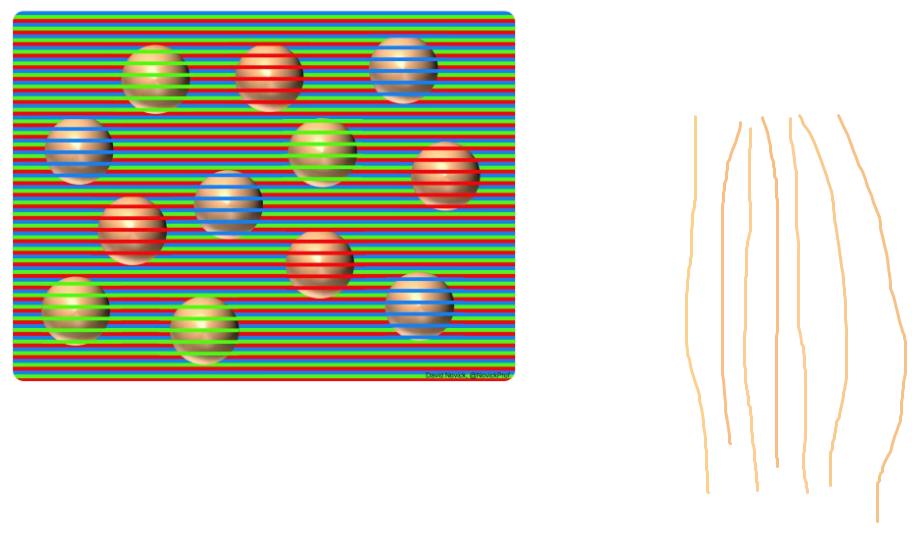
With User Experience, perception plays a big role. It helps to understand how colors work: a difficult topic with amazing results like: “All the balls are the same color — and that color is brown!”

All pictures below are from the [WayBack] Chaz Firestone on Twitter: “All the balls are the same color — and that color is brown!… “ thread.

Original by [WayBack] David Novick (@NovickProf) | Twitter: Professor of Engineering Education and Leadership, the University of Texas at El Paso. Tweets cover innovation & entrepreneurship, improv, and color illusions. El Paso, TX.

[Archive.is] David Novick on Twitter: “A three-color confetti illusion with spheres, which appear to be yellowish, reddish, and purpleish but in fact have exactly the same light-brown base color (RGB 255,188,144). Shrinking the image increases the effect. Original png file is at .… “

A PNG of the original is at engineering.utep.edu/novick/colors and his dropbox, and is even more stunning than the Twitter dithered versions below.

Colors from the color picker tool by [WayBack] #therightwaye (@therightwaye) | Twitter:

Grey backgrounds by [WayBack] Joffan (@Joffan7) | Twitter:

The cool thing is that this is being used in product packaging to make the fruits and vegetables look more orange.

Carrots by [WayBack] Hanon Ondricek on Twitter: “Oh right! And baby carrot bags have orange stripes… #itrustnothingnow… “:

Oranges and grapefruits by [WayBack] Alexei Kojenov (@kojenov) | Twitter:

–jeroen

Read the rest of this entry »

Posted in Color (software development), Development, Software Development, User Experience (ux) | Leave a Comment »