Archive for the ‘Delphi 8’ Category
Posted by jpluimers on 2014/02/18
About a year ago, I wrote about Delphi: you should avoid the with statement as it makes your code less future proof. Then I already tweeted I would follow up. Time to do it now (:
Besides my first post, these links inspired me most:
Posts about the with statement usually cause a stir: people either like or dislike it with passion.
Starting with some history and examples, this posts lists a few DOs and DON’Ts when using the with statement, shows advantages and drawbacks, and shows you tools to eliminate with statements. Read the rest of this entry »
Posted in Borland Pascal, Delphi, Delphi 1, Delphi 2005, Delphi 2006, Delphi 2007, Delphi 2009, Delphi 2010, Delphi 3, Delphi 4, Delphi 5, Delphi 6, Delphi 7, Delphi 8, Delphi x64, Delphi XE, Delphi XE2, Delphi XE3, Delphi XE4, Development, Pascal, Software Development, Turbo Pascal, With statement | 9 Comments »
Posted by jpluimers on 2014/02/13
Summary: Always try to avoid sharing .DCU files between projects.
I see a lot of projects at clients that do not have their individual DCU directories set (therefore having the DCU files in the same directory as the PAS files causing shared units to share the DCU files), or share DCU files among different projects.
Both are a very bad idea, as the compiler does not always understand when the DCU file does not match the combination of PAS file and compiler options.
The result is the occasional use of the DCU file in stead of the PAS file causing wrong code to be used, or wrong debugger information to be included.
Danny Thorpe phrased it on Stack Overflow: Read the rest of this entry »
Posted in Borland Pascal, Delphi, Delphi 1, Delphi 2005, Delphi 2006, Delphi 2007, Delphi 2009, Delphi 2010, Delphi 3, Delphi 4, Delphi 5, Delphi 6, Delphi 7, Delphi 8, Delphi x64, Delphi XE, Delphi XE2, Delphi XE3, Delphi XE4, Development, FreePascal, Lazarus, Pascal, Turbo Pascal | 9 Comments »
Posted by jpluimers on 2013/12/19
Almost a year ago, a thread on “premature Delphi optimization” came by on G+ about this code:
procedure ExchangeInteger(var AValue1, AValue2: Integer);
begin
  AValue1 := AValue1 xor AValue2;
  AValue2 := AValue1 xor AValue2;
  AValue1 := AValue1 xor AValue2;
end;
I don’t think that was premature optimization, just some code from an old fart that had already been programming in the era where processors had reasons to use it:
Back then, the only efficient way to exchange two variables of the same data type was using the XOR swap algorithm.
Nowadays you have more options, and this is where the fun in that thread began, which I will show in a minute.
First a bit of history
The XOR swap algorithm was widely known in the 80s of last century and before, especially because the 6502 processor (oh the days of LISA Assembler) was vastly popular, as was the Z80. Together, they powered the majority of the home computers in the 70s and 80s.
Read the rest of this entry »
Posted in Borland Pascal, Delphi, Delphi 1, Delphi 2005, Delphi 2006, Delphi 2007, Delphi 2009, Delphi 2010, Delphi 3, Delphi 4, Delphi 5, Delphi 6, Delphi 7, Delphi 8, Delphi x64, Delphi XE, Delphi XE2, Delphi XE3, Development, History, Pascal, Software Development, Turbo Pascal, UCSD Pascal | 7 Comments »
Posted by jpluimers on 2013/07/18
I bumped into the below answer that I gave a while (what is 4 years in a developer’s life ) on StackOverflow.
It is about Delphi Design Patterns. Sepcifically the Factory Pattern, and explains how virtual constructors implement it.
They are one of the 3 corner stones on which the component based Delphi form designer and object inspector are built:
- Virtual constructors
- Properties (events are just a special form of property)
- Run-Time Type Information.
So here it goes: Read the rest of this entry »
Posted in Delphi, Delphi 1, Delphi 2, Delphi 2005, Delphi 2006, Delphi 2007, Delphi 2009, Delphi 2010, Delphi 3, Delphi 4, Delphi 5, Delphi 6, Delphi 7, Delphi 8, Delphi XE, Delphi XE2, Delphi XE3, Delphi XE4, Development, Software Development | 6 Comments »
Posted by jpluimers on 2013/05/15
It is unwise to pass objects allocated in one framework over a DLL boundary to a different framework.
In the case of Using C dll in delphi return nothing, someone tries to pass an Interface to some memory in the C side over to Delphi.
Unless that interface is COM based, don’t do that!
In a more general way: don’t pass memory allocated on the DLL side over to the client side, no matter what kind of client you have.
From the DLL, either pass simple types, or fill buffers allocated at the client side.
Edit:
There was a nice Delphi DLL return string from C# … .NET 4.5 Heap Corruption but .NET 4.0 works? Explain please? – Stack Overflow question explaining in detail what to do for strings in a specific case: use the COM heap on the Delphi side using CoTaskMemAlloc (actually it uses the OLE task memory allocator as the Old New Thing explains).
–jeroen
via: Using C dll in delphi return nothing – Stack Overflow.
Posted in .NET, .NET 2.0, .NET 3.0, .NET 3.5, .NET 4.0, .NET 4.5, Delphi, Delphi 1, Delphi 2005, Delphi 2006, Delphi 2007, Delphi 2009, Delphi 2010, Delphi 3, Delphi 4, Delphi 5, Delphi 6, Delphi 7, Delphi 8, Delphi x64, Delphi XE, Delphi XE2, Delphi XE3, Development, Software Development | 5 Comments »
Posted by jpluimers on 2013/03/14
Variant Records are a feature that has been in the Pascal language since Standard Pascal.
A cool page for historic perspective is R3R: Pascal Features in Popular Compilers, hopefully someone will update it to more modern versions of the mentioned compilers.
There is not much official documentation on the Delphi side on this, so below some parts of a case I used for a project that started in 1997 and is still in use to day. Read the rest of this entry »
Posted in APPC, AS/400 / iSeries / System i, ASCII, COBOL, Communications Development, Conference Topics, Conferences, CPI-C, Delphi, Delphi 1, Delphi 2005, Delphi 2006, Delphi 2007, Delphi 2009, Delphi 2010, Delphi 3, Delphi 4, Delphi 5, Delphi 6, Delphi 7, Delphi 8, Delphi XE, Delphi XE2, Delphi XE3, Development, Encoding, Event, HIS Host Integration Services, Internet protocol suite, MQ Message Queueing/Queuing, SNA, Software Development, TCP, Unicode, UTF-8, WebSphere MQ | 9 Comments »
Posted by jpluimers on 2013/03/12
Few people know about a Delphi language feature that has been present since Delphi 1: prepending the type definition with a type keyword to make the type getting a new identity.
Each time I use it, I have to do some browsing for the consequences, and this time I wrote down some notes and created a small example program (source is also below).
This time I needed it when writing class wrappers on top of the Delphi bindings for WebSphere MQ.
WebSphere MQ has Queues where you can put and get messages. It also has Queue Managers to which you connect, and that provide queuing services and manages queues.
Both Queues and Queue Managers have names that can be up to 48 (single byte) characters long.
Those names mean totally different things, so though the have similar data types, they have a different identity.
The same holds for 20 byte character arrays (they can be used as names for ChannelName, ShortConnectionName and MCAName). The 264 byte character array is so far used for ConnectionName only.
Distinguishing those types: That’s what “type types” in Delphi are all about. Read the rest of this entry »
Posted in CP437/OEM 437/PC-8, Delphi, Delphi 1, Delphi 2005, Delphi 2006, Delphi 2007, Delphi 2009, Delphi 2010, Delphi 3, Delphi 4, Delphi 5, Delphi 6, Delphi 7, Delphi 8, Delphi x64, Delphi XE, Delphi XE2, Delphi XE3, Development, Encoding, Shift JIS, Software Development, Unicode, UTF-8, UTF8 | 1 Comment »
Posted by jpluimers on 2013/02/28
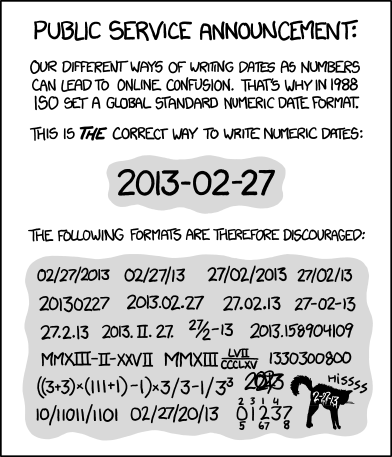
ISO 8601 was published on 06 05 88 and most recently amended on 12 01 04
Boy, am I glad with the xkcd: ISO 8601 post and image on the right.
One reason:
Please write dates and times so that everyone understands them, not just you.
The alt-text of the comic is hilarious (ISO 8601 was published on 06 05 88 and most recently amended on 12 01 04) showing the confusion of using 2 digit years not knowing which field means which (I thin XKCD author Randall Munroe and Mathematics of the ISO calendar got some of the dates, see PDF search dates below).
I found out in the mid 1980s that people I was communicating with internationally (back then the internet was forming and you already had BITNET Relay chat and email) were using different date formats than I did.
Ever since that, I’ve used the YYYY-MM-DD format of writing dates, encouraging others to use as well and as soon as I found out that was a standard, started to evangelize ISO 8601 (there is an ISO 8601 category on my blog), which – at the time of writing this – had had revisions in 1998 (on 1998-06-15), 2000 (on 2000-12-15) and 2004 (on 2004-12-01).
A lot later I found out that back in 1971, this date format was a recommendation, and in 1976 already a standard. Not nearly as old as Esperanto though (:
Speaking about languages:
At the end of last century, after Delphi 5 added year 2000 support (which made the 16-bit Delphi 1 disappear from the box as the effort to prove the product including all libraries was year 2000 proof), Delphi went cross platform.
The Delphi team working on both Kylix 1 and Delphi 6, the also added a DateUtils unit which provides a lot of cuntionality, including support for weak numbers. The first test version always assumed week 1 was the one with januari first in it. As ISO 8601 also indicates how the first week of a year should be determined, a couple of people (Jeroen W. Pluimers, Glenn Crouch, Rune Moberg and Ray Lischner) provided code that fixed this and a few other things in the unit. We even got mentioned by Cary Jensen!
That code is now also part of the RemObjects ShineOn library. That DateUtils unit is now on GitHub.
A Delphi XE version of the code (and a Delphi 2007 one) are now at NickDemoCode (Thanks Nick Hodges!).
Delphi is not the only environment having ISO 8601 support. XML has, .NET has, etc: it is now wide spread.
So follow your tools, and start using it yourself as well (:
Too bad the ISO 8601 standard text is not available publicly:
I remember the Y2K preparation era where the ISO-8601 standard was freely available at http://www.iso.ch/markete/8601.pdf, soon after the Year 2000, the PDF got locked behind a payment engine.
ISO suffers from heavy link rot too, for instance the ISO 3166 country codes used to be at http://www.iso.org/iso/prods-services/iso3166ma, but are now at http://www.iso.org/iso/home/standards/country_codes.htm. What about HTTP 303 or 302 redirect here guys?
Luckily people keep cached copies:
- “ISO 8601” “First edition” “1988-06-15” filetype:pdf
- “ISO 8601” “Second edition” “2000-12-15” filetype:pdf
- “ISO 8601” “Third edition” “2004-12-01” filetype:pdf
–jeroen
via: xkcd: ISO 8601.
Posted in .NET, Delphi, Delphi 2005, Delphi 2006, Delphi 2007, Delphi 2009, Delphi 2010, Delphi 6, Delphi 7, Delphi 8, Delphi x64, Delphi XE, Delphi XE2, Delphi XE3, Development, ISO 8601, Power User, Prism, Software Development | Tagged: date formats, delphi 1, delphi 5, delphi 6, delphi team, glenn crouch, internet, iso 8601, iso calendar, mid 1980s, ray lischner, software, technology, xkcd | 10 Comments »
Posted by jpluimers on 2013/02/20
Right now, documentation on Delphi Conditional Defines is on pages like Conditional compilation (Delphi) – RAD Studio XE2, but it is limited as it is for one specific version of Delphi only.
However, over the course of Delphi versions, compiler platforms and bitness, and not forget Free Pascal and Turbo Pascal/Borland Pascal, the matrix has become huge.
There is no complete documentation on that in one place. Right now include files like Defines.inc, the DSPack.inc, the JCL include directory the JVCL common include directory and the Jedi.inc documentation contain the collective knowledge about this.
Someone should condense that in a table and – more important – keep it up to date.
At least now there is a post collecting some of the links that contain the knowledge (:
Found one that contains these columns
- Product & Version
- VERxxx defines
- __BORLANDC__ value
- RTLVersion
- CompilerVersion
- Package Version
via Compiler/RTL version overview « Muetze1 wich is now available on the wayback machine: http://web.archive.org/web/20131229055045/http://www.muetze1.de/?page_id=547
–jeroen
Posted in Borland Pascal, Delphi, Delphi 1, Delphi 2005, Delphi 2006, Delphi 2007, Delphi 2009, Delphi 2010, Delphi 3, Delphi 4, Delphi 5, Delphi 6, Delphi 7, Delphi 8, Delphi x64, Delphi XE, Delphi XE2, Delphi XE3, Development, FreePascal, History, Pascal, Software Development, Turbo Pascal | 14 Comments »
Posted by jpluimers on 2013/02/15
I mailed the DelphiFeeds people to add the MonkeyStyler Blog by Mike Sutton.
It is a nice Delphi related blog focussing on FireMonkey stuff.
–jeroen
Posted in Delphi, Delphi 1, Delphi 2005, Delphi 2006, Delphi 2007, Delphi 2009, Delphi 2010, Delphi 3, Delphi 4, Delphi 5, Delphi 6, Delphi 7, Delphi 8, Delphi x64, Delphi XE, Delphi XE2, Delphi XE3, Development, FireMonkey, OS X FMX, Software Development | 4 Comments »


 The Wiert Corner - irregular stream of stuff