A while ago I was involved in a C header file translation for the header files of the IBM WebSphere MQ family of products, and the table helped a lot for the base types:
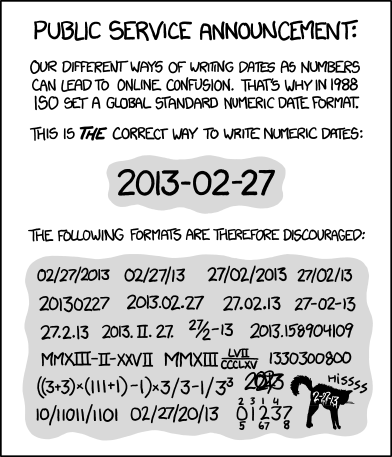
I found out in the mid 1980s that people I was communicating with internationally (back then the internet was forming and you already had BITNET Relay chat and email) were using different date formats than I did.
Ever since that, I’ve used the YYYY-MM-DD format of writing dates, encouraging others to use as well and as soon as I found out that was a standard, started to evangelize ISO 8601 (there is an ISO 8601 category on my blog), which – at the time of writing this – had had revisions in 1998 (on 1998-06-15), 2000 (on 2000-12-15) and 2004 (on 2004-12-01).
A lot later I found out that back in 1971, this date format was a recommendation, and in 1976 already a standard. Not nearly as old as Esperanto though (:
Speaking about languages:
At the end of last century, after Delphi 5 added year 2000 support (which made the 16-bit Delphi 1 disappear from the box as the effort to prove the product including all libraries was year 2000 proof), Delphi went cross platform.
The Delphi team working on both Kylix 1 and Delphi 6, the also added a DateUtils unit which provides a lot of cuntionality, including support for weak numbers. The first test version always assumed week 1 was the one with januari first in it. As ISO 8601 also indicates how the first week of a year should be determined, a couple of people (Jeroen W. Pluimers, Glenn Crouch, Rune Moberg and Ray Lischner) provided code that fixed this and a few other things in the unit. We even got mentioned by Cary Jensen!
Delphi is not the only environment having ISO 8601 support. XML has, .NET has, etc: it is now wide spread.
So follow your tools, and start using it yourself as well (:
Too bad the ISO 8601 standard text is not available publicly:
Few people know the name Peter Sollich, as he always chose not to be a public figure (for instance, he is absent on the Outstanding Technical Achievement video).
Peter has been very important for both the Delphi and the .NET worlds: he was the original author of the 32-bit product that became the Delphi x86 compiler.
A few interesting links came up when using his name in some Google searches.
I just watched this interview with Anders Hejlsberg for the first time. This is truly an amazing interview. It’s rather long, about 1 hour, but it is so worth it. I’m not giving anything away… you’ll have to just watch and enjoy.
I am giving a few things away: trip down memory lane, putting big parts of software development history into perspective,
Since Anders has been so versatile, influential and still humble, this is a must watch for anyone in the software field. To quote Research Channel:
This episode features industry luminary, Anders Hejlsberg. Before coming to Microsoft in 1996 he was well noted for his work as the principal engineer of Turbo Pascal and the chief architect of the Delphi product line. At Microsoft, he was the architect for the Visual J++ development system and the Windows Foundation Classes (WFC). Promoted to Distinguished Engineer in 2000, Anders is the chief designer of the C# programming language and a key participant in the development of Microsoft’s .NET Framework. In this show, Anders is joined by a surprise guest. This episode of ‘Behind the Code’ is hosted by Barbara Fox – former senior security architect of cryptography and digital rights management for Microsoft.
(PS: how a video published in the C# 3 era can be so current <g>).
And if you feel for more, here, here, here, here and here are some more, are a few lists of videos where Anders speaks.
From a historic perspective, I like these most:
However, over the course of Delphi versions, compiler platforms and bitness, and not forget Free Pascal and Turbo Pascal/Borland Pascal, the matrix has become huge.
The 1990 version 1.0.1 of Photoshop code was written in Object Pascal, and based on MacApp.
Back then Apple’s Object Pascal was one of the few IDEs available to develop Macintosh software. Later on, you also had Turbo Pascal and THINK Pascal (which many Macintosh developers preferred, was later acquired by Symantec, and died). A big reason they liked it so much was the THINK integrated debugger, which was lightyears ahead of any Pascal product on any other platform.
The MA7Q: WebSphere MQ – MQI for Delphi formal binding from IBM is incomplete. Even though it is from 2005, it doesn’t contain the MQCD definition that was there at least since WebSphere MQ 5.2 (released in 2000). And by now it should be gone, since MQSeries 5.x is not supported any more.
Since it is much more extensive than the IBM version, I am using it to update it for newer WebSphere versions.
Great help while updating are the Gefira MQ bindings for Python: readable, indexed on nullege, and helpful (for instance on the usage of MQHO_UNUSABLE_HOBJ – which is assigned when calling MQCLOSE, I found out later that it is also explained here). The latest Gefira change was in 2008, but still way better than the Delphi bindings.



 The Wiert Corner - irregular stream of stuff