The Wiert Corner – irregular stream of stuff

Jeroen W. Pluimers on .NET, C#, Delphi, databases, and personal interests

  • My badges

  • Twitter Updates

  • My Flickr Stream

  • Pages

  • All categories

  • Enter your email address to subscribe to this blog and receive notifications of new posts by email.

    Join 1,854 other subscribers

Archive for the ‘Software Development’ Category

Valetudo | Cloud-free control webinterface for Xiaomi vacuum robots

Posted by jpluimers on 2022/01/04

[Wayback] Valetudo | Cloud-free control webinterface for vacuum robots

Valetudo is a standalone binary which runs on rooted Vacuums of the Xiaomi ecosystem and aims to enable the user to operate the robot vacuum without any Cloud Connection whatsoever.

You can even use it to make a WiFi heat map of the floors in your home: the Valeroni app can do that for you.

The Valeroni app is open source too: [Wayback/Archive.is] ccoors/Valeronoi: A WiFi mapping companion app for Valetudo

Via [Archive.is] Kristian Köhntopp on Twitter: “Paging @sys_adm_ama: … Alternative Firmware für Robot-Staubsauger … Alternative Firmware für Robot-Staubsauger verwenden, um das Wifi im Haus zu mappen (und Staub zu saugen)”

–jeroen

Read the rest of this entry »

Posted in C++, Development, Hardware, LifeHacker, Power User, Software Development, WiFi | Leave a Comment »

Visual Studio Code: some notes on marco tools for vscode

Posted by jpluimers on 2022/01/03

In Visual Studio Code: blazingly fast text expansion with Emmet I wrote:

One of my behaviours I wanted to get rid of is heavily use of keyboard macros, so when doing more web-stuff, I bumped into Emmet (that in the past was called Zen Code).

That didn’t fully cut it, not even in combination with regular expression based search/replace, so I finally to some time to look at some links that might help me out with keyboard macros.

The links for my archive, most via [Wayback/Archive] vscode macro recorder – Google Search:

–jeroen

Posted in Development, Software Development, vscode Visual Studio Code | Leave a Comment »

Winbox configuration files

Posted by jpluimers on 2021/12/31

A few notes:

  • WinBox configuration files are under %APPDATA%\Mikrotik\Winbox
    • The subdirectory sessions contains binary *.viw files that seem to represent “view” configurations (the positions, dimensions and other properties of the open Windows in a Winbox session) where the * of the name seems to be an IPv4 address of a machine.
    • Directories named like 6.40.3-2932358209 and 6.43.13-695307561 contain configuration files that seem to determine what WinBox features a certain RouterOS version should reveal; files in those directories seem to always be these:
      • advtool.crc / advtool.jg
      • dhcp.crc / dhcp.jg
      • hotspot.crc / hotspot.jg
      • icons.crc / icons.png
      • mpls.crc / mpls.jg
      • ppp.crc / ppp.jg
      • roteros.crc / roteros.jg
      • roting4.crc / roting4.jg
      • secure.crc / secure.jg
      • wlan6.crc / wlan6.jg
    • There are binary files Addresses.cdb and settings.cfg.viw
    • A text file named sessionpath contains the expanded path %APPDATA%\Mikrotik\Winbox\sessions

The *.crc files contain a CRC code, presumably on the contents of the correspoding *.jg file. The *.jg files seem to contain some kind of JSON.

Some links I found:

–jeroen

Posted in Development, Internet, MikroTik, Power User, RouterOS, routers, Scripting, Software Development | Leave a Comment »

Productivity tips by Florian Haas and David Moreau-Simard: the mottos you work by

Posted by jpluimers on 2021/12/30

My own motto: learn new things every day.

Florian:

[Archive.is] Florian Haas 🇪🇺 on Twitter: “Docs or it didn’t happen.… “

David:

[Archive.is] ☁David Moreau-Simard on Twitter: “Hey software and system folks, I’m curious: what are some of the mottos you work by ? I’ll start:

Via Florian’s pinned Twitter post I found while writing media.ccc.de – No, we won’t have a video call for that! (Communications in distributed teams by Florian Haas).

–jeroen

Posted in Development, DevOps, Software Development | 1 Comment »

windows 7 – How can I eject a CD via the cmd? – Super User

Posted by jpluimers on 2021/12/30

Quite a while ago I found [Wayback] windows 7 – How can I eject a CD via the cmd? – Super User, but forgot to document that in the batch-files I created from it.

It shows both this one-liner:

powershell "(new-object -COM Shell.Application).NameSpace(17).ParseName('D:').InvokeVerb('Eject')"

The hardcoded const 17 is for the ssfDRIVES element in the ShellSpecialFolderConstants, which is documented at [Wayback] ShellSpecialFolderConstants (shldisp.h) – Win32 apps | Microsoft Docs.

There is no PowerShell equivalent of that element, hence the hardcoded value 17.

The script invokes the verb Eject, which works on any kind of removable media (not just optical drives). If you want to limit it to only certain drive types, then you would need to compare the Type of the ParseName() result. However, that result has a Type property returns a string for which the possible values are not documented.

Here are some links I tried to find out what is returned:

In addition to the Shell.Application, there also is Scripting.FileSystemObject, which allows enumerating the drives and filter on DriveType. This is the relevant documentation:

The second example in the above mentioned answer shows how to use this to filter for optical drives.

It also shows a cool technique to have a hybrid batch-file/JScript script:

@if (@CodeSection == @Batch) @then

@echo off
setlocal

cscript /nologo /e:JScript "%~f0"

goto :EOF

@end // end batch / begin JScript hybrid chimera

// DriveType=4 means CD drive for a WScript FSO object.
// See http://msdn.microsoft.com/en-us/library/ys4ctaz0%28v=vs.84%29.aspx

// NameSpace(17) = ssfDRIVES, or My Computer.
// See http://msdn.microsoft.com/en-us/library/windows/desktop/bb774096%28v=vs.85%29.aspx

var oSH = new ActiveXObject('Shell.Application'),
    FSO = new ActiveXObject('Scripting.FileSystemObject'),
    CDdriveType = 4,
    ssfDRIVES = 17,
    drives = new Enumerator(FSO.Drives);

while (!drives.atEnd()) {
    var x = drives.item();
    if (x.DriveType == CDdriveType) {
        oSH.NameSpace(ssfDRIVES).ParseName(x.DriveLetter + ':').InvokeVerb('Eject');
        while (x.IsReady)
            WSH.Sleep(50);
    }
    drives.moveNext();
}

–jeroen

Posted in Batch-Files, Development, JScript, PowerShell, Scripting, Software Development | Leave a Comment »

media.ccc.de – No, we won’t have a video call for that! (Communications in distributed teams by Florian Haas)

Posted by jpluimers on 2021/12/29

Not just for during the Covid times: the helpful examples and thorough explanation by Florian makes this a must-watch video for anyone wanting to participate in distributed teams.

[Wayback] media.ccc.de – No, we won’t have a video call for that!

The above link has downloads for both Video (mp4 and WebM formats) and audio (mp3 and opus formats). I found the video easier to digest.

If you want to watch it on-line, there is the YouTube video (below the signature) which has closed captions as well.

Kristian Köhntopp made a [Wayback/Archive.is] short intro and abstract on Twitter:

https://xahteiwi.eu/resources/presentations/no-we-wont-have-a-video-call-for-that/

Exactly one year ago, the office building I was working from every work day caught fire, and was closed for a month for renovation.

On the day of the planned reopening, my employer declared Covid emergency and asked everybody to work from home.

So that is how we work since then, and we will continue to do so until at least October.

Not too much has changed, though. When the new https://oosterdokseiland.nl/en/ opens, there will be probably a lot of pain between the people who go to the office to work and those who don’t.

The talk above by @xahteiwi explains in a nice way how to work properly remote first:

  • Writing over speaking.
  • Asynchronous over synchronous.
  • Structured communication over free form.

Some things require a free form video chat, but even then, set an agenda and write minutes.

Florian also explains when to use what, and what situations would require a synchronous wide-band channel, but most of them are exceptional, and most of the time you could execute better using structured, written, async mode comms.

Having said that, if you want his talk as a briefing, here is a Youtube: https://www.youtube.com/watch?v=NVnci3tyDa4

First watch the video, then read the full speaker notes at [Wayback] No, We Won’t Have a Video Call for That! – xahteiwi.eu “My talk from FrOSCon 2020, Cloud Edition.”

More on-line:

–jeroen

Read the rest of this entry »

Posted in Agile, Conference Topics, Conferences, Development, Event, LifeHacker, Power User, Software Development | 1 Comment »

Chrome: allow some URLs to “never sleep” (or hibernate/discard)

Posted by jpluimers on 2021/12/29

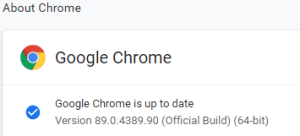
This option in Chrome has moved around a bit, so here is how it was in Version 89.0.4389.90 (Official Build) (64-bit) when I documented it.

  1. Browse to chrome://discards/
  2. Don’t be intimidated by the many rows and columns; only the rightmost 8 (at the time of writing) are interesting:

  3. Search for the URL (in my chase https://web.whatsapp.com/ , so I searched for whatsapp which you see as orange in the screenshots below) for which you want to ensure it will never sleep/hibernate (Chrome calls this “discardable”)

  4. Click Toggle under the checkmark ✔ so it changes into a cross ✘️ (so the URL will never be discarded, hence always stays awake)

Do this only for tabs that are not CPU/memory/traffic intensive

I got there via these posts:

When searching for discards, I found this post: [Wayback] How to Prevent Chrome from Reloading Tabs When You Switch to Them

Chrome has built-in memory management that causes inactive tabs to “sleep” as RAM is filled. When you click the tab again, it has to reload the page. It’s annoying.

–jeroen

Posted in Chrome, Development, Google, Power User, SocialMedia, Software Development, Web Development, WhatsApp | Leave a Comment »

Run the latest RDP session in full-screen

Posted by jpluimers on 2021/12/28

MSTSC.exe helptext

MSTSC.exe helptext

I created this small batch file:

:: start last RDP session (or new one with command-line parameters) full-screen
:: see https://interworks.com/blog/ijahanshahi/2012/01/02/mstsc-commands-and-creating-custom-remote-desktop-shortcut/
mstsc /f %*

It is based on [Wayback] MSTSC Commands and Creating a Custom Remote Desktop Shortcut | InterWorks, which has the helptext for MSTSC.exe (which stands for MicroSoft Terminal Services).

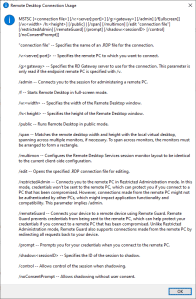
Later I found out a way easier method to get that helptext is to run MSTSC.exe /?, which shows a nice dialog:

[Window Title]
Remote Desktop Connection Usage

[Content]
MSTSC [] [/v:<server[:port]>] [/g:] [/admin] [/f[ullscreen]] [/w: /h:] [/public] | [/span] [/multimon] [/edit "connection file"] [/restrictedAdmin] [/remoteGuard] [/prompt] [/shadow: [/control] [/noConsentPrompt]]

"connection file" -- Specifies the name of an .RDP file for the connection.

/v:<server[:port]> -- Specifies the remote PC to which you want to connect.

/g: -- Specifies the RD Gateway server to use for the connection. This parameter is only read if the endpoint remote PC is specified with /v.

/admin -- Connects you to the session for administering a remote PC.

/f -- Starts Remote Desktop in full-screen mode.

/w: -- Specifies the width of the Remote Desktop window.

/h: -- Specifies the height of the Remote Desktop window.

/public -- Runs Remote Desktop in public mode.

/span -- Matches the remote desktop width and height with the local virtual desktop, spanning across multiple monitors, if necessary. To span across monitors, the monitors must be arranged to form a rectangle.

/multimon -- Configures the Remote Desktop Services session monitor layout to be identical to the current client-side configuration.

/edit -- Opens the specified .RDP connection file for editing.

/restrictedAdmin -- Connects you to the remote PC in Restricted Administration mode. In this mode, credentials won't be sent to the remote PC, which can protect you if you connect to a PC that has been compromised. However, connections made from the remote PC might not be authenticated by other PCs, which might impact application functionality and compatibility. This parameter implies /admin.

/remoteGuard -- Connects your device to a remote device using Remote Guard. Remote Guard prevents credentials from being sent to the remote PC, which can help protect your credentials if you connect to a remote PC that has been compromised. Unlike Restricted Administration mode, Remote Guard also supports connections made from the remote PC by redirecting all requests back to your device.

/prompt -- Prompts you for your credentials when you connect to the remote PC.

/shadow: -- Specifies the ID of the session to shadow.

/control -- Allows control of the session when shadowing.

/noConsentPrompt -- Allows shadowing without user consent.

[OK]

–jeroen

Posted in Batch-Files, Development, Power User, Remote Desktop Protocol/MSTSC/Terminal Services, Scripting, Software Development, Windows | Leave a Comment »

Windows: get CPU information on the console

Posted by jpluimers on 2021/12/28

It still seems that WMIC is the quickest way to get CPU information on the console:

T510-PSO C:\bin\rdp> wmic cpu get name,CurrentClockSpeed,MaxClockSpeed
CurrentClockSpeed  MaxClockSpeed  Name
2667               2667           Intel(R) Core(TM) i5 CPU       M 560  @ 2.67GHz

T510-PSO C:\bin\rdp> wmic path win32_Processor get Name,NumberOfCores,NumberOfLogicalProcessors
Name                                             NumberOfCores  NumberOfLogicalProcessors
Intel(R) Core(TM) i5 CPU       M 560  @ 2.67GHz  2              4

Actually, wmic cpu is shorthand for wmic path win32_Processor, so this works fine:

T510-PSO C:\bin\rdp> wmic cpu get name,CurrentClockSpeed,MaxClockSpeed,NumberOfCores,NumberOfLogicalProcessors
CurrentClockSpeed  MaxClockSpeed  Name                                             NumberOfCores  NumberOfLogicalProcessors
2667               2667           Intel(R) Core(TM) i5 CPU       M 560  @ 2.67GHz  2              4

The reason is that cpu is an alias:

T510-PSO C:\bin\rdp> wmic alias cpu list brief
FriendlyName  PWhere              Target
CPU           Where DeviceID='#'  Select * from WIN32_PROCESSOR

Via:

–jeroen

Posted in Batch-Files, Console (command prompt window), Development, Power User, Scripting, Software Development, T510, ThinkPad, Windows | Leave a Comment »

Sometimes you wish that companies – especially banks – would pay you for testing their sites instead of you paying them for using their sites

Posted by jpluimers on 2021/12/28

People around me often wonder why things that seem so obvious does not work, and ask me if I bump into similar things.

I do, and often wonder why banks do not pay users to do testing for them instead of the other way around.

Below the fold a few Twitter threads. They might be mainly involving ING, but that’s just because I use their business and consumer portals more than those of other banks.

Here are the summaries:

Read the rest of this entry »

Posted in Development, Software Development, Web Development | Leave a Comment »