Archive for the ‘SOAP/WebServices’ Category
Posted by jpluimers on 2013/05/14
I had some notes on Delphi WSDL and SOAP peculiarities somewhere, but I misplaced them.
Luckily, I found some links that explain most of my notes well:
–jeroen
Posted in Conference Topics, Conferences, Delphi, Delphi 2007, Delphi 2009, Delphi 2010, Delphi XE, Delphi XE2, Delphi XE3, Development, Event, SOAP/WebServices, Software Development | Leave a Comment »
Posted by jpluimers on 2012/07/18
On the research list as it seems a lot wider than HTTP Fiddler:
Paros Proxy
Paros is a valuable testing tool for your security and vulnerability testing. Paros can be used to spider/crawl your entire site, and then execute canned vulnerability scanner tests. But Paros goes beyond that, it comes with a built in utility that can proxy traffic. This Paros Proxy utility can be used to tamper or manipulate any http or https traffic on the fly. This makes some of the more interesting security types of testing. It will help you isolate potential area’s of security concern and then manual attempt to perform the type of testing you desire.
Paros Proxy
Paros also comes with a built in Session ID analyzer. It will display a graph of all the types of Session ID’s it has been presented with using a multiple threaded session initiator. You then can determine if the graph appears random enough for the Session ID. It is a pretty unique and interesting tool to use. Although typically most developers will rely upon another technology tomcat, apache, or some other application to generate Session ID’s. This is not always the case and as such a Session ID analysis should be performed. Sometimes the Session ID will not be randomized enough and the hash used to create the Session ID is easily predictable.
Paros also comes with a built in Fuzzer. You will need to generate your own Fuzzer library to use the Fuzzer, but it will perform all the fuzzing for you.
–jeroen
via: Paros Proxy | TestingSecurity.com.
Posted in Development, HTML, Java, Scripting, SOAP/WebServices, Software Development, Web Development | 2 Comments »
Posted by jpluimers on 2012/05/17
When trying to dissect .NET 1.1 web services from their .asmx and WSDL, you need some tooling.
You’d think the WCF Test Client works, but it only partially generates the calls; it gets the methods OK, but not the parameters.
Importing the .NET WebService in Visual Studio is another option, but not for a “quick play around with the calls”.
For that, Soap UI seems a good option.
If you know better tools, please let me know in the comments.
It works, and when you get it to work it is dead slow (it keeps one core running at 50%).
Getting it to work gives many people this kind of error message: Read the rest of this entry »
Posted in .NET, C#, Development, SOAP/WebServices, Software Development | Leave a Comment »
Posted by jpluimers on 2010/10/05
In Visual Studio 2010, the empty “ASP.NET Web Service Application” projects are gone.
This is probably because Microsoft rather has you use WCF, so a few of those “older” templates are now gone:
To simplify things a bit in 2010, we’ve removed a few of the older templates. You can get the same thing by creating an empty website and adding a web service to it.
Funny though, as the “old” templates are still mentioned, of course in their ASP.NET 3.5 web service documentation, but also in their Visual Studio 2010 ASP.NET Web services documentation :-)
–jeroen
via: Visual Web Developer Express 2010 – WebService Template – ASP.NET Forums.
Posted in .NET, ASP.NET, Development, SOAP/WebServices, Software Development | Leave a Comment »
Posted by jpluimers on 2010/09/22
Note that what you can do through the SDK (and vMA and its’ virtual appliance or that matter) is limited by what your ESX / ESXi license allows.
The VMware KB has more information on this: you will need at least a vSphere Essentials license for your ESXi box to use it..
If you have a free ESXi license, you will often get messages like these:
SOAP Fault:
Fault string: fault.RestrictedVersion.summary
Fault detail: RestrictedVersionFault
Read the rest of this entry »
Posted in Development, ESXi4, Power User, SOAP/WebServices, VMware | Leave a Comment »
Posted by jpluimers on 2010/02/12
Google published an interesting graph generated from their internal data based on their indexed web pages.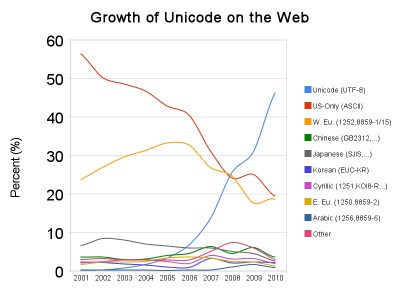
A quick summary of popular encodings based on the graph:
- Unicode – almost 50% and rapidly rising
- ASCII – 20% and falling
- Western European* – 20% and falling
- Rest – 10% and falling
Conclusion: if you do something with the web, make sure you support Unicode.
When you are using Delphi, and need help with transitioning to Unicode: contact me.
–jeroen
* Western European encodings: Windows-1252, ISO-8859-1 and ISO-8859-15.
Reference: Official Google Blog: Unicode nearing 50% of the web.
Edit: 20100212T1500
Some people mentioned (either in the comments or otherwise) that a some sites pretend they emit Unicode, but in fact they don’t.
This doesn’t relieve you from making sure you support Unicode: Don’t pretend you support Unicode, but do it properly!
Examples of bad support for Unicode are not limited to the visible web, but also applications talking to the web, and to webservices (one of my own experiences is explained in StUF – receiving data from a provider where UTF-8 is in fact ISO-8859: it shows an example where a vendor does Unicode support really wrong).
So: when you support Unicode, support it properly.
–jeroen
Posted in .NET, ASP.NET, C#, Database Development, Delphi, Development, Encoding, Firebird, IIS, InterBase, ISO-8859, ISO8859, Prism, SOAP/WebServices, Software Development, SQL Server, Unicode, UTF-8, UTF8, Visual Studio and tools, Web Development | 7 Comments »
Posted by jpluimers on 2010/01/05
Getting different architectures to talk can be a pain, even when using standards like SOAP.
In this case, the .NET WSDL imports Delphi generated WSDL in a different manner than you’d expect at first sight: when having both an ‘out’ parameter and a function ‘result’, the ‘result’ is not imported well.
But alas: SOAP didn’t accommodate for this situation in the past, and now SOAP now has some additions to solve this.
Bruneau Babet explains this here: [WayBack] SOAP inconsistency? Delphi 2010 (Win32) Server and .NET Client swapping ‘out-parameter’ and ‘result’. – Stack Overflow.
There he explains how to use the parameterOrder attribute, which the Delphi WSDL importer and exporter still do not support.
–jeroen
Posted in .NET, ASP.NET, Conference Topics, Conferences, Delphi, Development, Event, SOAP/WebServices, Software Development | Leave a Comment »
Posted by jpluimers on 2009/12/23
Had to use this on an old project, so I put this up as a reference (quite a few people have it, it was released late 2007 and I just put it up here as a reference for myself):
[WayBack] 24535 Delphi SOAP Runtime and Importer Update.
It contains the SOAP runtime and WSDL importer from Delphi 2007, but then compiled for Delphi 7, Delphi 2005 and Delphi 2006.
So if you have a project stuck in one of those old Delphi versions, you can use the SOAP/WSDL support from Delphi 2007.
–jeroen
Posted in Delphi, Development, SOAP/WebServices, Software Development | 1 Comment »
Posted by jpluimers on 2009/11/09
This just had this happen on a Windows 2003 server with a client’s client.
Any .asmx page would return a 404 error like this IIS log line shows:
2009-11-06 09:46:05 127.0.0.1 GET /MyVirtualDirectory/MyWebService.asmx – 80 – 127.0.0.1 Mozilla/4.0+(compatible;+MSIE+6.0;+Windows+NT+5.2;+SV1;+.NET+CLR+1.1.4322;+.NET+CLR+2.0.50727;+.NET+CLR+3.0.4506.2152;+.NET+CLR+3.5.30729) 404 2 1260
Searching for “iis 404 2 1260 asp.net” found this top from Marc Valk, that solved the issue: ASP.NET v2.0.5727 was prohibited to run.
Which means that none of the ASP.NET bound extensions would work: they all returned 404 errors.
(Note: if you are wondering where your IIS log files are, this post shows you).
–jeroen
Posted in .NET, ASP.NET, Development, IIS, SOAP/WebServices, Software Development, Web Development | Leave a Comment »


 The Wiert Corner - irregular stream of stuff