Archive for the ‘CSS’ Category
Posted by jpluimers on 2023/12/27
I like the featured snipped [WayBack] css color names – Google Search
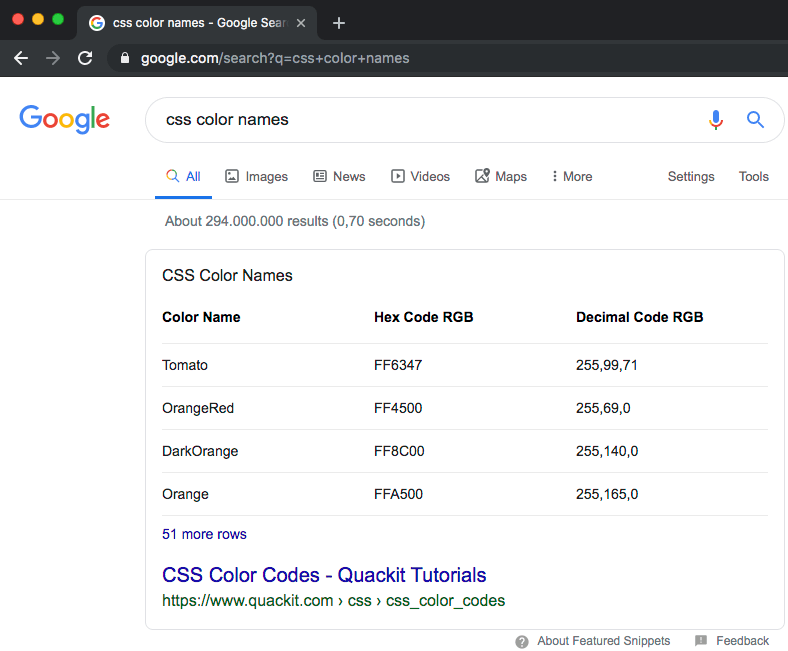
It points to [WayBack] Quackit: CSS Color Codes which has the below nice table (a few duplicates could be stripped, but the ordering and layout is great!)
Since then, I also found these very interesting pages on web colors that are also useful in any software development environment:
Read the rest of this entry »
Posted in Color (software development), CSS, Development, HTML, Software Development, Web Development | Leave a Comment »
Posted by jpluimers on 2023/10/31
Posted in Chrome, CSS, Development, Firefox, JavaScript/ECMAScript, Opera, Power User, Scripting, SocialMedia, Software Development, Web Browsers, Web Development, YouTube | Leave a Comment »
Posted by jpluimers on 2023/06/14
Based on [Wayback/Archive] javascript – how to refresh an iframe automatically – Stack Overflow and help from [Archive] Roderick Gadellaa (@RGadellaa) / Twitter, I used this JavaScript code right after the body in the html page to reload part of the iframes every 3 minutes and another part every 3 hours:
<script>
  var iframes3minuteInterval = setInterval( () => {
    const ids3minutes = [ 'agenda_iframe', 'month_iframe' ];
    ids3minutes.forEach( id => {
      element = document.getElementById( id );
      element.src = element.src;
    });
  }, 1000 * 60 * 3);
  var iframes3hourInterval = setInterval( () => {
    const ids3hours = [ 'weerplaza_nederland_iframe', 'weerplaza_radar_iframe', 'buienradar_iframe' ];
    ids3hours.forEach( id => {
      element = document.getElementById( id );
      element.src = element.src;
    });
  }, 1000 * 60 * 60 * 3);
</script>
The iframes are widgets for:
This was to workaround GitLab pages on a custom domain are nice, but be aware of intermittent 502 and certificate errors. Now the page only gets loaded once, and the widgets at intervals that are needed.
—jeroen
Posted in CSS, Development, HTML, JavaScript/ECMAScript, Scripting, Software Development, Web Development | Leave a Comment »
Posted by jpluimers on 2022/09/22
A long time ago, I found out that by default, you could only format td elements in HTML tables: somehow doing that with just tr failed, and I never understood why.
Since I wasn’t doing a lot of html stuff back then, I just lived with the few occurrences and moved on.
A while ago, I needed html tables again, and – since WordPress.com hosted blogs do not allow CSS style sheets – I had to use inline style attributes. That would bloat many td elements, so I did a [Wayback/Archive.is] html table border below row – Google Search, where the first few hits – all on StackOverflow – tremendously helped my to understand why this was the case and how to fix it:
–jeroen
Posted in CSS, Development, HTML, Software Development, Web Development | Leave a Comment »
Posted by jpluimers on 2022/09/15
I come from a background of Delphi, Visual Studio and Notepad++ editors that historically have expanded their functionality over decades of releases.
When switching much of my development to Visual Studio Code, which out of the box aims at basic support (which has grown remarkably over the years so it’s way beyond basic now), I decided to review my editing behaviours see if plugins (in vscode speak “extensions marketplace“) would assist me with that.
One of my behaviours I wanted to get rid of is heavily use of keyboard macros, so when doing more web-stuff, I bumped into Emmet (that in the past was called Zen Code).
I bumped into Emmet because I wanted to refactor quite a few bits of html, and embed many sections of text in tags. Normally I would have written a macro for that, but now I did a quick [Wayback/Archive.is] vscode html embed text in element – Google Search and bumped into [Wayback/Archive.is] html – How to do tag wrapping in VS code? – Stack Overflow (thanks [Wayback/Archive.is] Alex!)
Since Visual Studio Code has built-in support for Emmet, here are some links so I can quickly find them back:
Hopefully I will now also less rely on user-defined snippets, though they are still available: [Wayback/Archive.is] Snippets in Visual Studio Code
Using Emmet eventually might help me in my blog-writing too, which still is heavily WordPress.com, known for its limited editor, based.
Apparently, my Google Search fu still is good enough to find these kinds of gems (:
–jeroen
Posted in .NET, CSS, Development, HTML, HTML5, Software Development, Visual Studio and tools, vscode Visual Studio Code, Web Development | Leave a Comment »
Posted by jpluimers on 2022/08/02
Last year in OWASP top rated security “feature” A01:2021 – Broken Access Control, I promised to write more about how learn about OWASP documented and rated security vulnerabilities.
Today is the day you should start learning from [Wayback/Archive.is] Github: OWASP WebGoat:
Deliberately insecure JavaEE application to teach application security
It is a Java backend with a JavaScript/HTML frontend, but the vulnerabilities just as easily apply to other back-end stacks.
Repositories:
- [Wayback/Archive.is] WebGoat/WebGoat: WebGoat is a deliberately insecure application
WebGoat is a deliberately insecure web application maintained by OWASP designed to teach web application security lessons.
This program is a demonstration of common server-side application flaws. The exercises are intended to be used by people to learn about application security and penetration testing techniques.
WARNING 1: While running this program your machine will be extremely vulnerable to attack. You should disconnect from the Internet while using this program. WebGoat’s default configuration binds to localhost to minimize the exposure.
WARNING 2: This program is for educational purposes only. If you attempt these techniques without authorization, you are very likely to get caught. If you are caught engaging in unauthorized hacking, most companies will fire you. Claiming that you were doing security research will not work as that is the first thing that all hackers claim.
- [Wayback/Archive.is] WebGoat/WebGoat-Lessons: 7.x – The WebGoat STABLE lessons supplied by the WebGoat team.
This repository contains all the lessons for the WebGoat container. Every lesson is packaged as a separate jar file which can be placed into a running WebGoat server.
- [Wayback/Archive.is] WebGoat/WebWolf (Can’t have a goat without a wolf, but I wonder where the cabbage is)
- [Wayback/Archive.is] WebGoat/WebGoat-Legacy: Legacy WebGoat 6.0 – Deliberately insecure JavaEE application
This is the WebGoat Legacy version which is essentially the WebGoat 5 with a new UI.
This program is a demonstration of common server-side application flaws. The exercises are intended to be used by people to learn about application penetration testing techniques.
- [Wayback/Archive.is] WebGoat/WebGoat-Archived-Releases: WebGoat 5.4 releases and older
WebGoat 5.4 releases and older
- [Wayback/Archive.is] WebGoat/groovygoat: POC for dynamic groovy/thymeleaf based lesson system
POC to demonstrate dynamic lessons with groovy controller/thymeleaf templates
They are by OWASP:
The Open Web Application Security Project (OWASP) is an online community that produces freely-available articles, methodologies, documentation, tools, and technologies in the field of web application security.[4][5]The Open Web Application Security Project (OWASP) provides free and open resources. It is led by a non-profit called The OWASP Foundation. The OWASP Top 10 – 2021 is the published result of recent research based on comprehensive data compiled from over 40 partner organizations.
Very important is the [Wayback/Archive.is] OWASP Top Ten Web Application Security Risks | OWASP:
The OWASP Top 10 is a standard awareness document for developers and web application security. It represents a broad consensus about the most critical security risks to web applications.
Globally recognized by developers as the first step towards more secure coding.
Companies should adopt this document and start the process of ensuring that their web applications minimize these risks. Using the OWASP Top 10 is perhaps the most effective first step towards changing the software development culture within your organization into one that produces more secure code.
Changes in the OWASP Top 10 between 2017 and 2021:
More OWASP repositories (including the [Wayback/Archive.is] OWASP/Top10: Official OWASP Top 10 Document Repository and [Wayback/Archive.is] OWASP/www-project-top-ten: OWASP Foundation Web Respository which seem to be at a 4-year update interval got updated in 2021) are at [Wayback/Archive.is] Github: OWASP.
Related: [Archive.is] Jeroen Wiert Pluimers on Twitter: “This so much sounds like German government IT-projects: …”
Via:
–jeroen
Posted in Authentication, CSS, Development, Encryption, HTML, Java Platform, JavaScript/ECMAScript, Pen Testing, Scripting, Security, Software Development, Web Development | Leave a Comment »
Posted by jpluimers on 2022/07/26
Cool: [Wayback/Archive.is] eidam/cf-workers-status-page:
Monitor your websites, showcase status including daily history, and get Slack/Telegram/Discord notification whenever your website status changes. Using Cloudflare Workers, CRON Triggers, and KV storage
Will try this out in a while, hopefully before this actually reaches the front of the blog article queue (:
Via: [Wayback/Archive.is] Status Page – Scott Helme (via [Archive.is] Scott Helme on Twitter: “And yes, I’m also nervously watching my own status page 😅 …”).
Related blog post: One of the Let’s Encrypt’s Root Certificates expired today (and their corresponding intermediate yesterday); how is your infrastructure doing?
–jeroen
Posted in CSS, Development, JavaScript/ECMAScript, Scripting, Software Development, Web Development | Leave a Comment »
Posted by jpluimers on 2021/12/08
Some sites manage to disable various printing options (including layout, so you cannot choose between landscape and portrait any more, or force landscape when portrait works better or vice versa).
Googling this got me into a web of things that didn’t help me (see links below), but those led me to this query [Wayback] chrome save as pdf layout missing portrait landscape – Google Search.
That returned a helpful result at [Archive.is/Wayback] Chrome Print dialogue not offering fit to page, landscape, other printing options – Google Chrome Community:
I found a solution.
1. Install the
Stylus Extension.
2. Go into the Stylus extension and click on “Write new style”.
3. Put the following code in:
@page {
size: auto;
}
4. Give it a name (I called mine “Fix Orientation”) and save it.
5. Reload the page you’re trying to print and the print dialogue should now have the “Layout” option and you should always get it for any page you print from now on.
It’s about the extension [Archive.is] Stylus – Chrome Web Store
Redesign the web with Stylus, a user styles manager. Stylus allows you to easily install themes and skins for many popular sites.
I reconfigured the OHRA Mijn Zorg site to force re-enabling of layout by adding @page { size: auto !important; } for https://mijn.ohrazv.nl/ (click the Save button to save this change permanently):
Read the rest of this entry »
Posted in Chrome, CSS, Development, Google, HTML, Power User, Software Development, Web Development | Leave a Comment »


 The Wiert Corner - irregular stream of stuff