Archive for the ‘Mac’ Category
Posted by jpluimers on 2016/10/07
The most recent versions of Joe don’t even build from stock in OS X any more and there are no direct installers for them.
But there are two most recent older versions that have installers, and a formula recent brew based HomeBrew installation:
- joe-3.7-0.pkg – rudix-snowleopard – JOE – Rudix: The hassle-free way to get Unix programs on Mac OS X – Google Project Hosting.
- PROJECT DETAIL for Joe’s Own Editor.
- Homebrew Formulas – Joe.
After experimenting for a while without brew preferring the first over second, I’ve installed the the third as:
- The first actually installs version 3.6, but has the syntax highlighting files installed in the correct place, so you get syntax highlighting.
- The second does install version 3.7, but since the syntax highlighting files are in the wrong place: you get no syntax highlighting.
- The brew formula has an up to date joe version 4.0 and installs the syntax highlighting in the right place: you get syntax highlighting.
Before making a choice, you might want to consider reading about joe versions in JOE – Joe’s own editor / … /NEWS.md.
Having a background partially in the Linux world, I tried building joe from source on my Mac following the steps at JOE – Joe’s own editor / Discussion / joe-editor-general:Mac binary for 3.3 does not run on OS/X 10.8. It failed because the Mercurial 3.8 branch required automake and autoconf which are not available on just a Mac + Xcode. So I’m happy that others have bit the bullet and make a good HomeBrew build.
What makes HomeBrew so great is that it is based on a fully versioned git/ruby combination, allows for multiple Python versions, allows for binaries through bintray served bottles and has zillions (well, thousands) of installable formulae, all versioned.
–jeroen
Posted in *nix, *nix-tools, Apple, joe, Mac OS X / OS X / MacOS, Mac OS X 10.4 Tiger, Mac OS X 10.5 Leopard, Mac OS X 10.6 Snow Leopard, Mac OS X 10.7 Lion, MacBook, MacBook Retina, MacBook-Air, MacBook-Pro, MacMini, OS X 10.10 Yosemite, OS X 10.8 Mountain Lion, OS X 10.9 Mavericks, Power User | Leave a Comment »
Posted by jpluimers on 2016/09/26
Posted in Apple, Mac, Mac OS X / OS X / MacOS, MacBook, MacBook Retina, MacBook-Air, MacBook-Pro, MacMini, OS X 10.10 Yosemite, OS X 10.11 El Capitan, OS X 10.9 Mavericks, Power User | Leave a Comment »
Posted by jpluimers on 2016/09/23
I was looking for some PDF files that I knew for sure were on my SSD but Spotlight would not find them. Looking for more obvious files I noticed Spotlight was returning hardly any files at all: somehow the index was messed up.
Years ago I also had Spotlight issues; then it would find nothing (now it did find some files) which was solved by a reboot: Spotlight refuses to be enabled on Lion: reboot helped.
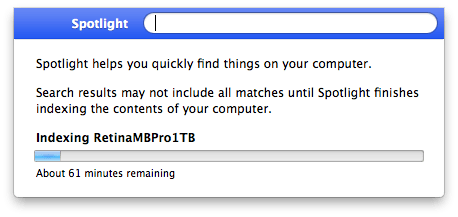
Screenshot 2016-06-29 12.57.34
Now this was right after a reboot, and because Spotlight did find some files I know Spotlight was turned on (no need for mdutil tricks mentioned in After restoring fresh HDD from Time Machine Backup: No results from Spotlight).
So I dug a bit deeper and decided to try [WayBack] Rebuild the Spotlight index on your Mac – Apple Support with these steps:
- Search for something that returns few results (in my case Xyzzy)
- Click
Spotlight Preferences...
- Go to the
Privacy tab
- From the
Finder, drag your disk(s) to the Prevent Spotlight from searching these locations list.
- Remove your disk(s) from that lists using the minus (-) button.
- Wait for re-indexing to complete
That worked like a charm to refresh the index: it started indexing again which took about one hour.
After a few minutes though, I found back the 32pfl7404h_12_dfu_nld.pdf I was looking for.
A second time, it had lost the index to iTunes, and found it back in about 2 hours (as the SSD was much more full).
A third time, this trick from [WayBack/Archive.is] Re-Index Spotlight from the Terminal, Re-Gain Valuable Time for Life [OS X Tips] | Cult of Mac worked:
sudo mdutil -E /
This basically re-indexes from the root (/) folder.
I find it easier than the above 6 steps (which are also on [WayBack/Archive.is] Make Spotlight Work Again [OS X Tips] | Cult of Mac).
–jeroen
Posted in Apple, Mac, Mac OS X / OS X / MacOS, MacBook, MacBook Retina, MacBook-Pro, OS X 10.10 Yosemite, OS X 10.11 El Capitan, OS X 10.9 Mavericks, Power User, SpotLight | Leave a Comment »
Posted by jpluimers on 2016/08/17
A while ago, testssl.sh [WayBack] needed Darwin binaries (for OS X): Supply Darwin binaries + install documentation · Issue #127 · drwetter/testssl.sh [WayBack]
So I created the small Bourne shell (sh) script below to deliver them.
It allows me to update these gists:
The build script itself is in a gist as well: https://gist.github.com/f4de3937630b87753133.git [WayBack]
It helped me to contribute to these testssl.sh issues:
Not all of these binaries are in https://github.com/drwetter/testssl.sh/tree/master/bin [WayBack] as it makes the testssl.sh repository too bloated. Some (including non-OSX builds made by others) are here:
Eventually the script might get merged into https://github.com/drwetter/testssl.sh/blob/master/utils/make-openssl.sh [WayBack] as there is a Darwin switch in this commit: https://github.com/drwetter/testssl.sh/commit/6efc3e90f52e5926b0853d3b2fb221b631dcf452 [WayBack]
Read the rest of this entry »
Posted in Apple, Development, Mac, Mac OS X / OS X / MacOS, Mac OS X 10.4 Tiger, Mac OS X 10.5 Leopard, Mac OS X 10.6 Snow Leopard, Mac OS X 10.7 Lion, MacBook, MacBook Retina, MacBook-Air, MacBook-Pro, MacMini, OpenSSL, OS X 10.10 Yosemite, OS X 10.8 Mountain Lion, OS X 10.9 Mavericks, Power User, Security, Software Development, xCode/Mac/iPad/iPhone/iOS/cocoa | Leave a Comment »
Posted by jpluimers on 2016/08/15
The culprit is usually the mds [WayBack] process (metadata server).
Simple command-line solution:
sudo killall mds
A more convoluted way with the Activity Monitor is in the link below.
–jeroen
via: Fix the OS X Finder not displaying the contents of specific folders | MacIssues [WayBack]
Posted in Apple, Mac, Mac OS X / OS X / MacOS, Mac OS X 10.4 Tiger, Mac OS X 10.6 Snow Leopard, MacBook, MacBook Retina, MacBook-Air, MacBook-Pro, MacMini, OS X 10.10 Yosemite, OS X 10.8 Mountain Lion, Power User | Leave a Comment »
Posted by jpluimers on 2016/06/22
Woof is a small simple stupid webserver that can easily be invoked on a single file. Your partner can access the file with tools he trusts (e.g. wget). No need to enter passwords on keyboards where you don’t know about keyboard sniffers, no need to start a huge lot of infrastructure, just do a
$ woof filenameand
tell the recipient the URL woof spits out. When he got that file, woof will quit and everything is done.And when someone wants to send you a file, woof has a switch to offer itself, so he can get woof and offer a file to you. …
Woof needs Python on a unix’ish operating system. Some people have used it successfully on Windows within the cygwin environment.
Source: Woof – simply exchange files
Works from homebrew on OS X.
via: Web Offer One File – Thomas Mueller (dummzeuch) – Google+
Source: Web Offer One File
–jeroen
Posted in *nix, *nix-tools, Apple, BSD, Home brew / homebrew, Linux, Mac, Mac OS X / OS X / MacOS, Power User | Leave a Comment »
Posted by jpluimers on 2016/06/07
Via the answer below I created the renew alias. I already had the first two aliases.
alias route-and-ipaddresses="netstat -nr | grep 'Internet\|Gateway\|default' && echo && ifconfig | grep '\: flags\|inet\|inet6' && echo more detailed info through ifconfig and netstat -nr"

alias whatismyip="curl http://whatismyip.akamai.com && echo"

alias renew_dhcp="sudo ipconfig set en0 DHCP && echo waiting 10 seconds for DHCP lease to be obtained && sleep 10 && route-and-ipaddresses && whatismyip"
–jeroen
via: network – How can I release and renew my DHCP lease from Terminal? – Ask Different.
Posted in Apple, bash, Development, Mac, Mac OS X / OS X / MacOS, Mac OS X 10.6 Snow Leopard, MacBook, MacBook Retina, MacBook-Air, MacBook-Pro, MacMini, OS X 10.10 Yosemite, OS X 10.8 Mountain Lion, OS X 10.9 Mavericks, Power User, Scripting, Software Development | Leave a Comment »
Posted by jpluimers on 2016/05/26
Thanks Adrian W for providing the below example in your answer about obtaining GLUE record information for a domain.
It is an excellent showcase for the $IFS Internal Field Separator available in any nx shell.
In this case it is used to get the TLD (top-level domain) from the domain name specified at the command-line.
After that, it obtains the name servers for that TLD, and queries the glue records there, both using dig.
Here is a little shell script which implements Alnitak’s answer:
#!/bin/sh
S=${IFS}
IFS=.
for P in $1; do
  TLD=${P}
done
IFS=${S}

echo "TLD: ${TLD}"
DNSLIST=$(dig +short ${TLD}. NS)
for DNS in ${DNSLIST}; do
  echo "Checking ${DNS}"
  dig +norec +nocomments +noquestion +nostats +nocmd @${DNS} $1 NS
done
Pass the name of the domain as parameter:
./checkgluerecords.sh example.org
–jeroen
via domain name system – How to test DNS glue record? – Server Fault.
Posted in *nix, Apple, bash, Development, DNS, Linux, Mac, Mac OS X / OS X / MacOS, Mac OS X 10.4 Tiger, Mac OS X 10.5 Leopard, Mac OS X 10.6 Snow Leopard, Mac OS X 10.7 Lion, openSuSE, OS X 10.10 Yosemite, OS X 10.8 Mountain Lion, OS X 10.9 Mavericks, Power User, Scripting, Software Development, SuSE Linux | Leave a Comment »
Posted by jpluimers on 2016/04/25
For one of my USB backup drives, Time Machine was stuck showing “Preparing Backup”.
tmutil (which has a lot of undocumented parameters) helped me out.
tmutil status would not show any change for hours either:
retinambpro1tb:~ root# tmutil status
Backup session status:
{
    BackupPhase = ThinningPreBackup;
    ClientID = "com.apple.backupd";
    DateOfStateChange = "2015-05-04 19:27:31 +0000";
    DestinationID = "01AE12C7-1D3E-469E-BE7E-32DA30F0030E";
    DestinationMountPoint = "/Volumes/Elements2TB1";
    Percent = "-1";
    Running = 1;
    Stopping = 0;
}
...
retinambpro1tb:~ root# tmutil status
Backup session status:
{
    BackupPhase = ThinningPreBackup;
    ClientID = "com.apple.backupd";
    DateOfStateChange = "2015-05-04 21:13:28 +0000";
    DestinationID = "01AE12C7-1D3E-469E-BE7E-32DA30F0030E";
    DestinationMountPoint = "/Volumes/Elements2TB1";
    Percent = "-1";
    Running = 1;
    Stopping = 0;
}
So I:
- removed the .inProgress file found by
ls -al /Volumes/Elements2TB1/Backups.backupdb/`scutil --get ComputerName`/*.inProgress
- rebooted with the USB drive attached
- waited for spotlight to complete
- manually started a backup
- verified it made progress using tmutil (you need to run that as root, for instance with
sudo su -)
And it indeed made progress and finished:
Read the rest of this entry »
Posted in *nix, Apple, Mac, Mac OS X / OS X / MacOS, MacBook, MacBook Retina, MacBook-Air, MacBook-Pro, MacMini, OS X 10.8 Mountain Lion, Power User, SpotLight | Leave a Comment »
Posted by jpluimers on 2016/04/01
IRC so: »i> Isotopp: Ich habe jetzt nen Mac als Arbeitsplatzrechner… Was will man als UNIX Hacker zuerst an Tools installieren?«
Source: IRC so: »i> Isotopp: Ich habe jetzt nen Mac als Arbeitsplatzrechner… Was will… by Kristian Köhntopp.
Since G+ is very bad at searching, I created this summary of the tools; read the full G+ post (Google Translate is quite OK), including comments on why.
Edit: 20160402 – I’m posting regular updates based on the comments for that G+ post. I’ve changed or added German iTunes store links to US-English ones.
Read the rest of this entry »
Posted in Apple, Audacity, Audio, Fusion, Hardware, Keybase, Keyboards and Keyboard Shortcuts, KVM keyboard/video/mouse, Mac, Mac OS X / OS X / MacOS, MacBook, MacBook Retina, MacBook-Pro, Media, OS X 10.10 Yosemite, OS X 10.11 El Capitan, Power User, Security, VirtualBox, Virtualization, VMware | Leave a Comment »


 The Wiert Corner - irregular stream of stuff