Every now and then I complete more pieces of my early 1990s vector fonts era. This time I’ve found back the name of the company that provided some parts of the software that we used at Polyvroom to produce vector fonts (both PostScript and TrueType): “Galiad Computers Ltd.” from Israel. I don’t remember Eitan Mizrotsky though.
At the time of writing, http://galiad.co.il/ seems down, but the Web Archive has old copies of it. I totally forgot they did some more public Border Software as well.
Another party involved back then was Visualogik. They still exist, so I will get in touch with them one day.
Mecanorma, LetterPress and Letraset dry tansfer lettering (click to enlarge).
Mecanorma was a French company and leading manufacture of instant lettering. The rub down lettering was manufactured by a Dutch company called Polyvroom BV. Around 1985 the company called Trip Productions took over Mecanorma and Polyvroom. In the following years Trip Productions BV developed digital fonts and produced the rub down lettering from Lisse in The Netherlands.
The main product of Mecanorma was always the production of the rub down lettering. It was not easy to to scale down the company when the market of the rub down lettering did almost disappear because of the new technology in the world. Many of the production lines for the rub down lettering were closed down. The rub down lettering is a decal technology and to survive Trip Productions did try to focus on that technology for a long time with success.
In 2012 the decision was made that they had to turn the company around. A new company was formed called Trip Licenses BV and they focus on the license of the Fonts and Patents the company has. The production and sales of the rub down lettering is still active and licensed to ProCraft BV in The Netherlands. The digital fonts are licensed to House of Type (ITF Inc.) in the USA.
FollowAlong with Letraset, the French company Mecanorma was one of the major vendors of instant rub-down lettering. Along with licensing typefaces from other vendors, Mecanorma commissioned original typeface designs.
From 1989 until 1994, Mecanorma worked with another Dutch company Visualogik to create digital versions of their typefaces. These typefaces were released in Type 1 format, bearing a “MN” suffix. In addition, Monotype licensed and digitized some of Mecanorma’s typefaces. In 1995, Mecanorma stepped back from the professional graphics market and entered into other areas such as home decoration. During that time, their decorative materials, including their instant rub-down lettering, were manufactured by the now defunct Dutch company, Trip Productions BV.
In 2004, International TypeFounders (ITF) licensed the digital typefaces from Trip Productions BV and released them as the Mecanorma Collection. This helped to preserve one of the finest digital font libraries of display typefaces around, combining real arts and crafts into the tools of today.
In 2014, International TypeFounders entered into a permanent agreement with Trip Consultants BV, the legal successor of the French type foundry Mecanorma. As the exclusive worldwide digital rights owners of the collection, ITF have now republished the Mecanorma Collection in OpenType for the first time.
Fantasque Sans Mono: A programming font, designed with functionality in mind, and with some wibbly-wobbly handwriting-like fuzziness that makes it unassumingly cool. Development hosted on Github: [Wayback] https://github.com/belluzj/fantasque-sans OFL (SIL Open Font License). Category: Monospaced
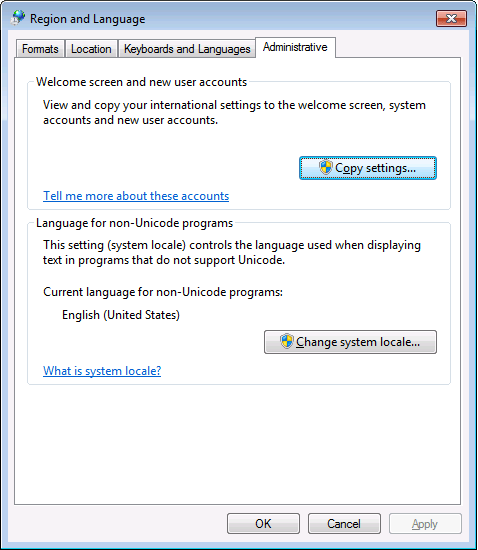
PowerShell 4.0 is madly in love with “English (United States)”
A long time ago I started writing up my blog post like this in March 2015 when I bumped into this the first time when upgrading from PowerShell 2 to PowerShell 4:
Good and not so good news: after reading the below linked posts, this is what works:
PowerShell 4 and up works fine with any [Wayback] Lucida Console size (including 12) and boldness
only when the “Language for non-Unicode programs” is set to “English (United States)”.
PowerShell 4 works fine with [Wayback] Consolas on any size and boldness
for any “Language for non-Unicode programs”
So if you’re like me and switch between “Dutch (Netherlands)” and “English (Ireland)” a lot (both use the EURO as currency, but have distinct enough other locale settings to cover a lot of European stuff) then you need to get used to the Consolas font.
The point made by Simson Garfield below reminds me I haven’t been at IKEA for a long long while (:
Verdana was everywhere, and now it was in one more place. It was becoming a non-font that we don’t even register. Which is precisely why it was so effective, and exactly why it was chosen.





 The Wiert Corner - irregular stream of stuff