Archive for the ‘*nix’ Category
Posted by jpluimers on 2013/05/13
Edit:
After writing this, DSA got deprecated then later removed. See [WayBack] Secure Secure Shell.
When working with SSH private/public keys (often because of ssh-keygen), and using DSA for auhtentication, these are the relevant files:
- $HOME/.ssh/id_dsa:
(on the local system)
The $HOME/.ssh/id_dsa file contains the protocol version 2 DSA authentication identity of the user.
- $HOME/.ssh/id_dsa.pub:
(on the local system)
The $HOME/.ssh/id_dsa.pub file contains the DSA public key for authentication when you are using the SSH protocol version 2. A user should copy its contents in the $HOME/.ssh/authorized_keys file of the remote system where a user wants to log in using DSA authentication.
- $HOME/.ssh/authorized_keys:
(on the remote system)
The $HOME/.ssh/authorized_keys file contains authorized DSA public keys (each line is the contents of a $HOME/.ssh/id_dsa.pub file) of users on systems that are auhorized to login on the remote system.
Important:
Be sure to transfer the contents of the local $HOME/.ssh/id_dsa.pub file to the remote system in a secure way.
–jeroen
via ssh-keygen – Wikipedia, the free encyclopedia.
Posted in *nix, Apple, Cygwin, Endian, Linux, Mac, Mac OS X / OS X / MacOS, Mac OS X 10.4 Tiger, Mac OS X 10.5 Leopard, Mac OS X 10.6 Snow Leopard, Mac OS X 10.7 Lion, OS X 10.8 Mountain Lion, Power User | Leave a Comment »
Posted by jpluimers on 2013/05/06
This 5 year article from 2007 (which was an update for the 2002 version) is still very up to date in 2012: Top Ten Mac OS X Tips for Unix Geeks – O’Reilly Media.
Originally it was to promote Mac OS X for Unix Geeks – O’Reilly Media. In between the updates there was Mac OS X Panther for Unix Geeks, 2nd Edition – O’Reilly Media.
Now it is to promote Mac OS X for Unix Geeks (Leopard), 4th Edition – O’Reilly Media.
Note there is also a nice, but independent presentation with the same title from HTGR-MacOSX.
–jeroen
Posted in *nix, Apple, Mac, Mac OS X / OS X / MacOS, Mac OS X 10.4 Tiger, Mac OS X 10.5 Leopard, Mac OS X 10.6 Snow Leopard, Mac OS X 10.7 Lion, Power User | Leave a Comment »
Posted by jpluimers on 2013/03/05
It starts to be not so funny any more: almost every week a new Java security update.
Time to update again, to stay secure and install the patch: Security Alert CVE-2013-1493.
On the funny side: Java 0day countdown.
–jeroen
via: Security Alert CVE-2013-1493.
Posted in *nix, Apple, Development, Java, Mac OS X / OS X / MacOS, Mac OS X 10.4 Tiger, Mac OS X 10.5 Leopard, Mac OS X 10.6 Snow Leopard, Mac OS X 10.7 Lion, OS X 10.8 Mountain Lion, Power User, Software Development, Windows, Windows 7, Windows 8, Windows Server 2003, Windows Server 2003 R2, Windows Server 2008, Windows Server 2008 R2, Windows Vista, Windows XP | Tagged: java security, new java, security alert, software, technology | 2 Comments »
Posted by jpluimers on 2012/12/30
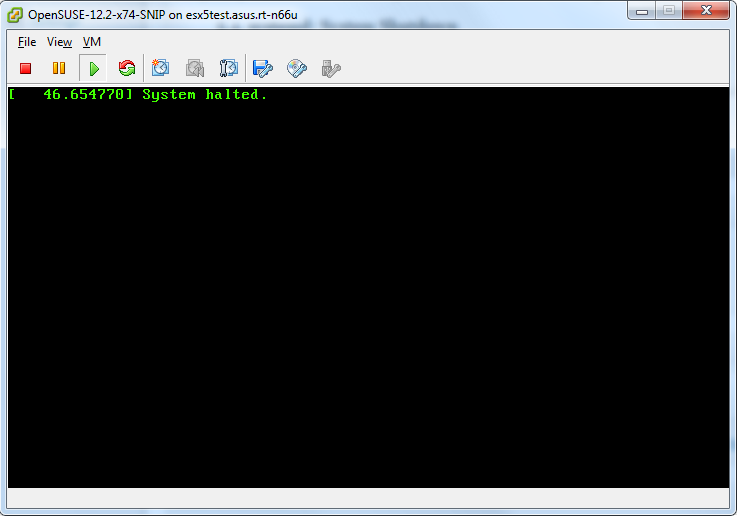
 Just noticed that in openSUSE 12.x, A plain halt will not shutdown the system properly.
On my system, it would leave the screen as shown on the right:
Only halt -p works, none of the other hints in the shutdown does not power off thread work, nor the acpi=off or acpi=oldboot settings.
The odd thing: a plain reboot still works properly.
If someone knows a better workaround: please let me know in the comments.
I hope they will fix this in a future openSUSE version; at least for 12.1 they have a “CHECKIT” marker in the documentation, but it has disappeared as of the 2.3 docs, but still fails:
5.4. systemd: System Shutdown
CHECKIT for 12.3. Is this entry still required?
To halt and poweroff the system when using systemd, issue halt -p or shutdown -h now on the command-line or use the shutdown button provided by your desktop environment.
Note: A plain halt will not shutdown the system properly.
Luckily, my openSUSE is a VM, which I can reboot from the ESXi host.
On a physical system, you will end up without any option to resurrect the system.
Later
After installing antivir, a plain halt works sort of: it says it is halted, but ESXi still thinks it is not:

After installing antivir, a plain halt appears to work, but it doesn’t.

ESXi is sure the system didn’t actually power down.
–jeroen
Posted in *nix, Linux, openSuSE, Power User, SuSE Linux | Tagged: acpi, computer, desktop environment, documentation, odd, openSUSE, reboot, shutdown button, software, SUSE, system shutdown, technology, thread work, vm | 4 Comments »
Posted by jpluimers on 2012/12/17
Interesting: namebench – Open-source DNS Benchmark Utility – Google Project Hosting.
It runs on Mac, Windows and Linux, comes with a GUI and a console version.
–jeroen
Posted in *nix, Apple, Mac OS X / OS X / MacOS, Mac OS X 10.4 Tiger, Mac OS X 10.5 Leopard, Mac OS X 10.6 Snow Leopard, Mac OS X 10.7 Lion, Power User, Windows, Windows 7, Windows 8, Windows Server 2000, Windows Server 2003, Windows Server 2003 R2, Windows Server 2008, Windows Server 2008 R2, Windows Vista, Windows XP | Leave a Comment »
Posted by jpluimers on 2012/12/14
A few links to Linux/Unix like commands available on Android devices:
Too bad the Android AVD is limited in that it does not allow you to use the Play Store. Without the Play Store, it is hard to install software, lucikly there is a downloadable version of this decent Android shell Terminal Emulator.
Not sure if you want to root the AVD in the way mentioned here.
–jeroen
via:
Posted in *nix, Android Devices, Power User | Leave a Comment »
Posted by jpluimers on 2012/12/11
Penetration testing is an important aspect of measuring how secure your network and computing systems are.
Both the German edition of iX magazine and the Dutch edition of c’t magazine had a series of articles (for instance this one) by Frank Neugebauer on penetration testing with Metasploit and the Armitage UI shell around it.
Just found out that Frank wrote a great book on Penetration testing mit Metasploit.
–jeroen
Posted in *nix, Power User, Windows | Leave a Comment »
Posted by jpluimers on 2012/09/29
If I read Inappropriate Use of Adobe Code Signing Certificate my conclusion is that anything signed by the Adobe Code Signing Certificate since 2012-07-10 potentially can be malware.
As a precaution, I will manually revoke the certificate on all my systems (that’ll take a while!). If anyone knows how to automate that process, please post a comment showing how to.
Hitching on a trusted certificate of a big software company comes close to the ultimate hack: trojaning signed malware in the distribution of an OS vendor.
–jeroen
via: Inappropriate Use of Adobe Code Signing Certificate « Adobe Secure Software Engineering Team (ASSET) Blog.
Posted in *nix, Adobe, Android Devices, Apple, HTC, HTC Sensation, iOS, iPad, iPhone, iPod, iPod touch, Linux, Mac, Mac OS X / OS X / MacOS, Mac OS X 10.4 Tiger, Mac OS X 10.5 Leopard, Mac OS X 10.6 Snow Leopard, Mac OS X 10.7 Lion, Opinions, OS X 10.8 Mountain Lion, Power User, Windows, Windows 7, Windows 8, Windows Server 2000, Windows Server 2003, Windows Server 2003 R2, Windows Server 2008, Windows Server 2008 R2, Windows Vista, Windows XP | Tagged: adobe software, conclusion, engineering team, precaution, secure software, software, software company, software engineering, technology, ultimate hack | Leave a Comment »
Posted by jpluimers on 2012/08/31
On monday, I wrote it was Time to disable Java for a while: Zero-Day Season is Not Over Yet.
Today Oracle released a fix, which you should either install immediately (that is NOW, don’t hesitate!).
For this vulnerability, it is enough to disable Java from your browser – see: How to disable Java in your web browser – but as with any software: if you don’t need it, just disable/uninstall it.
Disabling/uninstalling on a Mac may impose a problem, as Apple hasn’t come with an update for the OS X editions that came with Java pre-installed.
Most other users can either install the version on their current system on-line from Download Free Java Software, or download offline installers for other systems at Java Downloads for All Operating Systems.
I might actually try the Java Unattended Silent Installer and Updater from Ninite – Install or Update Multiple Apps at Once.
–jeroen
via:
Posted in *nix, Apple, LifeHacker, Mac, Mac OS X / OS X / MacOS, Mac OS X 10.4 Tiger, Mac OS X 10.5 Leopard, Mac OS X 10.6 Snow Leopard, Mac OS X 10.7 Lion, MacBook, MacBook-Air, MacBook-Pro, Power User, Windows, Windows 7, Windows 8, Windows Server 2000, Windows Server 2003, Windows Server 2003 R2, Windows Server 2008, Windows Server 2008 R2, Windows Vista, Windows XP | Leave a Comment »



 The Wiert Corner - irregular stream of stuff