[WayBack] Use the System File Checker tool to repair missing or corrupted system files:
Archive for the ‘Windows 7’ Category
Use the System File Checker tool to repair missing or corrupted system files
Posted by jpluimers on 2021/09/30
Posted in Development, Power User, Software Development, Windows, Windows 10, Windows 7, Windows 8, Windows 8.1, Windows Development | Leave a Comment »
Digging Through Event Log Hell (finding user logon & logoff) – Ars Technica OpenForum
Posted by jpluimers on 2021/08/31
This helped me big time finding failed logon attempts: [WayBack] Event Log Hell (finding user logon & logoff) – Ars Technica OpenForum
Alternatively, you can use the XPath query mechanism included in the Windows 7 event viewer. In the event viewer, select “Filter Current Log…”, choose the XML tab, tick “Edit query manually”, then copy the following to the textbox:
Code:<QueryList>
<Query Id="0" Path="Security">
<Select Path="Security">*[System[EventID=4624] and EventData[Data[@Name='TargetUserName'] = 'USERNAME']]</Select>
</Query>
</QueryList>This selects all events from the Security log with EventID 4624 where the EventData contains a Data node with a Name value of TargetUserName that is equal to USERNAME. Remember to replace USERNAME with the name of the user you’re looking for.
If you need to be even more specific, you can use additional XPath querying – have a look at the detail view of an event and select the XML view to see the data that you are querying into.
Thanks user Hamstro!
Notes:
- you need to perform this using
eventvwr.exerunning as an elevated process using an Administrative user CUA token. USERNAMEneeds to be the name of the user in UPPERCASE.- replacing
TargetUserNamewithsubjectUsername(as suggested by [WayBack] How to Filter Event Logs by Username in Windows 2008 and higher | Windows OS Hub) fails. - there are more relevant EventID values you might want to filter on (all links have screenshot and XML example of an event):
- [WayBack]
4624(S) An account was successfully logged on. (Windows 10) | Microsoft Docs - [WayBack]
4625(F) An account failed to log on. (Windows 10) | Microsoft Docs - [WayBack]
4626(S) User claims information./Device claims information. (Windows 10) | Microsoft Docs - [WayBack]
4634(S) An account was logged off. (Windows 10) | Microsoft Docs - [WayBack] 4647(S) User initiated logoff. (Windows 10) | Microsoft Docs
- [WayBack] 4648(S) A logon was attempted using explicit credentials. (Windows 10) | Microsoft Docs
- [WayBack]
4797(An attempt was made to query the existence of a blank password for an account) At the time of writing, it was undocumented, but it seems to be part of an account checking process as per [WayBack] Windows 8 Event ID 4797 in Security Log:
That means that an application or service makes an attempt to query the accounts which have blank password. I think some security software may make such request.
- [WayBack]
- blank (empty passwords) can only be used for local logon, so they disable network logon. That can be a useful security strategy.
Related:
- [WayBack] How to search the Windows Event Log for logins by username
- [WayBack] Active Directory – How to Find Failed Logon Requests – geekmungus
- [WayBack] Audit Failure – Suspicious Activity On A Server – IT Security – Spiceworks
–jeroen
Posted in Development, Microsoft Surface on Windows 7, Power User, Software Development, Windows, Windows 10, Windows 7, Windows 8, Windows 8.1, Windows 9, Windows Vista, Windows XP, XML/XSD | Leave a Comment »
The Windows key has no Unicode equivalent, so use ⊞ like Wikipedia and many others do
Posted by jpluimers on 2021/08/23
lFor Mac keyboard keys, almost all (except the old solid and open Apple logo’s) have a Unicode code point, see for instance the modifier keys from the [WayBack] List of Mac/Apple keyboard symbols · GitHub (the “Alt” column has a solid Apple logo in the bottom right; on non-Mac systems it will look differently as it is in the Unicode private range: [WayBack] Unicode Character ” (U+F8FF): ‘<Private Use, Last>’):
Sym Key Alt ⌃ Control ⌥ Option ⇧ Shift ⌘ Command
These are the code points for the “Sym” column:
- ⌃ – [WayBack] Unicode Character ‘UP ARROWHEAD’ (U+2303) (less wide than the below three)
- ⌥ – [WayBack] Unicode Character ‘OPTION KEY’ (U+2325)
- ⇧ – [WayBack] Unicode Character ‘UPWARDS WHITE ARROW’ (U+21E7)
- ⌘ – [WayBack] Unicode Character ‘PLACE OF INTEREST SIGN’ (U+2318)
Keys on many platforms
Posted in Microsoft Surface on Windows 7, Power User, Windows, Windows 10, Windows 7, Windows 8, Windows 8.1, Windows 95, Windows 98, Windows NT, Windows Server 2000, Windows Server 2003, Windows Server 2003 R2, Windows Server 2008, Windows Server 2008 R2, Windows Server 2012, Windows Server 2012 R2, Windows Server 2016, Windows Vista, Windows XP | 1 Comment »
The continued Windows PrintNightmare saga: no more printer Plug&Play for end-users on Windows
Posted by jpluimers on 2021/08/12
It was fun while it lasted, and puts other operating systems at an advantage.
[Wayback] Jeroen Wiert Pluimers on Twitter: “Bye bye printer Plug & Play on Windows for end-users: … Though MacOS has its share of printer driving issues (like only printing monochrome to colour printers), this is a serious step back on Windows compared to MacOS.”
More on the MacOS printer woes in a later blog post.
Web related:
- [Wayback] More PrintNightmare: “We TOLD you not to turn the Print Spooler back on!” – Naked Security
- [Wayback] Microsoft responds to PrintNightmare by making life that little bit harder for admins • The Register:
Have they forgotten SysAdmin Appreciation Day so soon?
- [Wayback] Point and Print Default Behavior Change – Microsoft Security Response Center
Today, we are addressing this risk by changing the default Point and Print driver installation and update behavior to require administrator privileges. The installation of this update with default settings will mitigate the publicly documented vulnerabilities in the Windows Print Spooler service. This change will take effect with the installation of the security updates released on August 10, 2021 for all supported versions of Windows, and is documented as CVE-2021-34481.
- [Wayback] KB5005652—Manage new Point and Print default driver installation behavior (CVE-2021-34481)
- [Archive.is] Security Update Guide – CVE-2021-36958
- [Wayback] Microsoft Warns: Another Unpatched PrintNightmare Zero-Day | Threatpost
Twitter related:
- [Archive.is] 🥝 Benjamin Delpy on Twitter: “Basicaly: – assuming default value is “restrict install to admin” 1 now – more check on remote files install path… “
- [Archive.is] 🥝 Benjamin Delpy on Twitter: “August PatchTuesday #printnightmare… “
- [Archive.is] 🥝 Benjamin Delpy on Twitter: “Want to test #printnightmare (ep 4.x) user-to-system as a service?🥝 (POC only, will write a log file to system32) connect to … with – user: .\gentilguest – password: password Open ‘Kiwi Legit Printer – x64’, then ‘Kiwi Legit Printer – x64 (another one)’… …”
- [Archive.is] Victor Mata on Twitter: “Hey guys, I reported the vulnerability in Dec’20 but haven’t disclosed details at MSRC’s request. It looks like they acknowledged it today due to the recent events with print spooler.… “
- [Archive.is] Will Dormann on Twitter: “For what it’s worth, Microsoft has just notified me that they published … for this issue. That is, the execution of code specified in “CopyFiles” directives of shared printers (VU#131152) is (per Microsoft’s confirmation to me): CVE-2021-36958… …”
–jeroen
Posted in Hardware, Power User, Printer drivers, Printers, Windows, Windows 10, Windows 7, Windows 8, Windows 8.1 | Leave a Comment »
How to turn on automatic logon in Windows
Posted by jpluimers on 2021/08/09
[WayBack] How to turn on automatic logon in Windows
Describes how to turn on the automatic logon feature in Windows by editing the registry.
Most archivals of the above post fail with a 404-error after briefly flashing the content, but this particular one usually succeeds displaying.
It is slightly different from the one referenced in my blog post automatic logon in Windows 2003, and because of the archival issues, I have quoted most of it below.
A few observations, at least in Windows 10 and 8.1:
- Major Windows 10 upgrades will disable the autologon: after each major upgrade, you have to re-apply the registry patches.
- If the user has a blank password, you can remove the DefaultPassword value.
- Empty passwords allow local logon (no network logon or remote desktop logon), no network access and no RunAs, which can actually help improve security. More on that in a later blog post
- For a local machine logon, you do not need the DefaultDomainName value either (despite many posts insisting you need them), but you can technically set it to the computer name using
reg add "HKEY_LOCAL_MACHINE\Software\Microsoft\Windows NT\CurrentVersion\Winlogon" /v DefaultDomainName /t REG_SZ /d %ComputerName% /f - If another user logs on and off, the values keep preserved, so after a reboot, the correct user automatically logs on
- you need a full reboot cycle for this to take effect
- The AutoLogon tool does not allow blank passwords
I wrote a batch file enable-autologon-for-user-parameter.bat that makes it easier:
if [%1] == [] goto :help :enable reg add "HKEY_LOCAL_MACHINE\SOFTWARE\Microsoft\Windows NT\CurrentVersion\Winlogon" /v AutoAdminLogon /t REG_SZ /d 1 /f :setUserName reg add "HKEY_LOCAL_MACHINE\SOFTWARE\Microsoft\Windows NT\CurrentVersion\Winlogon" /v DefaultUserName /t REG_SZ /d %1 /f :removePasswordIfItExists reg delete "HKEY_LOCAL_MACHINE\SOFTWARE\Microsoft\Windows NT\CurrentVersion\Winlogon" /v DefaultPassword /f if [%2] == [] goto :eof :setPassword reg add "HKEY_LOCAL_MACHINE\SOFTWARE\Microsoft\Windows NT\CurrentVersion\Winlogon" /v DefaultPassword /t REG_SZ /d %2 /f goto :eof :help echo Syntax: echo %0 username password
The article quote:
Posted in Batch-Files, Development, Microsoft Surface on Windows 7, Power User, Scripting, Software Development, Windows, Windows 10, Windows 7, Windows 8, Windows 8.1, Windows 9, Windows Server 2003, Windows Server 2003 R2, Windows Server 2008, Windows Server 2008 R2, Windows Server 2012, Windows Server 2012 R2, Windows Server 2016, Windows Vista, Windows XP | Leave a Comment »
Custom Resolution Utility (CRU)
Posted by jpluimers on 2021/07/16
This tool can help resetting monitor/display configurations for when your machines gets out of suspend/sleep/shutdown mode and resets the displays to wrong defaults (especially wrong scaling).
Documentation and download: [WayBack] Custom Resolution Utility (CRU)
Custom Resolution Utility (CRU) allows custom resolutions to be defined for both AMD/ATI and NVIDIA GPUs by creating EDID overrides directly in the registry without dealing with .inf files. Download:
Note the requirements:
- Windows Vista or later (Windows XP does not support EDID overrides)
- AMD/ATI or NVIDIA GPU with appropriate driver installed (Microsoft Basic Display Adapter driver does not support EDID overrides)
- Some Intel GPUs and laptops with switchable graphics are supported with one of these drivers:
- 6th/7th generation (Skylake/Kaby Lake): Intel Graphics Driver for Windows [15.45]
- 4th/5th generation (Haswell/Broadwell): Intel Graphics Driver for Windows [15.40]
- 4th generation (Haswell) for Windows 7/8.1: Intel Graphics Driver for Windows 7/8.1 [15.36]
Old version at [WayBack] GitHub – radamar/Custom-Resolution-Utility-ToastyX: Custom Resolution Utility for Windows by ToastyX, duplicated so the source won’t be lost..
Short instructions (but be sure to read the long ones above as well) slightly rephrased for readability:
- For each monitor
- Disable all of the default “Established Resolutions”
- Delete all of the default “Detailed Resolutions”
- Delete all of the default “Standard Resolutions”
- Add a new “Detailed Resolution”
- Under new “Detailed Resolution” I left all of the settings the same except for the active horizontal and vertical pixel dimensions, which is obviously where you set your desired screen resolution.
- Once all monitors are configured properly, close CRU and run the restart.exe or restart64.exe included with CRU and you should be good to go!
Posted in Power User, Windows, Windows 10, Windows 7, Windows 8, Windows 8.1, Windows Vista | Leave a Comment »
VMware VMRC: connect to a remote console without the vSphere Client
Posted by jpluimers on 2021/06/21
Interesting tool: https://www.vmware.com/go/download-vmrc.
Back when scheduling this post in 2019, this was the most recent version: [WayBack] Download VMware vSphere: Download VMware Remote Console 10.0.4
- WayBack: VMware Remote Console 10.0.4 for Windows (zip)
- WayBack: VMware Remote Console 10.0.4 for Mac (dmg)
- WayBack: VMware Remote Console 10.0.4 for Linux (bundle)
From [WayBack] ovf – How to connect ESXi vm console from ESXi host console – Stack Overflow:
Example of vmrc.exe command :
"C:\Program Files (x86)\VMware\VMware Remote Console\vmrc.exe" vmrc://<ESXi host username>@<ESXi host IP>/?moid=<VM ID>
Basically it uses the vmrc scheme to start a connection to the remote screen for a specific MoRef ID. On ESXi, this is actually the VM ID that you get from vim-cmd vmsvc/getallvms. In that sense this is very similar to getting a single screenshot for the VM from the ESXi host by using the https://%5BHOST%5D:%5BPORT%5D/?id=%5BVM-MOREF%5D like described in ESXi and VMware Workstation: quick way of getting Console screenshots in PNG format; some URLs on your ESXi machine.
In MacOS, starting VMware Remote Console is slightly different as you have to start it through a URI using using the vmrc scheme from either a browser or with the open command on the console.
The reason is that there is no vmrc binary on MacOS.
- [WayBack] Using VMware’s Standalone Remote Console for OS X with free ESXi | Der Flounder:
vmrc://@[HOST]:[PORT]/?moid=[VM-MOREF]- HOST = the hostname or IP address of the ESXi server
- PORT = the HTTPS port of the ESXi server, which is usually 443
…
open 'vmrc://@server_name_here:port_number_here/?moid=vmid_number_here'
- [WayBack] Standalone VMRC now available for Mac OS X:
just provide the following URI which will prompt for your ESXi credentials
vmrc://@[HOST]:[PORT]/?moid=[VM-MOREF]Once you have generated the VMRC URI, you MUST launch it through a web browser as that is how it is passed directly to the Standalone VMRC application. In my opinion, this is not ideal especially for customers who wish to automatically generate this as part of a VM provisioning workflow to their end users and not having to require a browser to launch the Standalone VMRC application. If you have some feedback on this, please do leave a comment.
In the mean time, a quick workaround is to use the “open” command on Mac OS X along with the VMRC URI which will automatically load it into your default browser and launch the Standalone VMRC application for you.
open 'vmrc://@192.168.1.60:443/?moid=vm-18'
On one of my test systems, for VMID 3 (see below), this comes down to this:
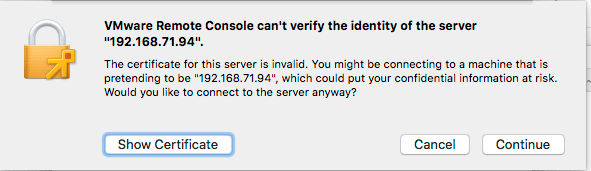
open 'vmrc://@192.168.71.94:443/?moid=3'
Note you have to accept the ESXi self generated TLS certificate once on MacOS:
After this, these processes were started (note there is no vmrc like on Windows):
± ps -ax | grep -i "\(vmware\|vmrc\)"
65239 ?? 0:04.15 /Applications/VMware Remote Console.app/Contents/MacOS/VMware Remote Console
65343 ?? 0:00.01 /Applications/VMware Remote Console.app/Contents/Library/services/VMRC Services 3 4
65360 ?? 0:00.16 /Applications/VMware Remote Console.app/Contents/Library/vmware-usbarbitrator
65363 ?? 0:00.01 /Applications/VMware Remote Console.app/Contents/Library/services/VMware USB Arbitrator Service 3 4
65393 ?? 0:01.29 /Applications/VMware Remote Console.app/Contents/Library/vmware-remotemks -@ vmdbPipeHandle=42; vm=_7FD2A461E8E0_3; gui=true -H 44 -R -P 2 -# product=256;name=VMware Remote Console;version=10.0.1;buildnumber=5898794;licensename=VMware Remote Console;licenseversion=10.0; -s libdir=/dev/null/Non-existing DEFAULT_LIBDIRECTORY
65872 ttys001 0:00.00 grep -i \(vmware\|vmrc\)
VM IDs (or VM-MOREFs)
You get the VM IDs using the vim-cmd vmsvc/getallvms command; they appear in the left column:
[root@ESXi-X9SRI-3F:/] vim-cmd vmsvc/getallvms Vmid Name File Guest OS Version Annotation 1 Lampje [EVO860_250GB] Lampje/Lampje.vmx opensuse64Guest vmx-14 3 X9SRI-3F-W10P-NL [EVO860_250GB] X9SRI-3F-W10P-NL/X9SRI-3F-W10P-NL.vmx windows9_64Guest vmx-14
Note that in practice, this is much harder so I wrote a script for that which you can find in VMware ESXi console: viewing all VMs, suspending and waking them up: part 1.
bundle files
I did not know about bundle files, but they seem to be sh scripts that precede a binary: [WayBack] What is a .bundle file and how do I run it? – Super User.
Inspecting such a files, shows it starts with this code:
#!/usr/bin/env bash # # VMware Installer Launcher # # This is the executable stub to check if the VMware Installer Service # is installed and if so, launch it. If it is not installed, the # attached payload is extracted, the VMIS is installed, and the VMIS # is launched to install the bundle as normal. # Architecture this bundle was built for (x86 or x64) ARCH=x64 if [ -z "$BASH" ]; then # $- expands to the current options so things like -x get passed through if [ ! -z "$-" ]; then opts="-$-" fi # dash flips out of $opts is quoted, so don't. exec /usr/bin/env bash $opts "$0" "$@" echo "Unable to restart with bash shell" exit 1 fi
–jeroen
Posted in Apple, ESXi6, ESXi6.5, ESXi6.7, Mac OS X / OS X / MacOS, macOS 10.12 Sierra, macOS 10.13 High Sierra, Power User, Virtualization, VMware, VMware ESXi, Windows, Windows 10, Windows 7, Windows 8, Windows 8.1 | Leave a Comment »
Error 0x8007232b or 0x8007007B occurs when you try to activate Windows
Posted by jpluimers on 2021/06/18
Since [WayBack/Archive.is] archival of Error 0x8007232b or 0x8007007B occurs when you try to activate Windows fails (the first indicates cookies need to be enabled, the second archives a page without support content), and the Google cached URL returns a 404, here is the full content:
Error 0x8007232b or 0x8007007B occurs when you try to activate Windows
Home users: This article is intended for use by support agents and IT professionals. If you’re looking for more information about Windows 10 activation error messages, see the following Windows website:
Symptoms
When you try to activate a Windows installation (client or server), you receive one or more error messages that resembles the following.
Error message 1
Activation Error: Code 0x8007232b
DNS Name does not existError message 2
Windows could not be activated.
Key management services (KMS) host could not be located in domain name system (DNS), please have your system administrator verify that a KMS is published correctly in DNS.Error: 0x8007232b
Description: DNS name does not exist.Error message 3
Error: 0x8007007B
The file name, directory name, or volume label syntax is incorrectResolution
To resolve this problem, use one or more of the following methods, as appropriate for your situation.
Method 1: Change the product key to an MAK
If KMS activation will not be used, and if there is no KMS server, the product key should be changed to an MAK. For Microsoft Developer Network (MSDN), or for TechNet, the stock-keeping units (SKUs) that are listed below the media are generally volume licensed-media, and the product key that’s provided is an MAK key.
To change the product key to an MAK, follow these steps:
- Open an elevated command prompt. To do this, use one of the following methods, as appropriate for your OS.
- At the command prompt, type the following command, and then press Enter:
slmgr -ipk xxxxx-xxxxx-xxxxx-xxxxx-xxxxxNote The xxxxx-xxxxx-xxxxx-xxxxx-xxxxx placeholder represents your MAK product key.
Method 2: Configure a KMS host server for the clients to activate against
KMS activation requires that a KMS host server be configured for the clients to activate against. If there are no KMS host servers configured in your environment, install and activate one by using an appropriate KMS host server key. After you configure a computer on the network to host the KMS software, publish the Domain Name System (DNS) settings. For information about the KMS host server configuration process, see Set up a KMS host on a Windows Server 2008 R2 machine.
For more information about how to set up a KMS server and how to publish the DNS settings, go to the following Microsoft websites:
- Install a KMS host on a Windows Vista-based or Windows Server 2008-based computer
- Install KMS Hosts
- Deploy KMS Activation
- Volume activation in Windows Vista or Windows Server 2008, see the Volume Activation 2.0 Technical Guidance
- Planning for Volume Activation in Windows 7 or Windows Server 2008 R2
Method 3: Manually create a KMS SRV record in a Microsoft DNS server
If your network has a KMS host computer set up, and if the client cannot locate a KMS host on the network for activation, follow these steps:
- Verify that the computer that has the KMS host installed and is activated by using a KMS key that’s registered in DNS. To do this, follow these steps:
- Open an elevated command prompt.Windows 7 or Windows Vista (Windows Server 2003)
Select Start > All Programs > Accessories, right-click Command Prompt, and then select Run as administrator. If you are prompted for an administrator password or for confirmation, type the password or provide confirmation.
Windows 8.1 and Windows 10 (Windows Server 2012, Windows Server 2012 R2)
Press Windows logo key+X, and then select Command Prompt(Admin), or right-click the Start button, and then select Command Prompt(Admin). If you are prompted for an administrator password or for confirmation, type the password or provide confirmation.
- At the command prompt, type the following command, and then press Enter:
nslookup -type=all _vlmcs._tcp>kms.txt- Open the KMS.txt file that’s generated by the command. This file should contain one or more entries that resemble the following entry:
_vlmcs._tcp.contoso.com SRV service location: priority = 0 weight = 0 port = 1688 svr hostname = kms-server.contoso.com- If these “_vlmcs” entries are present, and if they contain the expected KMS host names, go to Method 4.
- Check the registry to determine whether the KMS host server is registering with DNS. By default, a KMS host server dynamically registers a DNS SRV record one time every 24 hours. To check this setting, follow these steps:
- Start Registry Editor.Windows 7 or Windows Vista
Click Start, type regedit, and then press Enter.
Windows 8.1 and Windows 10
Right-click Start, select Run, type regedit, and then press Enter.
- Locate and then click the following subkey:HKEY_LOCAL_MACHINE\SOFTWARE\Microsoft\Windows NT\CurrentVersion\SLIf the DisableDnsPublishing subkey is present and has a value of 1, the KMS service does not register in DNS.
a If the DisableDnsPublishing subkey is missing, create a new DWORD value named DisableDnsPublishing. If dynamic registration is acceptable, change the subkey value to 0. To do this, right-click DisableDnsPublishing, click Modify, type 0 in the Value data box, and then click OK.
Note By default, this registry key has an undefined value that results in the dynamic registration every 24 hours.
If the DNS Server service does not support dynamic updates, or if dynamic updates are not occurring, the “VLMCS._TCP, SRV” record can be manually registered.
To manually create a KMS SRV record in a Microsoft DNS server, follow these steps:
- On the DNS server, open DNS Manager. To open DNS Manager, click Start, click Administrative Tools, and then click DNS.
- Click the DNS server where you have to create the SRV resource record.
- In the console tree, expand Forward Lookup Zones, right-click the domain, and then click Other New Records.
- Scroll down the list, click Service Location (SRV), and then click Create Record.
- Type the following information:
Service: _VLMCS
Protocol: _TCP
Port number: 1688
Host offering the service: <FQDN_of_KMS_Host>
- When you are finished, click OK, and then click Done.
To manually create SRV records in a BIND 9.x Compliant DNS server include the following information when you create the record.
Note If your organization uses a non-Microsoft DNS server, you can create the required SRV records as long as the DNS server is BIND 9.x compliant.
- Name=_vlmcs._TCP
- Type=SRV
- Priority = 0
- Weight = 0
- Port = 1688
- Hostname = <FQDN or A-Name of the KMS host>
Note The Priority and Weight fields are not used by KMS and are ignored by the KMS client. However, they must be included in the zone file.
To configure a BIND 9.x DNS server to support KMS auto-publishing, configure the BIND server to enable resource record updates from KMS hosts. For example, add the following line to the zone definition in Named.conf or in Named.conf.local:
allow-update { any; };Method 4: Manually assign a KMS server
By default, the KMS clients use the automatic discovery feature and query DNS for a list of servers that have published the _VLMCS record within the membership zone of the client. DNS returns the list of KMS hosts in a random order. The client picks a KMS host and tries to establish a session on it. If this attempt works, the client caches the server and tries to use it for the next renewal attempt. If the session setup fails, the client picks another server randomly. We highly recommend that you use the automatic discovery feature. However, you can manually assign a KMS server. To do this, open an elevated command prompt on the KMS client.
- Open an elevated command prompt.Windows 7 or Vista (Windows Server 2003)
Click Start, type cmd in the Start Search box, right-click cmd.exe in the results list, and then click Run as administrator. If you are prompted for an administrator password or for confirmation, type the password or provide confirmation.
Windows 10 and Windows 8.1 (Windows Server 2012 R2, Windows Server 2012)
Press the Windows logo key+X, and then select Command Prompt(Admin), or right-click Start, and then select Command Prompt(Admin). If you are prompted for an administrator password or for confirmation, type the password or provide confirmation.
- Use the following commands at an elevated command prompt:
- To assign a KMS host by using the FQDN of the host, type the following command:
cscript \windows\system32\slmgr.vbs -skms <KMS_FQDN>:<port>- To assign a KMS host by using the version 4 IP address of the host, type the following command:
cscript \windows\system32\slmgr.vbs -skms <IPv4Address><:port>- To assign a KMS host by using the version 6 IP address of the host, type the following command:
cscript \windows\system32\slmgr.vbs -skms <IPv6Address><:port>- To assign a KMS host by using the NETBIOS name of the host, type the following command:
cscript \windows\system32\slmgr.vbs -skms <NetbiosName><:port>- To revert to automatic discovery on a KMS client, type the following command:
cscript \windows\system32\slmgr.vbs –ckmsMethod 5: Automatically publish KMS in multiple DNS domains
If the previous methods have not resolved this problem, the problem may be related to the ability of the client to resolve the DNS name of the KMS server or to connect to the KMS server. If this is the problem, follow these steps:
Note Unless otherwsie stated, do the following steps on a KMS client that has experienced the error that is mentioned in the “Symptoms” section:
- At a command prompt, type the following command, and then press Enter:
IPCONFIG /all- From the command results, note the assigned IP address, the DNS server address, and the default gateway address.
- Verify basic IP connectivity to the DNS server by using the ping command. To do this, run the following command.
ping <DNS_Server_IP_address>Note If this command does not ping the server, this problem must be resolved first.
For more information about how to troubleshoot TCP/IP issues if you cannot ping the DNS server, see the Microsoft TechNet topic Troubleshooting TCP/IP.
- Verify that the search list of the primary DNS suffix contains the DNS domain suffix that the KMS host registered.For the computers that have joined the domain, the DNS automatic discovery of KMS requires that the DNS zone contains the SRV resource record for the KMS host. This DNS zone is the DNS zone that corresponds to either the primary DNS suffix of the computer or to the domain of the Active Directory DNS.
For workgroup computers, the DNS automatic discovery of KMS requires that the DNS zone contains the SRV resource record for the KMS host. This DNS zone is the DNS zone that corresponds to either the primary DNS suffix of the computer or to the DNS domain name that is assigned by the Dynamic Host Configuration Protocol (DHCP). This domain name is defined by the option that has the code value of 15 as defined in Request for Comments (RFC) 2132.
- Verify that the KMS host SRV records are registered in DNS. At an elevated command prompt, type the following command, and then press Enter:
nslookup -type=all _vlmcs._tcp>kms.txt- Open the Kms.txt file that was generated by this command. This file should contain one or more entries that resemble the following:
_vlmcs._tcp.contoso.com SRV service location: priority = 0 weight = 0 port = 1688 svr hostname = kms-server.contoso.comVerify the IP address, host name, and port of the KMS host.
Note If the nslookup command finds the KMS host, it does not mean that the DNS client can find the KMS host. If the nslookup command finds the KMS host, and if you still cannot activate the KMS host server, check the other settings, such as the primary DNS suffix and the search list of the DNS suffix.
The SRV records are registered in the DNS zone that corresponds to the KMS host domain membership. For example, assume that a KMS host joins the contoso.com domain. In this scenario, the KMS host registers its VLMCS._TCP SRV record under the contoso.com DNS zone. Therefore, the VLMCS._TCP.CONTOSO.COM record is created.
If the clients are configured to use a different DNS zone, automatically publish KMS in multiple DNS domains. To do this, follow these steps:
- Log on to a KMS host.
- Open an elevated command prompt.Windows 7 or Vista (Windows Server 2003)
Select Start, type cmd in the Start Search box, right-click cmd.exe in the results list, and then select Run as administrator. If you are prompted for an administrator password or for confirmation, type the password or provide confirmation.
Windows 8.1 and Windows 10 (Windows Server 2012, Windows Server 2012 R2)
Press the Windows logo key+X, and then select Command Prompt(Admin), or right-click Start, and then select Command Prompt(Admin). If you are prompted for an administrator password or for confirmation, type the password or provide confirmation.
- At the command prompt, type regedit.exe, and then press Enter.
- Locate and then click the following registry subkey:HKEY_LOCAL_MACHINE\SOFTWARE\Microsoft\Windows NT\CurrentVersion\SL
- In the navigation pane, select SL.
- Right-click a blank area in the details pane, point to New, and then select Multi-String Value.
- Type DnsDomainPublishList as the name for the new value, and then press Enter.
- Right-click the new DnsDomainPublishList value, and then select Modify.
- In the Edit Multi-String dialog box, type each DNS domain suffix that is published by KMS on a separate line, and then select OK.
- In the Edit Multi-String dialog box, type each DNS domain suffix that is published by KMS on a separate line, and then select OK.Note For Windows 7 and for Windows Server 2008 R2, the format for DnsDomainPublishListdiffers.
For more information, see the Volume Activation Technical Reference Guide.
- Restart the Software Licensing service by using the Service administrative tool. This operation creates the SRV records.
- Verify that the host name that is returned in the last step can be resolved by using a typical method on the KMS client. When the name is resolved, also verify that the IP address that is returned is accurate. If either of these verifications fails, investigate this DNS client resolver issue.
- To use the KMS automatic discovery feature, run the following command at an elevated command prompt to clear any previously cached KMS host names:
cscript C:\Windows\System32\slmgr.vbs –ckms- If you believe that you have an SRV record issue, you can troubleshoot it by using one of the commands that are documented in “Method 4” to statically specify a KMS host. The following commands can be used to determine whether this is a name resolution issue or an SRV record issue. If none of these commands resolves the problem, you may be encountering a blocked port or an inaccessible host (see the “More Information” section).Run the following commands:
cscript \windows\system32\slmgr.vbs -skms <KMS_FQDN>:<port> cscript \windows\system32\slmgr.vbs –atoIf these commands resolve the problem, this is an SRV record issue. To fix it, you must troubleshoot the SRV record.
If these commands do not resolve the problem, run the following commands:
cscript \windows\system32\slmgr.vbs -skms <IP Address>:<port> cscript \windows\system32\slmgr.vbs –atoIf these commands resolve the problem, this is most likely a name resolution issue.
The 1688 TCP port is used for the activation communication between the KMS client and the KMS host. If the communication seems to be blocked, check the firewall configurations or anything else that may block the 1688 TCP port.
More Information
This problem may occur if one or more of the following conditions are true:
- You use volume-licensed media with a Volume License generic product key to install one of the following operating systems:
- Windows Server 2012 R2
- Windows Server 2012
- Windows Server 2008 R2
- Windows Server 2008
- Windows 10
- Windows 8.1
- Windows 8
- Windows 7
- Windows Vista Enterprise
- Windows Vista Business
- The activation wizard cannot connect to a Key Management Service (KMS) host computer.
When you try to activate the system, the activation wizard uses DNS to locate a corresponding computer that’s running the KMS software. If the wizard queries DNS and does not find the DNS entry for the KMS host computer, the wizard reports an error. If you have a KMS host computer set up, the correct DNS entries are not seen by the client computer. If you do not have a KMS host computer set up, you must either set up a KMS host computer or switch to an MAK product key method to activate your volume license installation.
Microsoft Developer Network (MSDN) and Microsoft TechNet provide volume-licensed media for the following operating system stock-keeping units (SKUs):
- Windows Server 2012 R2
- Windows Server 2012
- Windows Server 2008 R2
- Windows Server 2008
- Windows 10 Enterprise
- Windows 8.1 Enterprise
- Windows 8 Enterprise
- Windows 7 Enterprise
- Windows Vista Enterprise
The volume-licensed media does not prompt you for a product key during installation. If you do not change the product key to the MSDN key, you receive an error message when you try to activate the operating system. If you use MSDN or TechNet media, you must change the product key to the MSDN product key. Use the “Method 1” procedure in the “Resolution” section to change the product key.
Note The MSDN or TechNet product key is the MAK product key.
References
For more information about Volume Activation, see the following Microsoft Knowledge Base article:
929712 Volume Activation information for Windows Vista, Windows Server 2008, Windows Server 2008 R2 and Windows 7For more information about volume licensing, go to the Microsoft Volume Licensing website.
For more information about how to activate copies of Windows Vista or Windows Server 2008 that were installed by using volume-licensed media, go to the Product Activation and Key Informationwebpage.
–jeroen
Posted in Microsoft Surface on Windows 7, Power User, Windows, Windows 10, Windows 7, Windows 8, Windows 8.1, Windows Server 2008, Windows Server 2008 R2, Windows Server 2012, Windows Server 2012 R2, Windows Server 2016 | Leave a Comment »
Still relevant for current Windows versions: hard drive – defrag /x – consolidate free space not really working – Windows Server 2012 – Server Fault
Posted by jpluimers on 2021/06/11
From my answer at [WayBack] hard drive – defrag /x – consolidate free space not really working – Windows Server 2012 – Server Fault
I’ve tried many tools, starting with
defrag C: /X(which tries, but doesn’t give good results) and found out these steps give the best results:
- Perform an Ultradefrag full optimisation
- Perform a MyDefrag
Consolidate free spacescript on the drive.Note that MyDefrag (formerly named JkDefrag) is not maintained any more but the 4.3.1 version in the WayBack machine still works very well as the underlying defragmentation APIs in Windows haven’t changed.
References:
- (WayBack) UltraDefrag – An Open Source Defragmenter
- WayBack: MyDefrag v4.3.1
- (WayBack) MyDefrag – Wikipedia
- (WayBack) Defragmenting Files (Windows)
- (WayBack) The Challenge of Defragmenting an NTFS Partition | Systems Management content from Windows IT Pro
- (WayBack) windows – How do you defragment the MFT on an NTFS disk? – Super User
The original MyDefrag disappeared two times (temporarily in 2014 because the domain expired, then permanently in 2017 because the domain went off-line).
Luckily, the WayBack machine at archive.org has the latest version saved (not all the links from the archive.org search page have an executable as sometimes it shows the expired domain or a non-existing redirect when the domain got off-line):
- https://web.archive.org/web/20150811002116/http://www.mydefrag.com/Downloads/Download.php?File=MyDefrag-v4.3.1.exe
- https://web.archive.org/web/20120517021802/http://www.mydefrag.com/Downloads/Download.php?File=MyDefrag-v4.3.1.exe
- via [WayBack] map –unmap hanging on non-contiguous ISO file · Issue #212 · chenall/grub4dos · GitHub
- which also pointed to the installation documentation: [WayBack: MyDefrag v4.3.1]
Note that chocolatey install --yes mydefrag --version 4.3.11 fails because of the missing download. See [WayBack] Chocolatey Software | MyDefrag 4.3.1.
(The --version parameter trick is from [WayBack] Chocolatey – How to install hidden and unlisted package? – Super User, via [WayBack] “This package is unlisted and hidden from package listings.” – Google Search).
–jeroen
Posted in Power User, Windows, Windows 10, Windows 7, Windows 8, Windows 8.1, Windows Server 2008, Windows Server 2008 R2, Windows Server 2012, Windows Server 2012 R2, Windows Server 2016, Windows Vista, Windows XP | Leave a Comment »
authentication – Bypassing Windows 10 password with Utilman.exe trick – fixed? – Information Security Stack Exchange
Posted by jpluimers on 2021/05/03
It is debatable if these tricks are vulnerabilities or not: [WayBack] authentication – Bypassing Windows 10 password with Utilman.exe trick – fixed? – Information Security Stack Exchange.
There are arguments that leaving a system open to physical access or allow operating system manipulation, it means it is busted.
On the other hand, making systems more resilient to modification, helps alleviate these problems.
So it pays for developers to harden operating systems against modification.
From the question:
Of the
sethc.exe,Utilman.exe, andosk.exeones in Windows,Utilman.exeseems to have been fixed.
Related:
- [Archive.is] Der gute alte utilman Hack funktioniert fortan nur noch im abgesicherten Modus – Administrator
- [WayBack] authentication – Bypassing Windows 10 password with Utilman.exe trick – fixed? – Information Security Stack Exchange
–jeroen
Posted in Power User, Windows, Windows 10, Windows 7, Windows 8, Windows 8.1 | Leave a Comment »