


An eternal Dilbert strip that is based on the tiny Here’s a nickel kid. Go buy yourself a real computer fragment from single.h:
#if _FP_W_TYPE_SIZE < 32

#error "Here's a nickel kid. Go buy yourself a real computer."

#endif
Posted by jpluimers on 2015/06/24
An eternal Dilbert strip that is based on the tiny Here’s a nickel kid. Go buy yourself a real computer fragment from single.h:
#if _FP_W_TYPE_SIZE < 32
#error "Here's a nickel kid. Go buy yourself a real computer."
#endif

Posted in *nix, ARM, Assembly Language, Delphi, Delphi 1, Development, Fun, Geeky, History, MS-DOS, Power User, Software Development, Windows, Windows 8.1, Windows 95, Windows NT, x86 | 2 Comments »
Posted by jpluimers on 2015/06/18
Almost two years ago, I wrote “the only issues missing are #28, #30 and #31.”. As of mid May any more:
All of them are from the 5th anniversary year.
–jeroen

Posted in 6502 Assembly, Assembly Language, BitSavers.org, C, C++, Development, History, Pascal, Software Development, Turbo Pascal | Leave a Comment »
Posted by jpluimers on 2015/02/21
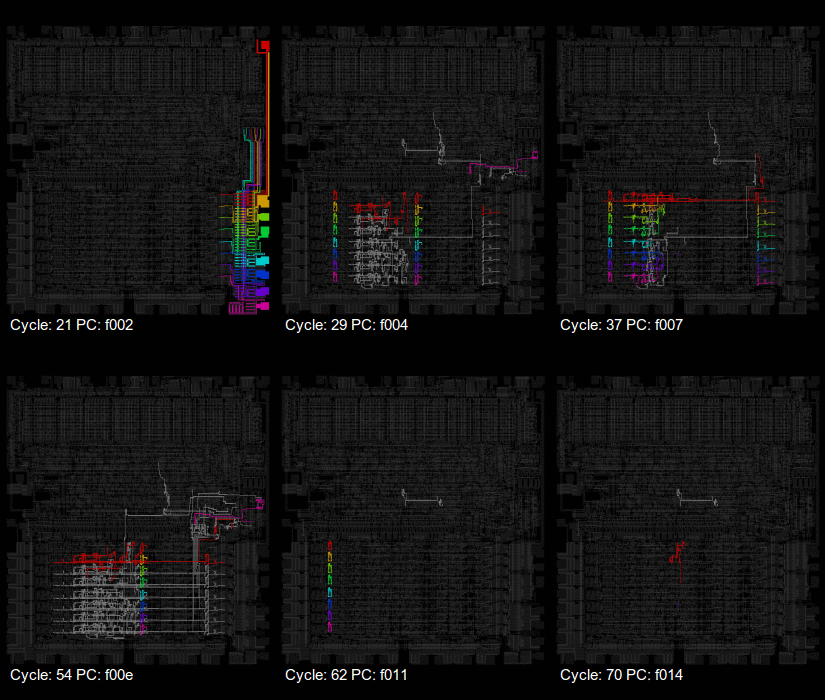
visual6502 pictures via: mos6502 – Google+.
I’ve edited their post below to embed all the links.
–jeroen
Original post with embedded links and edited for readablity:
This week, a new visualisation of the 6502, upcycled from an old favourite. Xray6502 uses the data from the visual6502 project to animate the flow of data values around the chip in rainbow colours. Wladimir has put the code up on github[1], and shared some animations on the 6502 forums too – see our featured link.
You may know that visual6502 is a transistor-level simulation of the NMOS 6502 for your browser. We still see it referenced from time to time[2][3], to explore the circuit and to illustrate exact cycle by cycle behaviour of the chip, and also used to teach the workings of microprocessors in universities[4…7]. It first saw daylight when Greg James presented his findings at SIGGRAPH back in 2010[8], but Greg had been tracing the circuit for much of the previous year. Barry and Brian Silverman had been constructing the circuit simulator and the presentation as a web site. Later that year visual6502.org went live, and went through a series of performance improvements, enhancements and a few bug fixes. It now hosts several simulations, a wiki of notes about the 6502, and several other die photos.
Because visual6502 is open source, it’s been used before for related projects: Michael Steil has published perfect6502[9] which is a C port of the simulation. Elsewhere we find visual2A03[10] which expands the simulation to the CPU chip in the NES. (But note, to save on duplicated effort, this is a real 6502 simulated, not the one with decimal mode ripped out[11] which is actually in the chip.)
Now Wladimir joins in, with this data-tracing visualisation – what can we expect next? Have you played with your visual6502 today?
- [1] https://github.com/laanwj/xray6502
- [2] http://forum.6502.org/viewtopic.php?t=3152
- [3] http://forum.6502.org/viewtopic.php?p=36006#p36006
- [4] http://www.cs.otago.ac.nz/cosc243/ (see lectures 6,7,8)
- [5] https://web.archive.org/web/20130513022146/http://www.cs.uiuc.edu/homes/luddy/PROCESSORS/Nintendo.pdf
- [6] http://iccd.et.tudelft.nl/2009/proceedings/10Shimizu.pdf
- [7] http://eecs.ucf.edu/seniordesign/sp2011su2011/g03/Senior%20Design%202%20Final%20Documentation.pdf
- [8] http://www.visual6502.org/docs/6502_in_action_14_web.pdf
- [9] https://github.com/mist64/perfect6502
- [10] https://www.qmtpro.com/~nes/chipimages/visual2a03/
- [11] http://visual6502.org/wiki/index.php?title=6502DecimalMode#Decimal_mode_and_the_NES.27_RP2A03G
via mos6502 – Google+.

Posted in 6502 Assembly, Assembly Language, Development, Power User | Leave a Comment »
Posted by jpluimers on 2014/12/24
Cool:
Scot Stevenson Shared publicly
For the 6502, 65c02 and 65816 freaks out there: WDC, who still produce the chips, have made their Programming the 65816 Including the 6502, 65C02 and 65802 available for free again (see link below). It’s the standard reference for the new version of these CPUs. Yes, this will be on the test. Ping +Alan Cox HT to BDD on 6502.org
–jeroen
For the 6502, 65c02 and 65816 freaks out there: WDC, who still produce the….
Posted in 6502, 6502 Assembly, Assembly Language, Development, History | Leave a Comment »
Posted by jpluimers on 2014/08/14
Today yet another post in the series of BitSavers and History articles.
I already wrote a bit on the Z80 processor in XOR swap/exchange: nowadays an almost extinct means to exchange two distinct variables of the same size.
Popular Z80 powered computers were Amstrad CPC, MSX, Exidy Sorcerer, TRS-80, P2000, Sinclair ZX80, ZX81 and ZX Spectrum, Kaypro, Osborne 1 and the Z-80 SoftCard for Apple II.
The Z80 was widely popular in the 1980s as it could do more than the MOS 6502 of that time:
- The 6502 (see 6502.org) had
– only 56 instructions (the 65C02 variations had a few more), and the XOR was called EOR.
– addressing memory was limited (not all instructions understood both zero-page-absolute and absolute addressing)
– only 3 registers (A, X and Y)- The Z80 (see z80.info) had:
– only 68 instructions and XOR was indeed called XOR
– many more addressing modes than the 6502
– a whopping 9 registersStill the XOR swap algorithm was used a lot back then because of register pressure in the Z80.
Compared to current processors you’d think the Z80 was so small that a few pages of documentation would suffice.
Not so: back then they had a truckload of documentation and it would all be on paper (PDF ame in 1993 and it took quite a while to become popular).
Some of the Z80 documentation has found its way to BitSavers.org:
–jeroen
Posted in Assembly Language, BitSavers.org, Development, History, Software Development | Leave a Comment »
Posted by jpluimers on 2014/04/27
At USD 50, this seems like a bargain for Apple I / Apple II lovers.
From the The WOZPAK Special Edition – Overview page:
In 1978, The WOZPAK was a 300 page technical manual produced by Apple Pugetsound Program Library Exchange. The poor resolution of copy machines and fax machines of the era made The WOZPAK an illegible and challenging to use collection of handwritten and typed notes. This collection as a whole was provided to the A.P.P.L.E. by Apple Computer, Inc. co-founder Steve Wozniak and then company president Mike Scott.
…
Thanks to the encouragement of a number of computer industry legends, and the efforts of Apple historians, Brian Wiser and Bill Martens, we now have a completely refurbished and dramatically enhanced version of The WOZPAK. The WOZPAK Special Edition comes complete with the original materials from The WOZPAK and The WOZPAK II as well as some new materials provided by Apple legends from their personal libraries.
–jeroen
via: The WOZPAK Special Edition – Overview.
Posted in //e, 6502, Apple, Apple Pascal, Apple ][, Assembly Language, Development, History, Pascal, Power User, Software Development | Leave a Comment »
Posted by jpluimers on 2013/12/23
Another interesting series that just started: Understanding ARM Assembly Part 1 – Ntdebugging Blog – Site Home – MSDN Blogs.
–jeroen
Posted in ARM, Assembly Language, Development, Software Development | Leave a Comment »
Posted by jpluimers on 2013/07/17
2 more issues got on-line both close to a 100 pages each:
So the only issues missing are #28, #30 and #31.
–jeroen
Posted in Assembly Language, BitSavers.org, C, C++, Development, History, Pascal, Software Development, Turbo Pascal, Turbo Prolog, x86 | Tagged: Media, technology | 1 Comment »
Posted by jpluimers on 2013/04/08
Last quarter, 11 issues of Micro Cornucopia appeared on BitSavers including the final May 1990 issue.
This month, another 7 issues appeared, most of which cover a form of Pascal in one or more of the articles and advertisements:
A fun thing to notice are the advertisements for Modula-2. Logitech Modula-2. Yes though the Logitech Wikipedia page does not mention it at all, Logitech didn’t only sell mice, keyboards and web-cams. They had more products. Being Swiss, they were big in Modula-2. And Bitsavers has a PDF of that too: Logitech_Modula-2_86_1.0_Feb84.pdf
The only issues still to be scanned are #28 till #32.
–jeroen
Posted in Assembly Language, BitSavers.org, C, C++, Delphi, Development, History, Pascal, Software Development, Turbo Assembler, Turbo Pascal, x86 | Tagged: computer, Media, research, science, technology | 2 Comments »
Posted by jpluimers on 2013/01/26
Back in the days I started programming, Micro Cornucopia was a wonderful magazine, so I’m glad that BitSavers scanned a few more issues and put them online today, a week after some great PDF scans: Turbo Assembler/Debugger (1993/1994), Borland C++/Object Windows Library (1993):
They covered a lot of languages (x86 and 68k assembly, C, C++, Turbo Pascal and many more), and very interesting hardware designs.
–jeroen
via: Index of /pdf/microCornucopia.
Posted in Assembly Language, BitSavers.org, C, C++, Delphi, Development, History, Pascal, Software Development, Turbo Assembler, Turbo Pascal, x86 | Tagged: computer, software, technology, wonderful magazine | 2 Comments »
 The Wiert Corner - irregular stream of stuff