Archive for the ‘Hardware Interfacing’ Category
Posted by jpluimers on 2016/02/22
If for instance your Boxee gets old or breaks down, you can use a Raspberry Pi as a replacement with Kodi as media player.
This combination will understand the Video+USB over HDMI which most TV supports officially named HDMI-CEC , but most vendors “invented” their own names (see list below).
The core is the kodi support for CEC.
Basically it comes down to using three cables going to the Pi: Power from TV (or some other source), HDMI to TV, and wired Ethernet. And a distribution for RaspberryPi containing kodi will work, for instance from OpenELEC Mediacenter – Download: Raspberry Pi Builds
Chad MILLER has more details on how to get this to work: My Boxee box is getting old, but I knew of no replacements. The problem is I …
Names known for HDMI-CEC via Wikipedia:
Anynet+ (Samsung), Aquos Link (Sharp), BRAVIA Link and BRAVIA Sync (Sony), HDMI-CEC (Hitachi), E-link (AOC), Kuro Link (Pioneer), INlink (Insignia), CE-Link and Regza Link (Toshiba), RIHD (Remote Interactive over HDMI) (Onkyo), RuncoLink (Runco International), SimpLink (LG), T-Link (ITT), HDAVI Control, EZ-Sync, VIERA Link (Panasonic), EasyLink (Philips), and NetCommand for HDMI (Mitsubishi).
Because of the naming, turning on CEC can be confusing: How to Enable HDMI-CEC on Your TV, and Why You Should
–jeroen
Posted in *nix, *nix-tools, Development, Hardware Development, Hardware Interfacing, HDMI, Linux, Power User, Raspberry Pi | Leave a Comment »
Posted by jpluimers on 2014/03/19
Nicely done: the USB Typewriter — Classic Typewriters for the Digital Age, as they can do almost all keys a PC keyboard can do see the USB Typewriter — FAQ using a mechanical (not electrical!) typewriter.
Basically the opposite of the IBM Selectric Computer Terminal, the Daisy wheel printing, the IBM 1050 system, and the IBM 2741 Console.
Note the kits (there are both soldering and non-soldering versions) are mostly aimed at models that once were popular in the USA, so for manufacturers like Adler there are no guidelines (but the existing guidelines for soldering and for non-soldering probably work fine).
–jeroen
Posted in Development, Hardware Development, Hardware Interfacing, Keyboards and Keyboard Shortcuts, LifeHacker, Power User, USB | Tagged: Classic Typewriters | 2 Comments »
Posted by jpluimers on 2012/10/15
I needed to make backups of a couple of maintenance USB drives.
It turned out to be pretty easy: How To Backup Bootable USB Drive describes how to do that based on a small USB Image Tool developed in .NET.
One of the things you can do with this is backup bootable Windows installation media.
Note it is a simple tool, so it backups only same size to same size. For more advanced copy purposes, use something like the professional tools from Acronis.
–jeroen
Posted in .NET, Development, Hardware Interfacing, Power User, Software Development, USB, Windows, Windows 7, Windows 8, Windows Server 2000, Windows Server 2003, Windows Server 2003 R2, Windows Server 2008, Windows Server 2008 R2, Windows Vista, Windows XP | Leave a Comment »
Posted by jpluimers on 2012/05/28
Electric Imp – that wants to power The Internet of Things using imps – is introducing some really interesting hardware, one of the devevelopment kits combining Arduino and Imp on one board:
Duino: Arduino, with Imp
Featuring an ATMEGA328 processor, this board is compatible with the Arduino Uno but instead of having a USB-serial port on it, it has an Imp socket. You can use a modified version of the Arduino IDE to update the ATMEGA code from anywhere in the world when an Imp is plugged in, and use simple serial commands in your Arduino programs to control other Imp devices.
The ATMEGA will operate standalone when no imp card is inserted.
Dimensions: 72mm x 54mm x 14mm
Power supply: USB Mini-B socket (5v) or 2.1mm barrel jack (7-12v)
Price: $20
Some must read links:
–jeroen
via: electric imp – developer kits.
Posted in Arduino, Hardware Development, Hardware Interfacing, USB | 2 Comments »
Posted by jpluimers on 2010/11/16
Amanda Wozniak on hardware design (which is almost, but not quite entirely unlike software design).
Quote from a viewer:
Very cool, fast paced intro. Its odd to hear about hardware design from software based world we now have – i started when things were reversed and it was/is near impossible to convey that there are different design processes. I wish production sw folks would realize that prototype != production, but once sw works sorta, it ships. Also interesting views on CAD SW and how unlike photoshop, houdini, etc it is. Perhaps the industry is ripe for a package that does recognize last 15yrs of software improvements.
Quote from the video:
If you want start tinkering around, get an Arduino. It is like 30 bucks…. Arduino is like electronics for artists. If artists can do it, so can you.
–jeroen
via Hardware Will Cut You.
Posted in Development, Hardware Development, Hardware Interfacing | Leave a Comment »
Posted by jpluimers on 2010/10/18
A great new ESXi 4.1 feature us the much simplified support of USB Pass Through.
In fact it is one of the biggest reasons I updated so quickly; I have been running it now for almost 3 months now. Read the rest of this entry »
Posted in ESXi4, Hardware Interfacing, Power User, USB, VMware | 3 Comments »
Posted by jpluimers on 2009/09/09
I forgot to explicitly mention that the normal “Safely Remove Hardware” icon in the system tray notification area sometimes disappears.
Today, I bumped in such a system, so I was glad I had a reference explaining how manually call the “Safely Remove Hardware” dialog to solve it.
But now I had this dumb icon:
So here are the full steps, including icon.
1. Add a shortcut with this command line:
[script sourcecode=’cscript’]
RunDll32.exe shell32.dll,Control_RunDLL hotplug.dll
[/sourcecode]
2. Change the icon to take icons from this DLL:
[script sourcecode=’cscript’]
%SystemRoot%\system32\hotplug.dll
[/sourcecode]
3. Name the shortcut “Safely Remove Hardware”
So, now you have a nice shortcut with the correct.
This shortcut works, even when it is gone from the system tray:
BTW: Rob van der Woude has a nice page with rundll32 scripts.
–jeroen
Posted in CommandLine, Development, Hardware Interfacing, Software Development, USB | Leave a Comment »
Posted by jpluimers on 2009/08/30
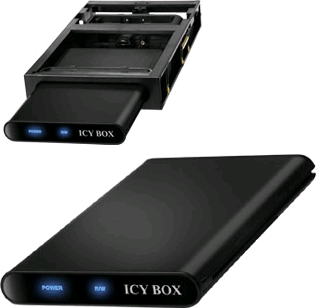 Over the last couple of years, I have upgraded a few SATA laptop hard-disk drives to larger ones.
The easiest way to reuse these drives, is to put them into an external USB enclosure.
But: USB does not deliver the speed of SATA.
So, a few years ago, I found the ICY BOX IB-266StUSD-B from RaidSonic – the picture at the top.
This box contains both the actual enclosure part IB-266StUS-B (note the missing D from the part number) – the picture on the bottom, and a docking station that fits in a regular 3.5″ external bay (now normally used for multi-card readers, in the past used for floppy drives or ZIP drives).
The cool thing is that the enclosure has both an USB and an eSATA connection:

Even cooler is that the docking station also has a SATA connection. Which means that as soon as you insert the HDD, you have full SATA speed.
Now the not so cool thing is that Windows does not allow you to hot eject or hot insert a SATA drive.
Or does it?
In fact it does allow inserts, and even ejects, but with a lot of fiddling with Device Manager, and only if your SATA driver allows it from within the Device Manager.
This is where HotSwap! kicks in… Read the rest of this entry »
Posted in Development, Hardware Interfacing | 1 Comment »
Posted by jpluimers on 2009/06/02
Last week I spoke at the GeekNight of the Dutch Microsoft DevDays 2009.
A great conference, signalling two important industry wide trends:
- Cloud computing
- Natural user interfaces
There were many interesting presentations on both, and we are only at the beginning of those trends: interesting times are ahead!
My presentation (.NET & hardware – capture video & control servos, in a fun application) was as a GeekNight session.
That imposed geeky stuff, but in addition it addressed an important point: there will be many more means of interaction.
In particular, my ‘geek’ combination of hardware and software would react on movements seen by the webcam by pointing the beam of the laserpointer towards the largest area that moved.
After that I enjoyed the long Pentecost weekend (yes, the monday after Pentecost is a Holiday in the Netherlands, so most people have a day off then).
Today I updated my Conferences, seminars and other public appearances page with my DevDays materials to download.
It contains both the sourcecode, and the presentation in English.
Enjoy the download :-)
–jeroen
Posted in .NET, C#, C# 2.0, C# 3.0, DevDays09, Development, Event, Hardware Interfacing, Servo, Software Development, USB, WebCam | Leave a Comment »


 The Wiert Corner - irregular stream of stuff