


Just for my own record, a link clearance of WinRT in relation to Delphi.
I amended this a couple of time already, will try to do so over time: Read the rest of this entry »
Posted by jpluimers on 2012/08/25
Just for my own record, a link clearance of WinRT in relation to Delphi.
I amended this a couple of time already, will try to do so over time: Read the rest of this entry »

Posted in Delphi, Development, Software Development, WinRT-with-Delphi | Tagged: c runtime library, marc hoffman, nick hodges, software, stack overflow, technology | 3 Comments »
Posted by jpluimers on 2012/08/24
Now for some lighter Delphi XE3 related stuff:
These icons seem to go very well with the Metropolis UI Applications that you can create (and convert from VCL!) with Delphi XE3 (see the XE3 video at 0:30).
–jeroen
via:
Posted in Delphi, Delphi XE3, Development, Software Development, UI Design | 2 Comments »
Posted by jpluimers on 2012/08/23
I hope I read these mobile and iOS parts of the XE3 and beyond : A look at mobile post by John Ray “JT” Thomas correctly: Read the rest of this entry »
Posted in Delphi, Delphi XE2, Delphi XE3, Development, Software Development | 7 Comments »
Posted by jpluimers on 2012/08/23
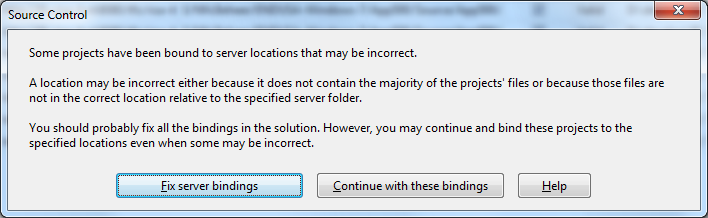 A while ago, I inherited a bunch of C# and VB.NET projects. One of them always generated the below error when including it in Team Foundation System (yes, the original projects were salvaged from Visual Source Shredder version 6.0c):
[Source Control]

Some projects have been bound to server locations that may be incorrect.

A location may be incorrect either because it does not contain the majority of the projects' files or because those files are not in the correct location relative to the specified server folder.

You should probably fix all the bindings in the solution. However, you may continue and bind these projects to the specified locations even when some may be incorrect.

[Fix server bindings] [Continue with these bindings] [Help]
First I tried the Help button: it links to a Help page on MSDN explaining the error can be cause with some statistics on projects not being in the source control system. Since all projects were, there, I looked for more information.
I tried finding a “Fix Server Bindings” or a 2010 “Some projects have been bound to server locations that may be incorrect” link that fitted my use case (getting projects from VSS into TFS), but the solutions I tried eventually all led to the same issue.
Fixing the server bindings would always fail: the solution (which itself is also a project) would get the status Invalid.
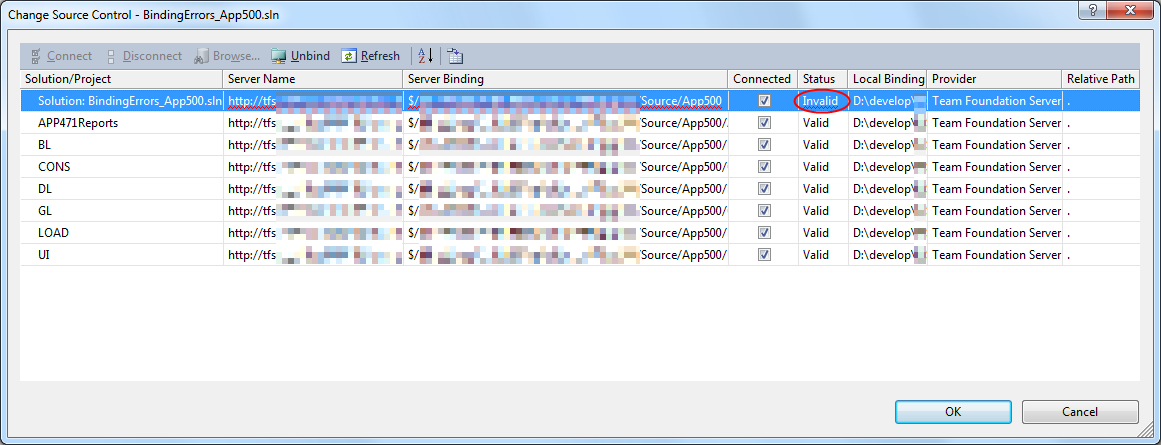
The next steps were these: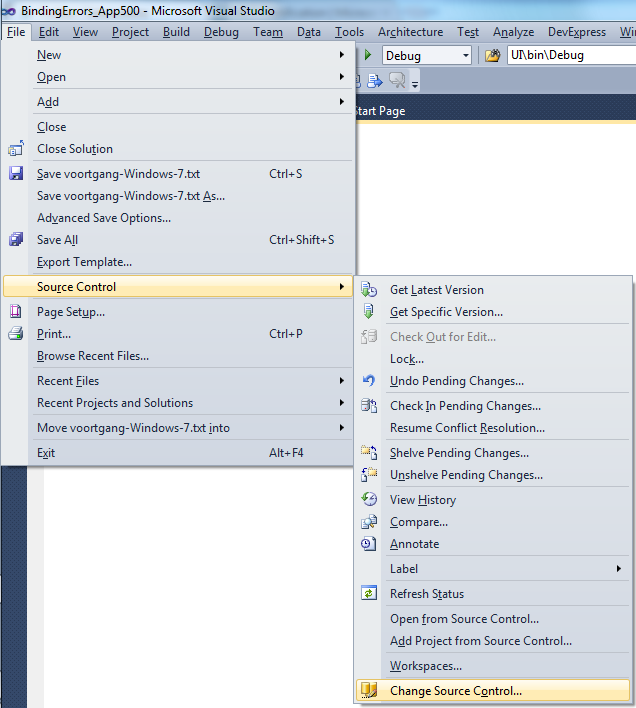
Project("{2150E333-8FDC-42A3-9474-1A3956D46DE8}") = "Solution Items", "Solution Items", "{8D9964D4-6129-4B8F-9238-F9161A02B968}"

ProjectSection(SolutionItems) = preProject

...

Framework\Config.dll = Framework\Config.dll

...

EndProjectSection

EndProjectReading the Help more carefully, with in the back of my mind keeping “Solution Items” all as projects, I finally got the cause:
When some percentage of Solution Items cannot be found locally, and are not in the version control system, Visual Studio marks the solution binding to the version control system as “Invalid”.
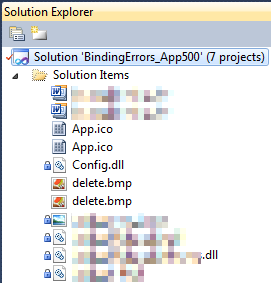 The temporary solution is to ignore the error, until I have found all the missing files (they are scattered around some network shares), or made sure they are not needed at all.
There are many of those (you recognize them from the missing padlock icon in the Solution Explorer).
Version control rot is just like link rot, that’s why one of the high priority action items is to introduce for build automation at this client, then deploy those as clean builds into the Develop and Test stages of the DTAP, then verify if the solutions still work).
–jeroen

Posted in .NET, C#, C# 1.0, C# 2.0, C# 3.0, C# 4.0, C# 5.0, Development, Internet, link rot, Power User, Software Development, Source Code Management, TFS (Team Foundation System), VB.NET, Visual Studio 2010, Visual Studio and tools, WWW - the World Wide Web of information | Leave a Comment »
Posted by jpluimers on 2012/08/22
In Generating a WordPress posting categories page – part 1, you learned how to
This episode, you will learn how the data read from the XHTML can be transformed to a simple tree in HTML suited for a posting categories page like mine.
In the final post, the same data will be transferred into a real category cloud with font sizes indicating the frequency of the category usage.
From there, you can go into other directions (for instance generating squarified treemaps from the data).
That’s the cool thing about data: there are many ways to visualize, and this series was meant – next to some groundwork on how to get the data – as inspiration into some forms of visualization.
Hope you had fun reading it!
                StringBuilder outputHtml = new StringBuilder();
                string rootUrl = args[1];
                foreach (optionType item in select.option)
                {
                    if (item.Level == optionType.RootLevel)
                        continue;

                    // <a style="font-size: 100.3986332574%; padding: 1px; margin: 1px;" title="XML/XSD (23)" href="https://wiert.me/category/development/xmlxsd/">XML/XSD</a>
                    string url = String.Format("{0}/category{1}", rootUrl, item.HtmlPath);
                    string prefix = new string('.', item.Level * 5);// optionType.NbspEscaped.Repeat(item.Level);
                    outputHtml.AppendFormat("{0}<a title="{2}" href="{1}">{2} ({3})</a>", prefix, url, item.Category, item.Count);
                    outputHtml.AppendLine();
                }
One way of generating an HTML tree, is to prefix every node with a series of dots corresponding with the level of that node. Not the most pretty sight, but it will suffice for this episode.
Inside each node, I want to show the Category and Count.
Since the optionType as generated from the XSD only contains the below properties, a major portion on this posting is how to decode the Value so we can generate HTML like this:
...............<a href='https://wiert.me/category/development/software-development/net/c-' title='C#'>C# (118)</a> ....................<a href='https://wiert.me/category/development/software-development/net/c-/c--2-0' title='C# 2.0'>C# 2.0 (46)</a> ....................<a href='https://wiert.me/category/development/software-development/net/c-/c--3-0' title='C# 3.0'>C# 3.0 (33)</a> ....................<a href='https://wiert.me/category/development/software-development/net/c-/c--4-0' title='C# 4.0'>C# 4.0 (31)</a> ....................<a href='https://wiert.me/category/development/software-development/net/c-/c--5-0' title='C# 5.0'>C# 5.0 (2)</a>
optionType only contains the these properties:
Slug and Value without breaking the links between posts and categoriesThe extra properties needed for the HTML generation logic above are these:
Value undone from leading non breaking space character escapes, and the trailing count informationC# 5.0Value undone from leading non breaking space character escapes, Caption information, separator non breaking space character escapes, and surrounding parenthesis2class undone from the level- prefix4c--5-0 (it consists of lowercase letters and hyphens derived from the Category)/category in the category url/development/software-development/net/c-/c--5-0 that points to https://wiert.me/category/development/software-development/net/c-/c–5-0The really cool thing about XSD2Code is that it generated the optionType C# code as a partial class.
Which means we can extend the generated partial classes in a seperate C# file like the code fragments below (you can download it from the WordPressCategoriesDropDown.cs file at BeSharp.CodePlex.com)
partial class optionType
{
public const int RootLevel = -1;
private const string slash = "/";
private const char hyphen = '-';
public const string NbspEscaped = " ";
private const string emptyCountInParenthesis = "(-1)";
public optionType parent { get; set; }
public string Category
{
get
{
string result;
string countInParenthesis;
splitValue(out result, out countInParenthesis);
return result;
}
}
public int Count
{
get
{
string category;
string countInParenthesis;
splitValue(out category, out countInParenthesis);
string count = countInParenthesis.Substring(1, countInParenthesis.Length - 2);
int result = int.Parse(count);
return result;
}
}
public int Level
{
get
{
if (string.IsNullOrWhiteSpace(@class))
return RootLevel;
string[] split = @class.Split(hyphen);
string number = split[1];
int result = int.Parse(number);
return result;
}
}
/// <summary>
/// This is the HTML part that WordPress uses to reference a Category
/// </summary>
public string Slug
{
get
{
StringBuilder result = new StringBuilder();
foreach (char item in Category)
{
if (char.IsLetterOrDigit(item))
result.Append(item.ToString().ToLower());
else
if (result.Length > 0)
result.Append(hyphen);
}
return result.ToString();
}
}
public string HtmlPath
{
get
{
if (RootLevel == Level)
return string.Empty;
string result = Slug;
if (null != parent)
result = parent.HtmlPath + slash + result;
return result;
}
}
private void splitValue(out string category, out string countInParenthesis)
{
// might want to do this using RegEx, but that is a write-only language https://wiert.me/category/development/software-development/regex/
string result = Value;
int nbspCountToStripFromLeftOfValue = Level * 3; // strip 3 for each Level
for (int i = 0; i < nbspCountToStripFromLeftOfValue; i++)
{
int nbspEscapedLength = NbspEscaped.Length;
if (result.StartsWith(NbspEscaped))
result = result.Substring(nbspEscapedLength, result.Length - nbspEscapedLength);
}
string doubleNbspEscaped = NbspEscaped + NbspEscaped;
if (result.Contains(doubleNbspEscaped))
{
string[] separators = new string[] { doubleNbspEscaped };
string[] split = result.Split(separators, StringSplitOptions.None);
category = split[0];
countInParenthesis = split[1];
}
else
{
category = result;
countInParenthesis = emptyCountInParenthesis;
}
}
public override string ToString()
{
string result = string.Format("Level {0}, Count {1}, Slug {2}, HtmlPath {3}, Category '{4}'", Level, Count, Slug, HtmlPath, Category);
return result;
}
}
The bulk of the above code is in the splitValue method (that could have used RegEx, but I try to avoid RegEx when I can do without it).
Note that the HtmlPath propererty uses the parent property. Without it, the HtmlPath code would have been very complex. The value of the parent properties for all optionType instances is generated in the selectType.FixParents method below since the selectType instance contains all the optionType instances in its’ option property.
    partial class selectType
    {
        public void FixParents()
        {
            Stack<optionType> itemStack = new Stack<optionType>();
            optionType parent = null;
            int previousLevel = optionType.RootLevel;

            foreach (optionType item in option)
            {
                int itemLevel = item.Level;
                if (itemLevel == previousLevel)
                {
                    if (optionType.RootLevel != itemLevel)
                    {
                        itemStack.Pop();
                        item.parent = parent;
                    }
                    itemStack.Push(item);
                }
                else
                {
                    if (itemLevel > previousLevel)
                    {
                        parent = itemStack.Peek();
                    }
                    else
                    {
                        do
                        {
                            itemStack.Pop();
                            parent = itemStack.Peek();
                            previousLevel = parent.Level;
                        }
                        while (previousLevel >= itemLevel);
                    }
                    itemStack.Push(item);
                    item.parent = parent;
                    previousLevel = itemLevel;
                }
            }
        }
    }
–jeroen
Posted in .NET, C#, C# 4.0, C# 5.0, Development, LINQ, Software Development, Usability, User Experience (ux), Web Development, WordPress, WordPress, XML, XML escapes, XML/XSD, XSD | 4 Comments »
Posted by jpluimers on 2012/08/21
Few people know about the INFORMATION_SCHEMA views that have been there since SQL-92.
Two funny things about that standard:
A few reasons I can imagine not many people know about the INFORMATION_SCHEMA:
I remember the Y2K preparation era where the ISO-8601 standard was freely available at http://www.iso.ch/markete/8601.pdf, soon after the Year 2000, the PDF got locked behind a payment engine.
ISO suffers from heavy link rot too, for instance the ISO 3166 country codes used to be at http://www.iso.org/iso/prods-services/iso3166ma, but are now at http://www.iso.org/iso/home/standards/country_codes.htm. What about HTTP 303 or 302 redirect here guys?
Since SQL-92, the INFORMATION_SCHEMA (and its twin DEFINITION_SCHEMA) have been extended. The last extension in 2008. Together they allow SQL databases to be self-describing (I think no vendor has attained that) and the structures queryable in a standard way
In fact that is the main purpose: these views in INFORMATION_SCHEMA are a very convenient standard way to query – in a vendor agnostic way – about tables, views, columns, etc. Read the rest of this entry »
Posted in Database Development, Development, Firebird, InterBase, ISO 8601, MySQL, OracleDB, PostgreSQL, Power User, SQL, SQL Server, SQL Server 2000, SQL Server 2005, SQL Server 2008, SQL Server 2008 R2, SQL Server 2012, SQL Server 7, Sybase | Leave a Comment »
Posted by jpluimers on 2012/08/21
Every so often, I come across a pearl that I hand’t read before. This time I was looking for the source of “nothing is more permanent than a temporary solution”, and somehow came across the book 97 Things Every Programmer Should Know.
It is full of interesting concepts phrased in easy to read chapters on important things like “Code in the Languae of the Domain“, “Don’t Repeat Yourself” and many (95 <g>) others.
For a small introduction, read the PDF presentation extract, and the 97 things website.
–jeroen
via: 97 Things Every Programmer Should Know – Programmer 97-things.
Posted in .NET, Delphi, Development, Software Development | 2 Comments »
Posted by jpluimers on 2012/08/20
Hoping this is the most recent version: Download: Office 2003 Update: Redistributable Primary Interop Assemblies – Microsoft Download Center – Confirmation.
http://download.microsoft.com/download/8/3/a/83a40b5a-5050-4940-bcc4-7943e1e59590/O2003PIA.EXE
–jeroen
Posted in .NET, Development, Software Development | Leave a Comment »
Posted by jpluimers on 2012/08/18
A question like How do you clear your MRU list in Visual Studio? is why I still like Stack Overflow.
The answers explain how to solve this in a version neutral way, including other MRU lists, and as a bonus point you to handy Visual Studio tools.
–jeroen
via: registry – How do you clear your MRU list in Visual Studio? – Stack Overflow.
Posted in Development, Software Development, Visual Studio 11, Visual Studio 2002, Visual Studio 2003, Visual Studio 2005, Visual Studio 2008, Visual Studio 2010, Visual Studio and tools | Leave a Comment »
Posted by jpluimers on 2012/08/16
The .NET 4.5 beta has a bug that manifests itself as an AV or an FatalExecutionEngineError in certain circumstances of String.Empty handling, which is fixed by the .NET 4.5 RTM that shipped earlier this month followed by Visual Studio 2010 RTM today.
Thanks both to the original poster for reporting it here, and to Michael for his excellent analysis.
My counterparts on the CLR tried to reproduce the bug here and discovered that it reproduces on the “Release Candidate” version of the 64 bit CLR, but not on the final “Released To Manufacturing” version, which had a number of bug fixes post-RC. (The RTM version will be available to the public on August 15th, 2012.)
They therefore believe this to be the same issue as the one that was reported here:
Many apologies for the error.
–jeroen
via: c# – What’s the cause of this strange bug? – Stack Overflow.
Posted in .NET, .NET 4.5, C#, C# 4.0, C# 5.0, Development, Software Development | Leave a Comment »
 The Wiert Corner - irregular stream of stuff