Archive for the ‘F#’ Category
Posted by jpluimers on 2025/07/16
I originally missed this as back then I was in the midst of managing trouble in my parental family, unaware I was already having rectum cancer. Then things went fast, not even including the Covid-19 years, so I was glad last year I got reminded of this mid-2019 article:
[Wayback/Archive] Alan Turing Wrote Object-Oriented Code In C And Ran It On BEAM – De Programmatica Ipsum writes a lot of interesting things on programming paradigms, starting with
In his rare 1994 book “Object-Oriented Programming In C” Axel Tobias Schreiner explains how to do inheritance, class methods, class hierarchies, and even how to raise exceptions using nothing else than pure, simple, pointer arithmetic-filled, ANSI C.
then arguing basically most of not all modern languages share the majority of programming paradigms and all these paradigms are repeats of the past:
But none of this is new. Smalltalk, arguably the precursor of object orientation, had collect and select methods which were the grandparents of our more common map and filter functional friends.
What sets modern languages apart is that they the majority covers all the paradigms you might need, just differing in how well they support the paradigm-du-jour.
It means programming language wars should have been a thing of the past for about two decades now.
Please let that sink in.
Oh: if you look for that ANSI C book, here it is: [Wayback/Archive] https://www.cs.rit.edu/~ats/books/ooc.pdf [Wayback PDF View/PDF View]
Via: [Wayback/Archive] De Programmatica Ipsum: “”In his rare 1994 book “Object…” – mas.to
--jeroen
Posted in .NET, C, C#, C++, Cloud, COBOL, Containers, Design Patterns, Development, Docker, Erlang, F#, Go (golang), Haskell, Infrastructure, Java, Java Platform, Kotlin, Kubernetes (k8n), ObjectiveC, OOP (Object Oriented Programming), Perl, Scala, Scripting, Software Development, Swift, VB.NET | Leave a Comment »
Posted by jpluimers on 2025/07/10
Below is a really cool tool-set for Visual Studio Code of which its development started when I was recovering from life-saving bowel-surgery during the series of procedures to get rid of my metastasised rectum cancer.
It supports decompilation of various languages (.NET C# and F#, GO, Rust and clang) into either x86 assembler or IR (Intermediate Representation, on the .NET side often also called IL for Intermediate Language) to research how well a compiler stack behaves.
[Wayback/Archive] badamczewski/PowerUp: ⚡ Decompilation Tools and High Productivity Utilities ⚡:
Read the rest of this entry »
Posted in .NET, C#, C++, Development, F#, Go (golang), Rust, Software Development | Leave a Comment »
Posted by jpluimers on 2023/12/18
[Wayback/Archive] awaescher/Fusion: 🧰 A modern alternative to the Microsoft Assembly Binding Log Viewer (FUSLOGVW.exe)
So, do you know what “Enable immersive logging” means? Or why you should separate log categories from “Default” and “Native Images”? Did you ever forget to disable the log again and wondered why every .NET application was that slow and your disk ran out of space?
…
Forget all the setup upfront – just hit “Record” to capture your assembly logs. If you are done, click “Stop” again. That’s it.
Via [Wayback/Archive] Meik Tranel on Twitter: “@Nick_Craver Take this: github.com/awaescher/Fusion Nice UI and never forget to disable that env var ever again.”.
–jeroen
Posted in .NET, C#, Development, F#, Software Development, VB.NET | Leave a Comment »
Posted by jpluimers on 2020/01/16
[WayBack] Mad With PowerShell: FileInfo and DirectoryInfo objects are not populated upon creation in PowerShell.
TL;DR:
- Apart from the
FullName property, the other poprerties of FileInfo and DirectoryInfo are populated later than their instance creation
- A call to their
Refresh method populates or re-populates them
- That method is implicitly called when you request other properties than
FullName
Example: see the [Archive.is]fileinfo.cs: Length property
–jeroen
Posted in .NET, C#, CommandLine, Development, F#, PowerShell, Software Development, VB.NET | Leave a Comment »
Posted by jpluimers on 2019/04/10
By now this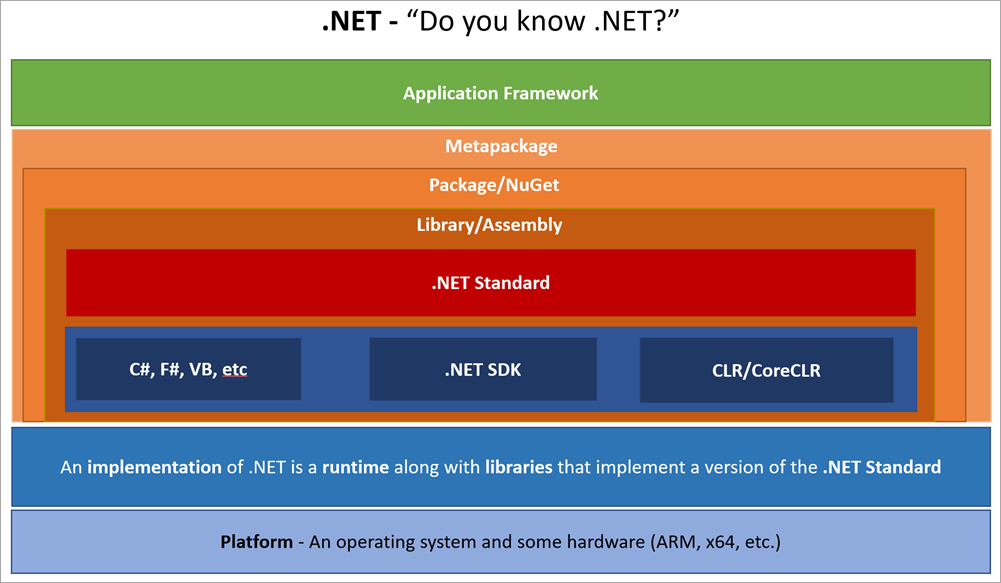 should be out of [WayBack] Draft – .NET Glossary Diagram – Scott Hanselman: a list of common terms to describe various parts of the .NET ecosystem.
He has a nice list of sentences where each term is used.
I’ll try to use them myself as well, so I gave it a start at paulcbetts/refit: The automatic type-safe REST library for Xamarin and .NET.
–jeroen
Posted in .NET, C#, Development, F#, Software Development, VB.NET, Visual Studio and tools | Leave a Comment »
Posted by jpluimers on 2017/12/07
Ah, C. The best lingua franca we have… because we have no other lingua francas. Linguae franca. Surgeons general? C is fairly old — 44 years, now! — and comes from a time when there were possibly more architectures than programming languages. It works well for what it is, and what it is is a relatively simple layer of indirection atop assembly. Alas, the popularity of C has led to a number of programming languages’ taking significant cues from its design, and parts of its design are… slightly questionable. I’ve gone through some common features that probably should’ve stayed in C and my justification for saying so. The features are listed in rough order from (I hope) least to most controversial. The idea is that C fans will give up when I call it “weakly typed” and not even get to the part where I rag on braces. Wait, crap, I gave it away.
Great re-read towards the end of the year: [WayBack] Let’s stop copying C / fuzzy notepad
Via: [WayBack] Old and busted: emacs vs vi. New and hot: Language war, everybody against everybody else. – Kristian Köhntopp – Google+
–jeroen
Posted in .NET, APL, Awk, bash, BASIC, C, C#, C++, COBOL, CoffeeScript, CommandLine, D, Delphi, Development, F#, Fortran, Go (golang), Java, Java Platform, JavaScript/ECMAScript, Pascal, Perl, PHP, PowerShell, PowerShell, Python, Ruby, Scala, Scripting, Software Development, TypeScript, VB.NET, VBScript | 3 Comments »
Posted by jpluimers on 2013/12/25
StackOverflow user Joe (sorry, no last name) helped me big time by answering my question on Business logic shared by ASP.NET / WinForms: find the location of the assembly to access relative files to it.
Before showing the code at the bottom of this blog post, let me explain the question in more detail:
Basically I was in the midst of refactoring some ‘inherited’ business logic code that – before refactoring – for the ASP.NET side needs to be initialized with an absolute path, but on the WinForms / WPF side only with a relative path to a GetExecutingAssembly directory.
To ease xcopy deployment, I wanted all configuration settings to be relative. But I hadn’t found a common means for these platforms to obtain a directory usable as a root for accessing relative files.
That way I could put identical settings in both the Web.config and App.config, heck even generate them based on a common fragment, whithout having to hard-code absolute path names.
I knew about Assembly.GetExecutingAssembly, but in ASP.NET that location is not where the web site is (both IIS and the WebDevelopment server make use of temporary locations to store the assemblies).
ASP.NET does have Server.MapPath and HostingEnvironment.MapPath, but I didn’t want to make the business logic depend on ASP.NET.
Joe came up with this solution, which works dandy: Read the rest of this entry »
Posted in .NET, .NET 1.x, .NET 2.0, .NET 3.0, .NET 3.5, .NET 4.0, .NET 4.5, ASP.NET, C#, C# 1.0, C# 2.0, C# 3.0, C# 4.0, C# 5.0, Development, F#, Prism, Software Development, VB.NET, VB.NET 10.0, VB.NET 11.0, VB.NET 7.0, VB.NET 7.1, VB.NET 8.0, VB.NET 9.0, Web Development | Leave a Comment »
Posted by jpluimers on 2013/10/29
Toon Krijthe posted an interesting question to SO.
Though 5 years old, I think it stilll is very valid one:
At my work, we have decided to stay with the ANSI characters for identifiers. Is there anybody out there using unicode identifiers and what are the experiences?
For all projects I work on (in various Languages like English, German, Dutch or other), I stick to ASCII characters (not even ANSI) for:
I also try to abstract the non-ASCII strings into places where I am sure that the encoding is preserved (for text files, I prefer UTF-8), or where these characters are properly escaped.
What is your take on this?
–jeroen
via: uniqueidentifier – What are the experiences with using unicode in identifiers – Stack Overflow.
Posted in .NET, Agile, AS/400 / iSeries / System i, C, C#, C++, COBOL, Continuous Integration, Delphi, Development, F#, Prism, Scripting, Software Development, VB.NET, Visual Studio and tools | 4 Comments »


 The Wiert Corner - irregular stream of stuff