The Wiert Corner – irregular stream of stuff

Jeroen W. Pluimers on .NET, C#, Delphi, databases, and personal interests

  • My badges

  • Twitter Updates

  • My Flickr Stream

  • Pages

  • All categories

  • Enter your email address to subscribe to this blog and receive notifications of new posts by email.

    Join 1,854 other subscribers

Archive for the ‘History’ Category

MCL65 – a cycle exact 6502 in an FGPA

Posted by jpluimers on 2017/11/24

Cool stuff: [WayBackMCL65

MicroCore Labs MCL65 6502 core

The MC65 is an ultra-small footprint, microsequencer-based, 100% instruction-set compatible, cycle-exact NMOS 6502 core that can be implemented in any FPGA or ASIC technology which can utilize as little as 252 LUTs  (0.77%) of a Xilinx Spartan-7 FPGA. It has also been ported to a Xilinx Spartan-3 device where it uses about 10% of the part.

The MCL65 is instruction set compatible with the original NMOS version of the 6502 which was the processor used in computers and game machines such as the Commodore VIC20, Apple II, Atari-2600, and the Commodore-64 as well as  many others.

It runs inside an Apple ][ fine: see the below videos by MicroCore Labs

  • [WayBack] Download
  • [WayBack] MCL65 Working!: The MCL65 is currently running inside of a Commodore VIC-20 computer!  I have no game cartridges at the moment, so I am just running the classic a=a+1 BASIC counting program…
  • [WayBack] MCL65 running on VIC-20: Here are a few pictures of the MCL65 running on a VIC20. Video is available at MicroCore Labs YouTube Channel
  • [WayBack] MCL65 in a Spartan-3: Just ported the MCL65 to a Xilinx Spartan-3 board which contains an XC3S250E. 490 LUTs are used, which is 10% of the device.
  • [WayBack] MCL65 running on Atari 2600: The Atari 2600 just arrived in the mail, so replaced the MOS6507 CPU with the MCL65 core which is fitted the Xilinx Spartan-7 board and then to a 28-pin header for the 6507 package…
  • [WayBack] MCL65 works in Apple II+: Received the Apple II+ in the mail today but it did not come with any diskettes. I used a terrific tool, ADTPro, to transfer disk images from my PC over to the Apple using the cassette port…
  • [WayBack] MCL65 running Apple II+ Programs:I uploaded some videos of the system running a few applications and games. My hope was to test the MCL65 on a variety of programs that could demonstrate the instruction as well as cycle accuracy…

Via:

–jeroen

Read the rest of this entry »

Posted in 6502, History | Leave a Comment »

Delphi history: No, dynamic arrays do not support a non-zero lower bound, but what if you want them? – via Stack Overflow

Posted by jpluimers on 2017/11/21

A post of some older Delphi stuff I did in the past just in case need it again.

David Heffernan found the documentation for this: [WayBackStructured Types (Delphi): Dynamic Arrays – RAD Studio

Since I needed a dynamic array structure supporting a non-zero lower bound, I was glad he also provided an answer with a data structure that does provide a non-zero lower bound.

For my own reference I’ve put his answers and questions below (as it’s way easier to search my blog than the complete internet) and my own implementation:

Read the rest of this entry »

Posted in Delphi, Development, History, Software Development | 10 Comments »

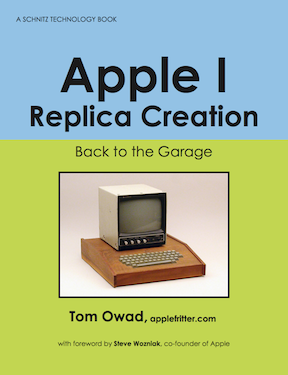
Applefritter | Applefritter

Posted by jpluimers on 2017/11/20

History: Applefritter | Applefritter

Posted in 6502, Apple I, History | Leave a Comment »

CompuServe’s forums, which still exist, are finally shutting down on 20171215

Posted by jpluimers on 2017/11/20

An era ends: [Archive.isCompuServe’s forums, which still exist, are finally shutting down

Before there was a World Wide Web, a sizable chunk of all meaningful conversation between computer users happened in the forums at CompuServe, which was the dominant online service until AOL came along. There was a CompuServe forum for everything from PC hardware to comic books, the signal-to-noise ratio was generally high, and … they if you … will be removed from what remains of CompuServe on December 15.

Via: Roy Nelson on Facebook

I remember spending a truckload of money on 100013,1443. Heck: it was the reason for getting a credit card in the first place!

–jeroen

Posted in borland, History | Leave a Comment »

For everyone who still loves and uses old computers.

Posted by jpluimers on 2017/11/13

For everyone who still loves and uses old computers.

Quite a few nice products for your vintage Apple II, //e and //c machines.

Posted in //e, 6502, Apple, Apple I, Apple ][, History, Power User | Leave a Comment »

Loss of Hewlett-Packard Archive a Wake-Up Call for Computer Historians – IEEE Spectrum

Posted by jpluimers on 2017/10/31

How not to preserve computer history:

The Wine Country fires destroyed an irreplaceable piece of Silicon Valley history

Source: [WayBack/Archive.isLoss of Hewlett-Packard Archive a Wake-Up Call for Computer Historians – IEEE Spectrum

Via: [WayBackAlan Cox – Google+

–jeroen

Posted in History | Leave a Comment »

The Format function introduced in Delphi 1 was based on the FormatStr function in Turbo Vision available in Turbo Pascal 6 or higher

Posted by jpluimers on 2017/10/26

I did find my Borland Pascal 7.0.1 ISO which showed that https://github.com/romiras/turbo-pascal-archive/blob/master/Files/Dos%20Navigator/FORMAT.ASM is identical to ./BP/RTL/TV/FORMAT.ASM which is used from ./BP/RTL/TV/DRIVERS.PAS to provide this:

{ String formatting routines }

{$L FORMAT.OBJ}

procedure FormatStr(var Result: String; const Format: String; var Params);external {FORMAT};

There are various examples like in ./BP/EXAMPLES/DOS/TVDEMO/ASCIITAB.PAS at line 143:

FormatStr(TempStr, ' Char: %c Decimal: %0# Hex: %0#x ', ASCIIChar);

So it was in the Drivers unit, but also easy to incorporate in your own unit by linking the .OBJ file and providing the external declaration in any unit.

The Drivers unit is very independent of the rest of Turbo Vision: it uses the Objects unit (which most projects use as the System unit at ~500 lines of code provided very little functionality by itself).

For the diskette based install, the .TPU files were on the standard disks and the sources for both RTL and Turbo Vision on separate disks, but anyone would install them as they provided a lot of insight. The CD-ROM has them all on the same medium (both as installers and unpacked in the BP directory).

I just checked Turbo Pascal 6.0 (that I did have a VM for) which has them in the same way.

Source: [WayBackWe’re discussing with the collegues: anybody knows when Format function was introduced in Delphi? – Klaus Edelmann – Google+

–jeroen

Posted in Borland Pascal, Delphi, Development, History, Pascal, Software Development, Turbo Pascal | Leave a Comment »

roelandjansen/pcmos386v501: PC-MOS/386 v5.01 final release including cdrom driver sources.

Posted by jpluimers on 2017/10/25

History: Borland C++ source code for the PC-MOS/386 5.01 version at roelandjansen/pcmos386v501: PC-MOS/386 v5.01 final release including cdrom driver sources.

Related:

–jeroen

Via: [WayBack/Archive.is] PC-MOS/386 is na dertig jaar opensourcesoftware – Computer – .Geeks – Tweakers

Posted in Borland C++, C, C++, Development, History, Software Development | Leave a Comment »

“You would make for a great computer programmer”

Posted by jpluimers on 2017/10/20

A while ago, Joe C. Hecht mentioned for the second time about his family joke along the lines that he had bad grades at school despite being good at the topics. He got tested which resulted in “You would make for a great computer programmer”.

I wonder how this happened with other people in the IT. Did you get yourself a degree in that direction, or teach yourself programming and such?

The reason is that I recognise what Joe wrote: I’m still a bad learner from books or theory as I learn by doing. I specifically didn’t try to get a Computer Science degree as in the late 1980s in The Netherlands it basically was a heavy math degree plus Computer Science topics. So it was basically doing two studies at once and I was only interested in the Computer Science parts.

So I chose studying Chemistry (one of the science topics I really liked at high school) at the closest university to my home so I kept living with my parents.

In 20-20 hindsight this was not the right choice. But at that time I didn’t know about the right choice.

In about 4 years, I finished like 2.5 years of studying, was a geek-prototype (good at computers, bad at people skills) and still did a lot of Computer Science topics (even though the exams would be worthless as back then individual exams didn’t count unless they were part of the main direction of your study). The last year was prepping for practice and advanced topics. I slowly attended less and less sessions and did more and more programming gigs as somehow that was way more fun before slowly bailing out. I also sold network equipment to the university department helping them to connect to the internet and helped a lot of co-students with their computing issues and assignments, learned my way in DOS/3com/Novell/EARN/BITNET/DECNet/SunOS and VAX/VMS based technologies.

I only found out why I bailed out more than a decade later: I was a pragmatic guy learning by doing, not suited for a university that tried educating theorists. Besides that the department I wanted to finish my studies has two four camps: a very theoretic camp (with nice guys: they were the ones wanting internet access very early on), two less theoretic camps fighting each other and a lazy camp filling their days basically with doing as little as possible. A very unproductive and depressing situation. I had worked at the research labs of the paint factory doing research close to my studies, but there was no way the university would allow me to do my research phase there. Even more depressing.

Now (as always, hindsight is 20/20 vision) I know I should have bailed out early on and go for a more pragmatic study maybe not even a university but a polytechnic. On the other hand it helped doing a truckload of Turbo Pascal work (which I started at High School with Turbo Pascal 1 on CP/M with Apple ][+ and //e machines), programming in assembler/prolog/FORTRAN/C, getting connected to the internet (BITNET RELAY chat, mailing lists, early newsgroups, uucp, TCP/IP basics, thick/thin ethernet converters, serial and modem communication with Kermit and FidoNET, gopher, FTP and truckloads more stuff).

It got me into the Delphi, .NET and open source worlds, doing a lot of travel and conference speaking and being an early adopter of many technologies and concepts (some even so early that they only got way popular decades later – like the 1980s “the network is the computer” mantra – or making sense – like the lock semantics topics really became useful when around the century turn  single processor machines got multi-processor siblings and a lustrum later multi-core and multi-threading processors became available and ubiquitous around 2010) and taught me that being able to search and find things is way more important than knowing things.

So I wonder about all my followers:

How did your education go and how did you end up in computing?

–jeroen

References via Joe C. Hecht:

Read the rest of this entry »

Posted in About, BBS, BITNET Relay, Chat, FidoNet, History, Opinions, Personal, SocialMedia | Leave a Comment »

It’s about world Cassette Store Day…

Posted by jpluimers on 2017/10/08

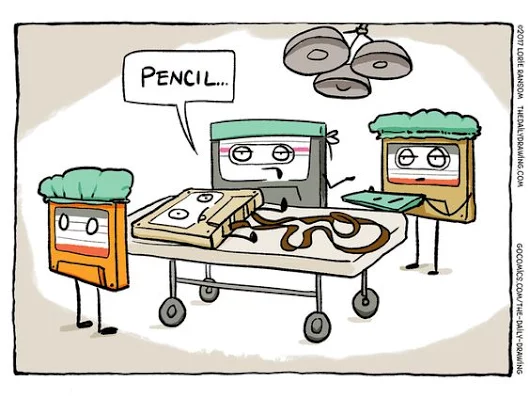
The Compact Cassette has been on a comeback path for a few years now and around this time of the year, I expect the [WayBack] Cassette Store Day to happen (check out https://www.facebook.com/CassetteStoreDay/ for the exact date).

So it’s time to re-share the The Daily Drawing by Lorie Ransom on the right.

[WayBackThe Daily Drawing by Lorie Ransom for Mar 13, 2017 | Read Comic Strips at GoComics.com

–jeroen

Background info:


Posted in Fun, Geeky, History | Leave a Comment »