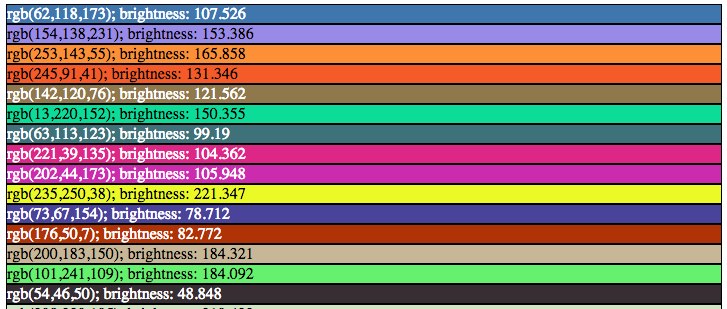
Fitting for a day like this.
[WayBack] Testing: Hammering Nails via [WayBack] Testing: Hammering Nails – This is why I Code – Google+
Posted by jpluimers on 2018/09/09
Fitting for a day like this.
[WayBack] Testing: Hammering Nails via [WayBack] Testing: Hammering Nails – This is why I Code – Google+
Posted in Fun, Testing | Leave a Comment »
Posted by jpluimers on 2018/09/07
One of the domains not yet monitored at embarcaderomonitoring.wiert.me, was the altd download server for ISOs and installers on http and https level. Ultimately you want https, as most of these are about installers, so you do not want any man-in-the-middle to fiddle with them.
Upitmerobot is not yet smart enough to check validity of TLS certificates on https connections.
Chrome, Firefox, Safari, Internet Explorer, wget, curl and ssllabs however are.
Uptimerobot did not like monitoring the plain http://altd.embarcadero.com/ and https://altd.embarcadero.com/ URLs, because the altd is not browsable, so it tries to hide most of its structure from access. This means they both return an odd response:


Those responses are actually 404 errors (note the - minus sign after curl --trace-ascii: it sends the trace to stdout):
$ wget http://altd.embarcadero.com/ --2018-09-05 10:44:23-- http://altd.embarcadero.com/ Resolving altd.embarcadero.com (altd.embarcadero.com)... 88.221.144.40, 88.221.144.10 Connecting to altd.embarcadero.com (altd.embarcadero.com)|88.221.144.40|:80... connected. HTTP request sent, awaiting response... 404 Not Found 2018-09-05 10:44:23 ERROR 404: Not Found. $ curl --verbose http://altd.embarcadero.com/ * Trying 88.221.144.40... * TCP_NODELAY set * Connected to altd.embarcadero.com (88.221.144.40) port 80 (#0) > GET / HTTP/1.1 > Host: altd.embarcadero.com > User-Agent: curl/7.54.0 > Accept: */* > < HTTP/1.1 404 Not Found < Server: Apache < Content-Type: text/html; charset=iso-8859-1 < Content-Length: 16 < Date: Wed, 05 Sep 2018 08:45:57 GMT < Connection: keep-alive < * Connection #0 to host altd.embarcadero.com left intact File not found." $ curl --trace-ascii - http://altd.embarcadero.com/ == Info: Trying 88.221.144.40... == Info: TCP_NODELAY set == Info: Connected to altd.embarcadero.com (88.221.144.40) port 80 (#0) => Send header, 84 bytes (0x54) 0000: GET / HTTP/1.1 0010: Host: altd.embarcadero.com 002c: User-Agent: curl/7.54.0 0045: Accept: */* 0052: <= Recv header, 24 bytes (0x18) 0000: HTTP/1.1 404 Not Found <= Recv header, 16 bytes (0x10) 0000: Server: Apache <= Recv header, 45 bytes (0x2d) 0000: Content-Type: text/html; charset=iso-8859-1 <= Recv header, 20 bytes (0x14) 0000: Content-Length: 16 <= Recv header, 37 bytes (0x25) 0000: Date: Wed, 05 Sep 2018 08:47:19 GMT <= Recv header, 24 bytes (0x18) 0000: Connection: keep-alive <= Recv header, 2 bytes (0x2) 0000: <= Recv data, 16 bytes (0x10) 0000: File not found." File not found."== Info: Connection #0 to host altd.embarcadero.com left intact
This is also the reason that WayBack does not want to archive that link, but it can be archived at [Archive.is] https://altd.embarcadero.com/.
Luckily, a Google search for site:altd.embarcadero.com revealed there is a non-installer file short enough (~72 kibibytes) for Uptime robot to check, so it now verifies it can access these:
–jeroen
Posted in *nix, *nix-tools, cURL, Encryption, HTTPS/TLS security, Monitoring, Power User, Security, Uptimerobot, wget | Leave a Comment »
Posted by jpluimers on 2018/09/07
Kristian Köhntopp commended:
GOD IS REAL UNLESS DECLARED INTEGER..
In some versions of Fortran, the default type of variables starting with I, J, K or L is integer, while other varianles are by default typed as real. The Fortran statement DECLARE can be used to explicitly declare a variables as being of a specific type.
The variable GOD stats with G and hence is implicitly real, unless you add an appropriate declare statement.
He reminded my of my FORTRAN 66 days at university when studying “computer usage for chemists”:
I remember a “computer usage for chemists” course during my studies where (end of the 1980s!) were supposed to program in FORTRAN 66.
Luckily the VAX/VMS machine supported a much more recent FORTRAN version and had support for 132 columns as well, which allowed me to indent properly (like I was used from my Pascal background).This tremendously helped me solve basically this problem:
- import tables with
- atom code, radius and valence (bonding count)
- atom1 code, atom2 code, minimum distance, maximum distance
- atom code, X/Y/Z coordinate
- determine which bonds can occur
- walk the bonds and determine the atomic structure, including cycle count
Especially the last one was easiest to solve with recursion, which FORTRAN does not support. So I wrote my own stack structure and solved the problem.
The student coach was mad when she found out I had printed the full documentation on continuous form paper which took the printer about half an hour for printing the ~100 pages.
Next morning, I had read it front-to-back and colour-indexed all the sections so it was far easier to find what the compiler could do for me. She could not believe I had done that.
All my co students were on a (non shielded!) 300 meter multiplexed serial connection with VT-120 emulators from PC’s with all sorts of connection problems.
I discovered a small room right above the VAX/VMS machine having a couple of terminals with direct connections that were hardly used. A few of them were VT-240 that had a session switch allowing for maximum 3 interactive sessions running at far higher priority than the compiler/linker batch queues provided.
This allowed me to perform quick release cycles of my project: 1 session for editing and inspecting logs, 1 session for compiling my last version, 1 session for linking the previously compiled version.
I was about the only student that delivered the project on time (:
Via: Archive.is Check out @chicaScientific’s Tweet: https://twitter.com/chicaScientific/statu… having
“Why did the integer drown?”
“Because he wasn’t a float”
–jeroen
Posted in Fun, History, Quotes, T-Shirt quotes | Leave a Comment »
Posted by jpluimers on 2018/09/07
A few days left for [WayBack] LiFePO4wered/Pi+ | Crowd Supply: A full-featured LiFePO4 battery, power manager, and UPS for the Raspberry Pi
via:
–jeroen
Posted in Development, Hardware Development, Power User, Raspberry Pi | Leave a Comment »
Posted by jpluimers on 2018/09/07
A few links that helped me track down why a sudden new Ziggo IP-address was blacklisted:
–jeroen
Posted in DNS, Internet, Power User | Leave a Comment »
Posted by jpluimers on 2018/09/07
Too bad most of them are very picky to the Linux distributions they run on.
–jeroen
Posted in *nix, Linux, openSuSE, Power User, SuSE Linux | Leave a Comment »
Posted by jpluimers on 2018/09/06
A valid SOAP message with <urn:timeStamp>9999-11-31T23:59:59.9999999</urn:timeStamp> in a xs:dateTime field return '9999-12-31 23:59:59,1000' is not a valid date and time from a Delphi application with this SOAP response:
<SOAP-ENV:Envelope xmlns:SOAP-ENV="http://schemas.xmlsoap.org/soap/envelope/" xmlns:xsd="http://www.w3.org/2001/XMLSchema" xmlns:xsi="http://www.w3.org/2001/XMLSchema-instance" xmlns:SOAP-ENC="http://schemas.xmlsoap.org/soap/encoding/">
<SOAP-ENV:Body>
<SOAP-ENV:Fault>
<faultcode>SOAP-ENV:Server</faultcode>
<faultstring>'9999-12-31 23:59:59,1000' is not a valid date and time</faultstring>
<faultactor/>
</SOAP-ENV:Fault>
</SOAP-ENV:Body>
</SOAP-ENV:Envelope>
The reason is this exception:
exception class EConvertError with message ''9999-12-31 23:59:59,1000' is not a valid date and time'.
This is from a .NET based test case passing in timeStamp = DateTime.MaxValuewhich is handled perfectly fine by other SOAP web services tested.
I know about different resolutions of time stamps, but would never expect the 999.9999 milliseconds to be rounded up to 1000 as it is always safer to truncated away from an upper limit.
A test using Soap UI [WayBack] with this parameter finally worked (max 3 digits second fraction):
<urn:timeStamp>9999-12-31T23:59:59.999</urn:timeStamp>
The true origin of problem is in this method in the Soap.XSBuiltIns unit which has been unchanged since at least Delphi 7:
function TXSBaseTime.GetMilliSecond: Word; begin Result := Round(FractionalSeconds*1000); end;
The problem exposed itself because as of Delphi XE6 the core of function TXSBaseCustomDateTime.GetAsDateTime piece was changed from
Result := EncodeDateTime(Year, Month, Day, Hour, Minute, Second, 0);
to
Result := EncodeDateTime(Year, Month, Day, Hour, Minute, Second, Millisecond);
A combination of lack of test cases and understanding XML specifications failed to reveal this bug.
The standards specify (among others):
'.' s+ (if present) represents the fractional seconds;All ·minimally conforming· processors ·must· support year values with a minimum of 4 digits (i.e., YYYY) and a minimum fractional second precision of milliseconds or three decimal digits (i.e. s.sss). However, ·minimally conforming· processors ·may· set an application-defined limit on the maximum number of digits they are prepared to support in these two cases, in which case that application-defined maximum number ·must· be clearly documented.s -- represents a digit used in the time element "second". The two digits in a ss format can have values from 0 to 60. In the formats described in this specification the whole number of seconds ·may· be followed by decimal seconds to an arbitrary level of precision. This is represented in the picture by "ss.sss". A value of 60 or more is allowed only in the case of leap seconds.Strictly speaking, a value of 60 or more is not sensible unless the month and day could represent March 31, June 30, September 30, or December 31 in UTC. Because the leap second is added or subtracted as the last second of the day in UTC time, the long (or short) minute could occur at other times in local time. In cases where the leap second is used with an inappropriate month and day it, and any fractional seconds, should considered as added or subtracted from the following minute.The reproduction is quite simple:
Posted in .NET, C#, Conference Topics, Conferences, Delphi, Development, Event, SOAP/WebServices, Software Development, XML, XML/XSD | Leave a Comment »
Posted by jpluimers on 2018/09/06
Interesting stuff:
Open-source home automation platform running on Python 3. Track and control all devices at home and automate control. Installation in less than a minute.
Source: Home Assistant
Via:
CounterDesk
@Dysan • 18 mei 2017 09:47Ik doe dus een hoop met home-assistant (https://home-assistant.io/) en wat custom Python scripts/apis wat allemaal op een oude laptop met ubuntu draait (10w verbruik).
De Horizon Box specifiek gaat via Harmony Hub, kan via de standaard integratie of via eigen brouwsels. Lifx en Nest heeft standaard integratie met Google Home. Al heb ik voor Lifx zelf het een-en-ander geschreven in Python om bijvoorbeeld scenes op te slaan en op te roepen met voice commando’s, dat kan weer niet standaard. NS API gaat ook via die Python API en wat er terug gezegd wordt (in het Nederlands) gaat via home-assistant.
Het voordeel van zelf zoiets bouwen is dat ik alles makkelijkers aan elkaar kan knopen dan bijvoorbeeld via IFTTT en Stringify o.i.d.. Zo kan ik bijvoorbeeld “Hey Google, sexy time” roepen en dan veranderd mijn verlichting langzaam naar iets romantischers (denk rood/oranje/roze), speelt er een zwoel lounge muziekje op mijn Sonos van een samba share, gaat de tempratuur wat omhoog en gaat mijn tv aan naar het chromecast kanaal en speelt er van die zelfde samba share een mp4 met een haardvuurtje.
Vet cheesy, I know, ik moet er de eerste vrouw nog mee verrassen
maar het was ook vooral als demo van wat ik allemaal kan aansturen, bedoeld als grapje voor vrienden etc.
Google voegt een notificatiefunctie toe aan zijn Home-speaker. Als gebruikers een belangrijk bericht krijgen, zullen de ledjes op de speaker de aandacht gaan trekken van de gebruiker. De speaker gaat vooralsnog niet uit zichzelf spreken.
Source: Home-speaker van Google krijgt notificatiefunctie – Beeld en geluid – Nieuws – Tweakers
–jeroen
Posted in Development, IoT Internet of Things, Network-and-equipment, Power User, Software Development | Leave a Comment »
Posted by jpluimers on 2018/09/06
Last year, I stumbled upon [WayBack] Defer defines the “postpone procedure” pattern, this postpone should schedule a “procedure: TProc” to run it after the end of the caller method… – Cesar Romero – Google+ that points to this repository:
Some people like this usage of the RAII pattern, but I do like it even though I do not use it very often. The implementation better than my TAnonymousMethodMemento in Delphi: a memento that executes any code at end of method for various reasons:
Now the documentation could use more English (some of it is in Portuguese).
–jeroen
Posted in Delphi, Development, Software Development | Leave a Comment »
Posted by jpluimers on 2018/09/05
Sometimes, the Delphi WSDL importer imports fine, but the generated code does not accept test cases sent by other tools.
Below are some links for messages and comment fragments that I want to investigate further.
// Cannot unwrap:
// - Input element wrapper name does not match operation's name
// - The output part is not a complex type// CODEGEN: Generating message contract since the operation prematchChanged is neither RPC nor document wrapped.I have included the .NET message, because my experience is that searching on those gives more accurate results for something that could be broken in more than one environment.
Based on those:
ReplyAction="*" seems to be causing a lot of questions:
Some on-line tools prefer the WSDL to be in one document, but a lot of WSDL documents use import and or include features, so here are some links on that too:
wsdl:import, but now also supports wsdl:include)Bruneau Babet correctly informed me that – though Delphi SOAP clients support both document literal and RPC encoded – Delphi SOAP servers cannot support document literal, as they can only support RPC encoded. Through that I found
The Win32/native SOAP server is currently on the Deprecated list and is classified as “Other Consideration: Need alternative.” If you want a document/literal server, you should build your SOAP server using Delphi for .NET (RAD Studio), which supports the SOAP specifications that are supported by the .NET framework.
The Win32 SOAP server support generates the older RPC|Encoded style WebServices. If you want a document/literal service or a service of any other WS-I compliant style, you should build your SOAP server using Delphi Prism, which supports the SOAP specifications that are supported by the .NET framework, including WS-I compliant styles.
Unable to create a SOAP Server Application (WebService) with [WayBack] WS-I Basic Profile 1.1 compliance.
As far as I know, with delphi we can developed RPC/Encoded web services but there is no way to create Document/Literal service.
There are some companies that continue to use SOAP for information transfer, SAP one of them and we had to use C # to develop the application server.
With C# only [WayBack]
[SoapDocumentMethod]or [WayBack][SoapRpcMethod]is assigned to the Web Method.
Back on those days, the big plan was to move everything Delphi to the .NET platform which supports both document literal and RPC encoded.
All in all, document literal has been on the radar with the Delphi R&D team since at least 2009, and nothing has been done.
References:
import, but not include)WS-I Basic Profile v1.1 provides guidance for using SOAP 1.1, WSDL 1.1, and UDDI 2.0.
WS-I Basic Profile v2.0 provides guidance for using SOAP 1.2, WSDL 1.1, UDDI 2.0, WS-Addressing, and MTOM.
wsdl:import is for a WSDL importing another WSDL
wsdl:definitions element and it has namespace and location attributesxsd:import is for a schema in a WSDL importing an XSD having a different namespace (many sites incorrectly refer to this as “WSDL import element”)
xsd:schemaelement and it has id, namespace and schemaLocation attributesxsd:include is for a schema in a WSDL including an XSD having the same namespace
xsd:schema element and it has id and schemaLocation attributesR1126 An INSTANCE MUST use a “500 Internal Server Error” HTTP status code if the response message is a SOAP Fault.env:Server, a statuscode 400 is to be used, but WS-I mandates 500.I looks like a wsdl message request part entries need to be named parameters for some tooling to correctly infer document/literal in a wrapped way. Some links for further research on this:
Note how the word “wrapped” does not appear. What IBM in their document is calling “document/literal/wrapped” is simply “document/literal”, that happens to use a single message part, that happens to have a name derived from the name of the service, and that happens to refer to an element, and which happens to contain both the parameters to the operation.
When you are surely running SOAP over HTTP, you can use this small class to raise exceptions which automatically get translated into SOAP Faults having the right return code using a trick I bumped into a few years ago from [WayBack] web services – Accessing the original TWebRequest object in a Delphi SOAP Server – Stack Overflow:
unit SoapFaultWithHttpCodeExceptionUnit;
interface
uses
System.SysUtils;
type
ESoapFaultWithHttpCodeException = class(Exception)
strict private
FHttpStatusCode: Integer;
public
constructor Create(const AHttpStatusCode: Integer);
property HttpStatusCode: Integer read FHttpStatusCode;
end;
implementation
uses
Winapi.WinHTTP,
Soap.WebBrokerSOAP,
Web.HTTPApp,
IdCustomHTTPServer;
constructor ESoapFaultWithHttpCodeException.Create(const AHttpStatusCode: Integer);
var
IdHTTPResponseInfo: TIdHTTPResponseInfo;
ReasonString: string;
WebDispatcher: IWebDispatcherAccess;
begin
IdHTTPResponseInfo := TIdHTTPResponseInfo.Create(nil, nil, nil);
try
FHttpStatusCode := AHttpStatusCode;
IdHTTPResponseInfo.ResponseNo := AHttpStatusCode;
ReasonString := Format('%d: %s', [AHttpStatusCode, IdHTTPResponseInfo.ResponseText]);
inherited Create(ReasonString);
// https://stackoverflow.com/questions/10405227/accessing-the-original-twebrequest-object-in-a-delphi-soap-server
if Supports(GetSOAPWebModule, IWebDispatcherAccess, WebDispatcher) then
begin
WebDispatcher.Response.StatusCode := HTTP_STATUS_SERVER_ERROR;
WebDispatcher.Response.ReasonString := ReasonString;
end
finally
IdHTTPResponseInfo.Free;
end;
end;
end.
—jeroen
Posted in .NET, C#, Conference Topics, Conferences, Delphi, Development, Event, SOAP/WebServices, Software Development, XML/XSD | Leave a Comment »