


Since I’m lazy and always misplace how to get the ISOs:
- http://cc.embarcadero.com/item/30652
- http://cc.embarcadero.com/Item/30620
- http://cc.embarcadero.com/Item/30514
–jeroen
Posted by jpluimers on 2016/11/15
Since I’m lazy and always misplace how to get the ISOs:
–jeroen

Posted in Delphi, Delphi 10.1 Berlin (BigBen), Development, Software Development | 1 Comment »
Posted by jpluimers on 2016/11/15
I need to test this with other Delphi versions:
Oh nice: the compiler settings in your .dproj files are not reflected in what Ctrl-O O emits as it always puts this as first line in your source code for Delphi XE7:
{$A8,B-,C+,D+,E-,F-,G+,H+,I+,J-,K-,L+,M-,N-,O+,P+,Q-,R-,S-,T-,U-,V+,W-,X+,Y+,Z1}Which means that changing integer values in <DCC_Alighment> or <DCC_MinimumEnumSize> and boolean values in <DCC_Optimize> have no effect.
Bummer.
Source: Oh nice: the compiler settings in your .dproj files are not reflected in what…
I will officially report it as soon as https://www.ssllabs.com/ssltest/analyze.html?d=quality.embarcadero.com grades B or better.
And I need to find out if I can help determining which of these causes it via [WayBack] Thomas Mueller (dummzeuch) – Google+:
There are two possibilities:
1. The settings in the dproj file have no effect
2. The settings Ctrl-O O writes to the source file do not reflect the actual compiler settings but are hard coded instead.
(3. Both)
–jeroen
Posted in Delphi, Delphi XE7, Development, Software Development | Leave a Comment »
Posted by jpluimers on 2016/11/15
Posted in Angular 2, Development, JavaScript/ECMAScript, Scripting, Software Development | Leave a Comment »
Posted by jpluimers on 2016/11/15
In the 1990s and early 2000s I did a lot of Unix-Like (Minix, SunOS, HP-UX, Xenox) and later Linux (mostly RedHat and SuSE) work. The internet and Linux weren’t as big as they are now and old stuff was still in use including syslogd.
So recently wanting to do more on the Linux side of things using OpenSuSE (as 15+ years ago, I spent most of my time with SuSE Linux) and assumed logging was still done using syslogd like Mac OS X does.
Boy, I was wrong. Like the internet and lots of other things, logging on OpenSuSE has fragmented in at least these three categories of which two syslog implementations (but syslogd is deprecated and – according to the URC #SUSE Channel – unmaintained):
/var/log like named, apache, etc)There seems to be heated debates on what to use when, so I’ll try to stick with the defaults as much as possible.
A few things I need to sort out:
Tonu Su (TSu2) posted an elaborate answer on the above questions on the OpenSuSE forums.
–jeroen
via:
Posted in *nix, *nix-tools, About, Linux, openSuSE, Power User, RedHat, SuSE Linux, Tumbleweed | 2 Comments »
Posted by jpluimers on 2016/11/15
Need to research this a bit further as this works:
powershell gwmi -Query 'Select LocalName, RemoteName, UserName from Win32_NetworkConnection'

__GENUS          : 2

__CLASS          : Win32_NetworkConnection

__SUPERCLASS     :

__DYNASTY        :

__RELPATH        :

__PROPERTY_COUNT : 3

__DERIVATION     : {}

__SERVER         :

__NAMESPACE      :

__PATH           :

LocalName        :

RemoteName       : \\w701ujpl\IPC$

UserName         : EN81ENTx64SCAN\jeroenp

PSComputerName   :
But this fails for some Powershell versions:
powershell

gwmi -Query 'Select * from Win32_NetworkConnection' | Select-Object LocalName, RemoteName, UserName, ConnectionState | Sort-Object LocalName | ft -auto
–jeroen
Source: user – Determine Domain and username used to map a network drive – Stack Overflow
Posted in Development, PowerShell, Scripting, Software Development | 1 Comment »
Posted by jpluimers on 2016/11/14
I need this one day: Audio Tape Recovery – Saving the Tapes
Recording done on an IBM ThinkPad X30 using Gnome Sound Recorder, post processing on an IBM ThinkPad X200 using Audacity.
–jeroen
via Will Hill commenting on Watch how old technology can make a comeback with trends, product quality and nostalgia. This is the last cassette factory in the world and the machines… – Jan Wildeboer – Google+
Posted in Audacity, Audio, History, LifeHacker, Media, Power User | Leave a Comment »
Posted by jpluimers on 2016/11/14
Boy I wish I had known about screen and tmux years ago. Screen is such a generic term that I never bumped into it, but tmux is easier to find and I like it more. When on the road, I regularly loose SSH sessions, so I’ve been starting tmux ever since I discovered it and reattach to it whenever needed thereby getting the same exact she’ll I was connected to.
http://unix.stackexchange.com/q/598/69111
–jeroen
Posted in *nix, *nix-tools, Communications Development, Development, Linux, openSuSE, Power User, SSH, SuSE Linux, TCP | Leave a Comment »
Posted by jpluimers on 2016/11/12
Calling C libraries from bash with virtual automatic data conversion based on symbol info in the .so files.
Source: Tavis Ormandy: Just when you thought we couldn’t take this any further…
–jeroen
Posted in bash, C, Development, gcc, Scripting, Software Development | Leave a Comment »
Posted by jpluimers on 2016/11/11
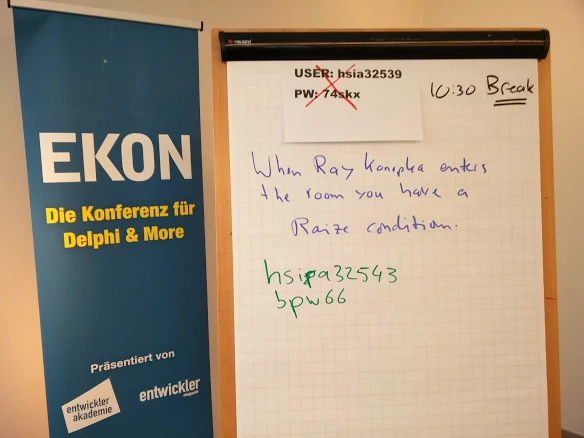
When Ray Konopka enters the room you have a Raize condition.
Via the EKON20 sessions, it made its way into the workshop If you thought you could do multi-threading, then play “The Deadlock Empire” games – Entwickler Konferenz
–jeroen

Posted in Conferences, Delphi, Development, EKON, Event, Software Development | Leave a Comment »
Posted by jpluimers on 2016/11/11
To grow you must first change the size of the container: the partition, the LV, or arraydevice. Then you can resize the file system. It’s the same with XFS, and NTFS. I’m only aware of Apple’sdiskutil resizevolume command that resizes the flavors of HFS+ and at the same time sets the new end valuefor the partition entry.
Source: Development of the BTRFS linux file system (not yet archived at the WayBack machine)
I will need the above for a single disk device having a BTRFS partition sandwiched between a swap and xfs partition:
# parted -l
Model: VMware Virtual disk (scsi)
Disk /dev/sda: 21.5GB
Sector size (logical/physical): 512B/512B
Partition Table: msdos
Disk Flags:

Number  Start   End     Size    Type     File system     Flags
 1      1049kB  1562MB  1561MB  primary  linux-swap(v1)  type=82
 2      1562MB  17.7GB  16.1GB  primary  btrfs           boot, type=83
 3      17.7GB  21.5GB  3799MB  primary  xfs             type=83
I’ll likekly be:
I might be able to do all this from the gparted live CD as moving xfs and growing btrfs is on the GParted — Features list.
Fingers crossed. Luckily I’ve backups (:
–jeroen
Posted in *nix, ESXi4, ESXi5, ESXi5.1, ESXi5.5, ESXi6, Linux, openSuSE, Power User, SuSE Linux, Tumbleweed, VMware, VMware ESXi | Leave a Comment »
 The Wiert Corner - irregular stream of stuff