The Wiert Corner – irregular stream of stuff

Jeroen W. Pluimers on .NET, C#, Delphi, databases, and personal interests

  • My badges

  • Twitter Updates

  • Pages

  • All categories

  • Enter your email address to subscribe to this blog and receive notifications of new posts by email.

    Join 1,854 other subscribers

Author Archive

Need to do some reading on local domains on the internal network

Posted by jpluimers on 2021/04/09

A long time I wondered why I saw ESXi systems on my local network have two entries in their /etc/hosts file:

[root@ESXi-X10SRH-CF:~] cat /etc/hosts
# Do not remove the following line, or various programs
# that require network functionality will fail.
127.0.0.1   localhost.localdomain localhost
::1     localhost.localdomain localhost
192.168.71.91   ESXi-X10SRH-CF ESXi-X10SRH-CF

Then I bumped into someone who had a different setup:

[root@ESXi-X10SRH-CF:~] cat /etc/hosts
# Do not remove the following line, or various programs
# that require network functionality will fail.
127.0.0.1   localhost.localdomain localhost
::1     localhost.localdomain localhost
192.168.0.23    esxi.dynamic.ziggo.nl esxi

So now I knew that the first entry can have a domain resolving it (it still makes be wonder why ziggo is using a top-level domain to resolve local stuff; but searching for  dynamic.ziggo.nl did not get me further on that).

So I installed a quick ESXi machine on that local network, and got the same.

When back home the machine still thought it was esxi.dynamic.ziggo.nl, though clearly I was outside a Ziggo network

I wanted to get rid of it, but that was hard.

Since I forgot to take screenshots beforehand, I can only provide the ones without a search domain bellow.

Reminder to self: visit someone within the Ziggo network, then retry.

Normally you can edit things like these in the default TCP/IP stack. There are two places to change this:

Neither of these allowed me to change it to a situation like this, but luckily the console did.

In the below files, I had to remove the bold parts, then restart the management network (I did keep a text dump, lucky me):

[root@esxi:/etc] grep -inr ziggo .
./vmware/esx.conf:116:/adv/Misc/HostName = "esxi.dynamic.ziggo.nl"
./resolv.conf:2:search dynamic.ziggo.nl 
./hosts:5:192.168.71.194    esxi.dynamic.ziggo.nl esxi
[root@esxi:/etc] cat /etc/resolv.conf 
nameserver 192.168.71.3
search dynamic.ziggo.nl 
[root@esxi:/etc] cat /etc/hosts
# Do not remove the following line, or various programs
# that require network functionality will fail.
127.0.0.1   localhost.localdomain localhost
::1     localhost.localdomain localhost
192.168.71.194  esxi.dynamic.ziggo.nl esxi

Future steps

  1. Read more on local domains, search domains and related topics
  2. Configure a local domain on my local network, so DHCP hands it out, and DHCP handed out host names are put in the local DNS
  3. Test if all services on all machines still work properly

Reading list

Read the rest of this entry »

Posted in DNS, ESXi6.5, ESXi6.7, Hardware, Internet, Mainboards, Network-and-equipment, Power User, SuperMicro, Virtualization, VMware, VMware ESXi, X10SRH-CF, X9SRi-3F | Leave a Comment »

Supermicro Single CPU Board for ESXi Home lab – Upgrading LSI 3008 HBA on the X10SRH-CLN4F | ESX Virtualization

Posted by jpluimers on 2021/04/09

This LSI 3008 HBA update to TI firmware is still on my wish list, but I could not find it when I bought the board in 2018.

[WayBack] Supermicro Single CPU Board for ESXi Home lab – Upgrading LSI 3008 HBA on the X10SRH-CLN4F | ESX Virtualization:

As you know my lab got an addition this year with Supermicro’s Single CPU board, the X10SRH-CLN4F. In this post we will be upgrading LSI 3008 HBA on the X10SRH-CLN4F.

I have learned a new way to patch via UEFI. In fact, it’s same (or easier) than through DOS-based bootable USB. The IT firmware can be reverted back to IR firmware as in the ZIP package there are both versions there. So in case you need a server with hardware RAID, you can use the IR version. I was actually wondering what it means the IT and IR and here is what I have found at LSI (Avago) website:

“IT” firmware maximizes the connectivity and performance aspects of the HBA. “IR” firmware offers RAID functionality via RAID 0, 1, and 10 capabilities.

Via:

SR-IOV?

The step afterwards is to enable SR-IOV for this LSI 3008 HBA.

These links should help with that:


–jeroen

Posted in ESXi6.5, ESXi6.7, Hardware, Mainboards, Power User, SuperMicro, Virtualization, VMware, VMware ESXi, X10SRH-CF | Leave a Comment »

UUID/GUID as primary keys in databases; generating them from a .NET assembly

Posted by jpluimers on 2021/04/08

Some links for my archive:

–jeroen

Posted in .NET, Database Development, Development, PostgreSQL, Software Development, SQL Server | Leave a Comment »

Tidy First?

Posted by jpluimers on 2021/04/08

Reminder to myself to check out of the Tidy First? book by Kent Beck got out yet.

I discovered he was writing it after reading this tweet:

Like Extreme Programming, which I used before I even know about the term, Tidy First is my natural way of approaching code: step by step tidying small spots, so I get a feel on the why and how of the code. For me, tidying consists of very small refactorings. I am anxious to see what it means for Kent.

Related links:

–jeroen

Read the rest of this entry »

Posted in Uncategorized | Leave a Comment »

Delphi TestInsight: when supporting it, test if it is running at all. Same library has a deferer pattern.

Posted by jpluimers on 2021/04/08

Interesting idea by Cesar Romero (who has some interesting repositories at [WayBack] cesarliws (Cesar Romero) · GitHub and [WayBack] cesarliws — Bitbucket) when using TestInsight for Delphi: first test if TestInsight is running at all: [WayBack] foundation-4-delphi/Foundation.Test.Utils.pas at master · cesarliws/foundation-4-delphi · GitHub.

function IsTestInsightRunning: Boolean;
{$IFDEF TESTINSIGHT}
var
  TestInsightClient: ITestInsightClient;
begin
  TestInsightClient := TTestInsightRestClient.Create;
  TestInsightClient.StartedTesting(0);
  Result := not TestInsightClient.HasError;
end;
{$ELSE}
begin
  Result := False;
end;
{$ENDIF}

procedure RunRegisteredTests;
begin
  ReportMemoryLeaksOnShutdown := True;

{$IFDEF TESTINSIGHT}
  if IsTestInsightRunning then
    TestInsight.DUnit.RunRegisteredTests
  else
{$ENDIF}
    DUnitTestRunner.RunRegisteredTests;
end;

Another interesting bit from the same library is the deferer pattern (which is different from the promise pattern!)  in [WayBack] foundation-4-delphi/Foundation.System.pas at master · cesarliws/foundation-4-delphi · GitHub with the below code examples.

I think a better name might be DeferExecutionToEndOfScopeFor.

procedure ProcessFile (const FileName: string);
var
  File: TFile;
begin
  File: = TFile.Open (FileName);
  Defer (File.Close);
  while not File.EOF
  begin
    // ... process file
  end;
end; // Defer will be executed here [File.Close]

procedure ExecSql (const ConnectionString, Sql: string);
var
  Database: TDatabase;
  Exec: IDeferred;
  Query: TQuery;
begin
  Database: = TDatabase.Create (ConnectionString);
  Exec: = Defer (Database.Free);
  Database.Open;
  Exec.Defer (Database.Close);

  Query: = Database.Query (SQL);
  Exec.Defer (Query.Free);
  Exec.Defer (Query.Close);
  if Query.IsEmpty then
   Exit;

  while not Query.EOF
  begin
    // ... process query
  end;

  Exec.Defer (
    procedure
    begin
      Writeln ('Finished ExecSql');
    end
  );
end; // Defer will be executed here [Writeln, Query.Close, Database.Close, Database.Free]

–jeroen

Posted in Delphi, Development, Software Development, Spring4D, TestInsight | Leave a Comment »

Small batch file to recursively compact a directory using NTFS compression

Posted by jpluimers on 2021/04/07

compact-directory-recursively.bat:

if [%1]==[] goto :eof
call compact /s /c %1 %1\*.*

Example usage:

compact-directory-recursively.bat C:\ProgramData\{51D553F1-B483-41C2-B35E-6D461D9E0F9C}

compact-directory-recursively.bat "C:\ProgramData\Package Cache"

@for /d %d in (*.*) do @call compact-directory-recursively.bat "%d"

The @ signs are to get less output clutter.

–jeroen

Posted in Batch-Files, Development, Scripting, Software Development | Leave a Comment »

Maintaining timestamps for future dates when you know the associated location

Posted by jpluimers on 2021/04/07

For past timestamps (or date-times), as long as you know the associated location, you always know the time zone rule that applies, no matter if you store them in UTC or local time zone.

For future dates, UTC might not be the best option, as you have no knowledge on future time zone rules. There you need to have at least three fields:

Read the rest of this entry »

Posted in .NET, Algorithms, Development, Jon Skeet, Software Development | Leave a Comment »

ReturnAddressUnit to provide ReturnAddress to Delphi versions not supporting it, and prevent CallerAddr warnings for Delphi versions having ReturnAddress. See https://bitbucket.org/jeroenp/wiert.me/src/8ae6cf29ffc601fde7c1182dead740adddb13fb8/Native/Delphi/Library/RTL/ReturnAddressUnit.pas

Posted by jpluimers on 2021/04/07

From a check-in a while ago, when some Delphi versions complained about CallerAddr having been replaced by ReturnAddress and other versions not understanding ReturnAddress, but having CallerAddr.

The code in the [WayBack] gist and on [WayBack] BitBucket:

ReturnAddressUnit to provide ReturnAddress to Delphi versions not supporting it, and prevent CallerAddr warnings for Delphi versions having ReturnAddress. See https://bitbucket.org/jeroenp/wiert.me/src/…/Native/Delphi/Library/RTL/ReturnAddressUnit.pas

Basically the code maps a variable having a variable ReturnAddress that is a function reference returning a pointer to a function and redirects to CallerAddr when there is no ReturnAddress available. This is the case for anything below Delphi XE2, and avoids W1000 Symbol 'CallerAddr' is deprecated: 'Use ReturnAddress' for Delphi XE2 and up

It is an extract from [WayBack] dunit-extension/TestCaseExtension.pas at master · fabriciocolombo/dunit-extension · GitHub.

There is more interesting code in [WayBack] GitHub – fabriciocolombo/dunit-extension: Extended DUnit TestCase provides assertions to the types Date, Enumerator, Double, and other types, and a class to help run tests with output as XML, text and GUI mode and even more in [WayBack] fabriciocolombo (Fabricio Colombo) · GitHub , which are on my list of things to play with in the future.

Some more [WayBack] commits are at [WayBack] GitHub – cesarliws/dunit-extension (more on [WayBack] Cesar Romero tomorrow).

I think the code from Fabricio is inspired by [WayBack] ZeosLib/TestFrameWork.pas at master · svn2github/ZeosLib · GitHub as it uses the same HAS_BUILTIN_RETURNADDRESS define.

The code by Fabricio is smarter though.

Via: “Delphi” “CallerAddr” “ReturnAddress” – Google Search

–jeroen

Read the rest of this entry »

Posted in Delphi, Development, DUnit, Software Development | Leave a Comment »

LeanEssays: What If Your Team Wrote the Code for the 737 MCAS System?

Posted by jpluimers on 2021/04/06

[WayBack] LeanEssays: What If Your Team Wrote the Code for the 737 MCAS System?.

When involved in writing systems, I always ask the question “Is a large crisis possible because of this system?”. When yes, such a system needs engineering mode, resulting much more vigorously asking questions on the things that can wrong and how to prevent anything that can go wrong.

So I wholeheartedly agree with Mary Poppendieck making these statements in the above article:

  1. One thing we knew for sure – we were responsible for designing safe systems, and we were not going to delegate that responsibility to anyone else. Another thing we knew for sure was that anything that could go wrong would eventually go wrong – so every element of our systems had to be designed to fail safely; every input to our system was suspect; and no output could be guaranteed to reach its destination. And because my seasoned engineering colleagues were suspicious of automation, they added manual (and very visible) emergency stop systems that could easily and quickly override my automated controls.
  2. would you write the code as specified, or would you ask some questions – such as “What if the stall signal is wrong, and there really isn’t a stall?” Or “Under what conditions do we NOT send an adjustment signal?” Or “When and how can the system be disabled?”

Software engineers need to understand what civil engineers learn as undergraduates – safety is not someone else’s job; it is the responsibility of every engineer involved in the design and implementation of a system whose failure might cause harm. If your team is not ready to accept this responsibility, then call yourselves developers or programmers or technicians – but not engineers.

Proper engineers can do this, even in an agile environment.

–jeroen

Via [WayBack] Mary Poppendieck on Twitter: “It was not a software malfunction that caused two 737 MAX airplanes to crash – the software did exactly what it was supposed to do. But does this mean that software engineers have no responsibility for safety? My 2 cents: …”

Read the rest of this entry »

Posted in Agile, Development, Software Development | Leave a Comment »

msbuild verbosity is not passed to the Delphi command-line compiler any more, but for found units, you can use /p:DCC_OutputDependencies and for dfm/resource files /p:DCC_OutputDependencies

Posted by jpluimers on 2021/04/06

Last week, I wrote about msbuild verbosity levels. The post was both for my own documentation, but also out of need as I wanted to have way more verbose logging for a Delphi build process involving search path configurations.

When using my Delphi build script you can both pass msbuild options and Delphi compiler options:

Run-Dependend-rsvars-From-Path.bat 5 msbuild -verbosity:detailed "/p:DCC_OutputDependencies=true" MyProject.dproj

The bold one is the msbuild parameter, the italic one the Delphi compiler parameter for unit dependencies. They are directly passed to msbuild:

...\msbuild.exe /target:build /p:DCC_BuildAllUnits=true /p:config=Debug -verbosity:detailed "/p:DCC_OutputDependencies=true" MyProject.dproj

You can multiple options too:

Run-Dependend-rsvars-From-Path.bat 5 msbuild -verbosity:detailed "/p:DCC_OutputDependencies=true" "/p:DCC_Quiet=false" MyProject.dproj

In addition to unit dependencies, you can also get an overview of .dfm and other resource file dependencies by passing /p:DCC_OutputDRCFile=true on the command-line this will generate a DRC file that not just has all the resource string constants in it, but also a comment section specifying all resource files including these file types:

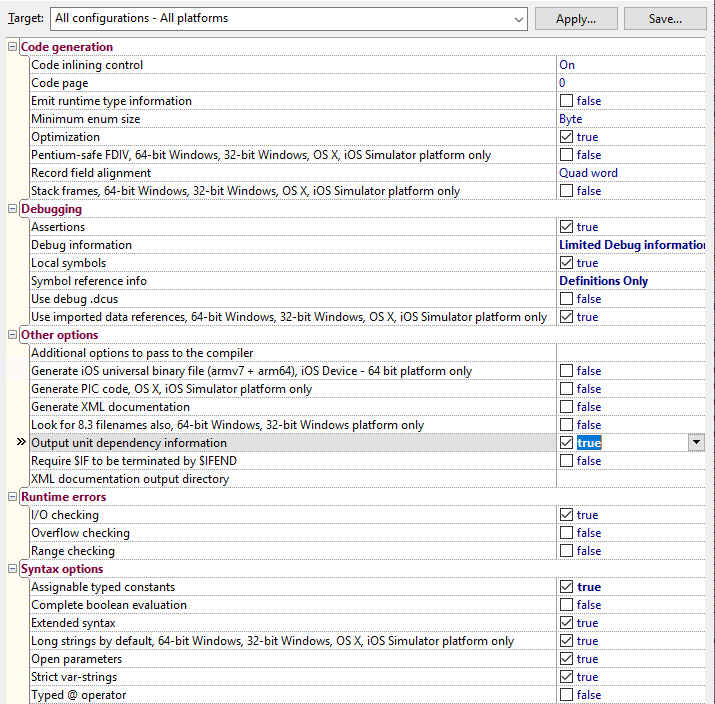
Both DCC_OutputDependencies and DCC_OutputDRCFile can also be set to true in a .dproj file and are configurable under two different project option paths:

  • DCC_OutputDependencies: “Project Options” -> “Delphi Compiler” -> “Compiling” -> “Output unit dependency information”
  • DCC_OutputDRCFile: “Project Options” -> “” -> “Delphi Compiler” -> “Linking” -> “Ouput resource string .drc file”

The -verbosity:detailed however, is not passed to the various Delphi DCC compilers, as somewhere along the line, the CodeGear.Delphi.Targets got changed to Quiet="true" somewhere in-between Delphi 2007 and Delphi 2010.

Delphi 2007 had from Borland.Delphi.Targets files containing from Quiet="$(DCC_Quiet)"; the file got renamed and changes likely in Delphi 2009. See these related posts:

This means as of then on, the DCC commandline compilers will always output non-verbose logging. Even specifying "/p:DCC_AdditionalSwitches=-Q-" will not help: you will just get blank lines.

In the past, one of the things the verbose DCC logging would help you to see which files where accessed using the actual build. This was a tremendous help when figuring out search path problems that kick in every now and then.

For units, there is a little trick you can use here: it’s the /p:DCC_OutputDependencies=true" option you see above.

It will output an additional file with the .d extension that:

  • on the first two lines are an empty line followed by lining having the the .dpr filenamea space and a backslash
  • continues with units in reverse order of dependency:
    • optional lines having two tabs, a full .dcu filename (even if the file was actually a .pas file), a space and a backslash
    • a final line having two tabs, a full .dcu filename (even if the file was actually a .pas file) but no space or backslash

That file is relatively easy to scan or parse for path problems.

Project settings

I am not sure at which Delphi version the depends feature became a project setting, but it is. The odd thing: it does not always work, at least not in the Delphi 102. Tokyo installations I have used.

In a .dproj file, it is inside this element: <DCC_OutputDependencies>true</DCC_OutputDependencies> just like the msbuild name.

In the UI, you can find it here:

Related

–jeroen

Posted in Continuous Integration, Delphi, Development, msbuild, Software Development | Leave a Comment »