Thanks DevShed:
ls -l –time-style=full-iso
Emits full ISO 8601 time stamps and it works on:
- SuSE Linux
- Mac OS X
- Cygwin
–jeroen
Posted by jpluimers on 2013/12/16
Thanks DevShed:
ls -l –time-style=full-iso
Emits full ISO 8601 time stamps and it works on:
–jeroen
Posted in *nix, Cygwin, Linux, Power User, SuSE Linux | Leave a Comment »
Posted by jpluimers on 2013/12/06
Like forgetting about the tar syntax, I usually forget which is the left parameter in an ln command (the file or link? it is the file!)
Thanks [WayBack] cyberciti.biz:
There are two types of links
- symbolic links: Refer to a symbolic path indicating the abstract location of another file
- hard links : Refer to the specific location of physical data.
To create a symbolic link in Unix or Linux, at the shell prompt, enter the following command:
ln -s {target-filename} {symbolic-filename}
–jeroen
Posted in *nix, Cygwin, Endian, Linux, Power User, SuSE Linux | 2 Comments »
Posted by jpluimers on 2013/09/09
A while ago, I had to transfer a couple of files from a Linux machine where I did have console access, but no proper network access.
This was the sequence to get it connected and copy a directory to the USB flash drive:
# fdisk -lDisk /dev/sdd: 8019 MB, 8019509248 bytes
20 heads, 16 sectors/track, 48947 cylinders
Units = cylinders of 320 * 512 = 163840 bytes
Device Boot Start End Blocks Id System
/dev/sdd1 * 1 48948 7831512 b Win95 FAT32/mnt/USB directory to mount the device to using the mkdir command:# mkdir /mnt/USBmodprobe command to make sure the vfat file system support is loaded:# modprobe vfatmount command to mount the device from the first step (/dev/sdd1) to the directory you created (/mnt/USB)# mount /dev/sdd1 /mnt/USBrsync command to recursively (-p) copy a directory maintaining timestamps (-t) and showing progress (-v)# rsync -rtv /home/user/directory/ /mnt/USB/directory/umount command to unmount the directory (and therefore the device)# umount /mnt/USB–jeroen
Posted in *nix, Linux, Power User, SuSE Linux | Leave a Comment »
Posted by jpluimers on 2013/09/06
As Dave mentioned a couple of years ago in an article smbd_unable_to_connect_to_cups_server, even if you have printing disabled in Samba, you can get errors in /var/log/messages like these±
May 5 09:45:02 www smbd[<pid>]: [2008/05/05 09:45:02, 0] printing/print_cups.c:cups_connect(69)
May 5 09:45:02 www smbd[<pid>]: Unable to connect to CUPS server localhost:631 - Connection refused
This happens even if you disable the printers and print$ shares from within YaST2.
He proposed a 5-line change in the /etc/samba/smb.conf, but testing this on openSUSE 12.x, shows the actual diff is a lot smaller: just change the entry for printcap name, then add an entry for disable spoolss.
This is the diff of /etc/samba/smb.conf.printing versus /etc/samba/smb.conf: Read the rest of this entry »
Posted in *nix, Linux, openSuSE, Power User, SuSE Linux | Leave a Comment »
Posted by jpluimers on 2013/09/02
When installing samba on a “minimal” server openSUSE 12.x can give you a funny error that the install process conflicts with a “patterns-openSUSE-minimal_base-conflicts” package as for instance described in OpenSUSE 12.2 Samba Standalone Server With tdbsam Backend | HowtoForge – Linux Howtos and Tutorials.
The first time I got that message, I was confused, and it took me a while to find out about the meaning of the base-conflicts package, as it was hard to get a Google search query with really meaningful result.
At last I found a Gitorious entry describing the minimal_base-conflicts package:
create a separate minimal_base-conflicts pattern
this allows to keep the minimal_base pattern upon installing a conflicting package. A better solution would be weak-conflicts but we don’t have that atm
From there I found the security request openFATE – #312150: weak conflicts/softlocks/no-recommends for patterns:
Installation of a pattern also draws in packages that are not in the pattern but only recommended by those listed in the pattern. For the “minimal” pattern this behavior is not desirable though as one really wants a minimal installation without the optional stuff.
So basically, the minimal_base-conflicts package allows the minimal_base package to reference package without pulling in a truckload of package (that would basically violate the idea of a “minimal_base” install).
If you want to install one of the truckload (samba is one of them), then you need to uninstall the minimal_base-conflicts package.
–jeroen
via: OpenSUSE 12.2 Samba Standalone Server With tdbsam Backend | HowtoForge – Linux Howtos and Tutorials.
Posted in *nix, Linux, openSuSE, Power User, SuSE Linux | Leave a Comment »
Posted by jpluimers on 2013/08/30
When VMware Workstation/Player does an Easy Install of SUSE Linux (and most other Linuxes), it does this:
For Linux, both of them contain autoinst.xml files to automate the boot process.
It has a few drawbacks including a hardcoded boot partition size and unmount problems, so if you don’t want those, follow the guidelines at How to Stop Easy Install in VMware Workstation.
–jeroen
Posted in *nix, Linux, openSuSE, Power User, SuSE Linux, Virtualization, VMware, VMware Workstation | Leave a Comment »
Posted by jpluimers on 2013/08/26
PDF User Manual for Avira AntiVir Server | Unix and Avira AntiVir Professional | Unix.
It is not completely up to date (as most installations are now RPM based), but gives great background information.
If you are using SUSE Linux, then note that as of openSUSE 11.3, there is a glitch when you use the SUSE security repository (see Bug 633771 – antivir cannot be installed because of missing libdazuko.so).
Basically there are two solutions to this:
The former seems to be a viable solution as per PDF User Manual, the installation proceeds as follows:
linking /usr/lib/AntiVir/guard/libdazuko.so to /usr/lib/AntiVir/guard/
libdazuko3compat2.so...
And indeed it does: these are the steps to follow, first for adding the security repository, then to install the package (click on images to view larger versions): Read the rest of this entry »
Posted in *nix, Linux, openSuSE, Power User, SuSE Linux | Leave a Comment »
Posted by jpluimers on 2013/08/19
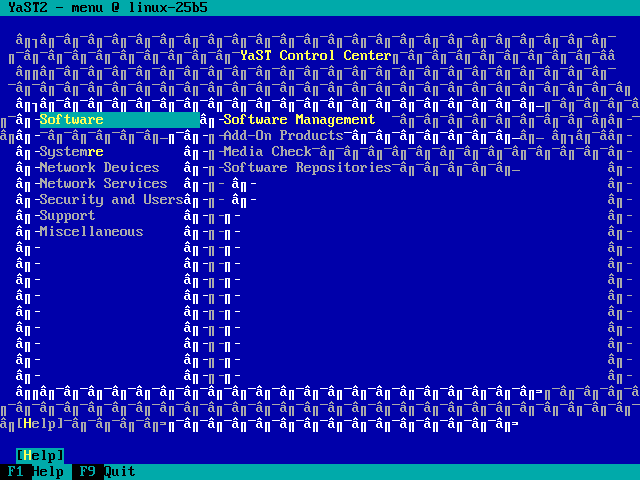
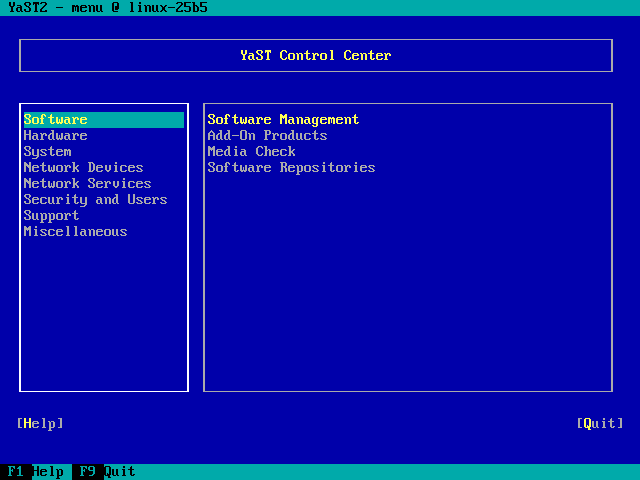
Since SuSE 11.2, when installing then the CLI version of YaST looks horrible on the first (Ctrl-Alt-F1) console before you do your first reboot.
Workarounds:
Before/After (click on the images to enlarge):
–jeroen
Posted in *nix, Linux, openSuSE, Power User, SuSE Linux | Leave a Comment »
Posted by jpluimers on 2013/07/31
Wrote a small script that goes into my monthly crontab.
It gets ftp://ftp.internic.net/domain/named.cache into /var/lib/named/named.cache.new, and logs when you need to copy it over into /var/lib/named/root.hint
Posted in *nix, Development, Linux, Power User, Scripting, Sh Shell, Software Development, SuSE Linux, wget | Leave a Comment »
Posted by jpluimers on 2013/07/05
My sendmail setup is a 2-staged one.
Every once in a while one of the stages stops, and mostly they recover.
Sometimes the second stage doesn’t, which causes a lot of messages in the queue get the deferred status.
Re-trying those deferred messages was a bit of a trial and error case, as my search efforts resulted in a lot of messages telling me what should work, but not what actually works.
First of all, mailq shows you what is stuck in the queue.
snap:~ # mailq
/var/spool/mqueue (2 requests)
-----Q-ID----- --Size-- -----Q-Time----- ------------Sender/Recipient-----------
q9FLFBkD002197 11967 Mon Oct 15 23:15 MAILER-DAEMON
(Deferred: Connection timed out with smtp.anbid.com.br.)
<debutvtr1@anbid.com.br>
q7S6oxgS023145 5067 Tue Aug 28 08:50 MAILER-DAEMON
8BITMIME (Deferred: Connection timed out with mail.admail.com.ar.)
<trustiest76@admail.com.ar>
Total requests: 2
You can add some parameters for it to show other queues.
So I have a little mq script that shows all queues:
#!/bin/bash
echo "Outgoing mailq";
sudo mailq;
echo " ";
echo "Submit mailq";
sudo mailq -Ac;
echo " ";
echo "Incoming mailq";
sudo mailq -C/etc/sendmail-rx.cf;
These are the commands I tried to flush the outgoing mailq:
sendmail -v -q
sendmail -v -q -OTimeout.hoststatus=0m
sendmail -v -qR@
Only the last one worked correctly.
–jeroen
Posted in *nix, Linux, Power User | Leave a Comment »