Ah, C. The best lingua franca we have… because we have no other lingua francas. Linguae franca. Surgeons general? C is fairly old — 44 years, now! — and comes from a time when there were possibly more architectures than programming languages. It works well for what it is, and what it is is a relatively simple layer of indirection atop assembly. Alas, the popularity of C has led to a number of programming languages’ taking significant cues from its design, and parts of its design are… slightly questionable. I’ve gone through some common features that probably should’ve stayed in C and my justification for saying so. The features are listed in rough order from (I hope) least to most controversial. The idea is that C fans will give up when I call it “weakly typed” and not even get to the part where I rag on braces. Wait, crap, I gave it away.
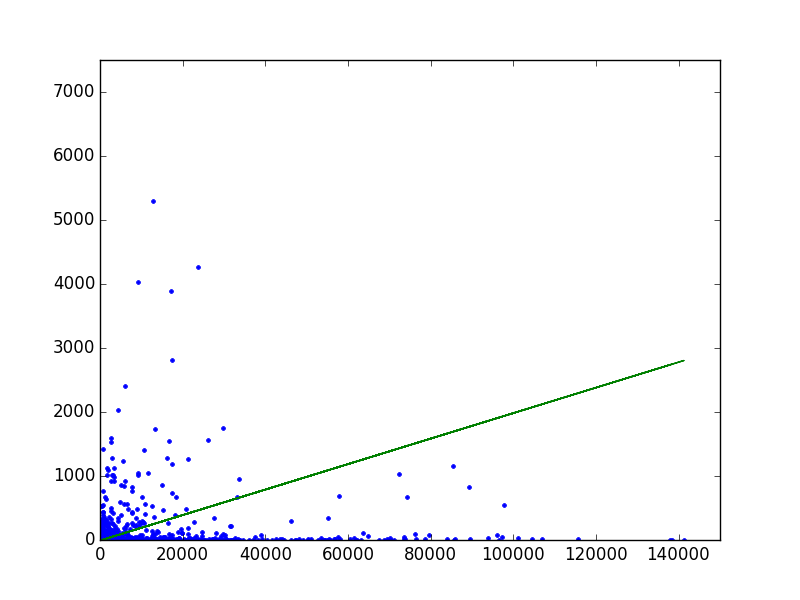
First example is to eliminate outliers in the below graph.
He also has a really cool (German) Playlist on data analysis with Python called Datenanalyse in Python and has a great site with examples at franz.media.
It’s free until the end of Friday, Dec 1, 2017. Afterwards it goes back to its normal $50 price. (Though you can use this link https://www.udemy.com/automate/?couponCode=FOR_LIKE_10_BUCKS to buy it for $10. And it’s an open secret that if you browse Udemy in privacy mode, they’ll show you the discount price to lure in a “new” customer. But course creators get a much larger cut when people use their referral codes.)
The course follows the book of the same name, which is available for free, in full, at [WayBack] https://automatetheboringstuff.com under a Creative Commons license. (Which I encourage you to use to share your own creative works.)
A network graph with more than a thousand programming languages connected by influence relations. Highly influential languages like Lisp, Smalltalk, C, Java, Pascal, C++, Haskel or Python are shown as larger circles as compared to languages with little influence on others like PHP or Argh!. / The influence relation data was retrieved from Freebase in 2013. This design available on posters and other products. An awesome gift for programmers who are into digital art. • Also buy this artwork on wall prints, apparel, kids clothes, and more.
As seen on TV! What if you could increase the resolution of your photos using technology from CSI laboratories? Thanks to deep learning and #NeuralEnhance, it’s now possible to train a neural network to zoom in to your images at 2x or even 4x. You’ll get even better results by increasing the number of neurons or training with a dataset similar to your low resolution image. The catch? The neural network is hallucinating details based on its training from example images. It’s not reconstructing your photo exactly as it would have been if it was HD. That’s only possible in Hollywood — but using deep learning as “Creative AI” works and its just as cool! Here’s how you can get started..
Interesting, as I thought Mac OS X Yosemite and up – having Python installed – would also keep Python up-to-date, but they don’t.
Hence:
Installing Python on Mac OS X
The latest version of Mac OS X, Yosemite, comes with Python 2.7 out of the box.
…
The version of Python that ships with OS X is great for learning but it’s not good for development. The version shipped with OS X may be out of date from the official current Python release, which is considered the stable production version.





 The Wiert Corner - irregular stream of stuff