


Got an error when pushing a relatively large commit to GitLab: error: RPC failed; HTTP 502 curl 22 The requested URL returned error: 502
There was no big difference in information between these commands¹:
git pushgit push --verbose
Posted by jpluimers on 2026/05/27
Got an error when pushing a relatively large commit to GitLab: error: RPC failed; HTTP 502 curl 22 The requested URL returned error: 502
There was no big difference in information between these commands¹:
git pushgit push --verbose
Posted in //e, 6502, Apple, Apple ///, Apple IIgs, Apple ][, Development, DVCS - Distributed Version Control, git, GitLab, History, Power User, Software Development, Source Code Management, Versioning | Leave a Comment »
Posted by jpluimers on 2026/05/06
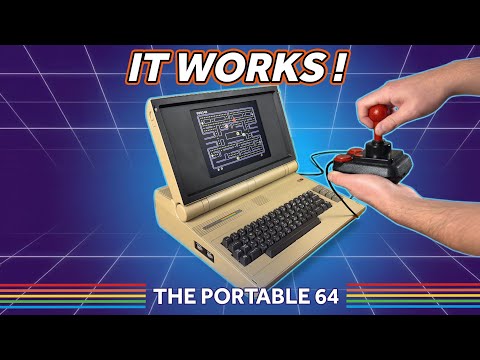
Cool to see what 3D printing plus a Raspberry Pi emulating a C64 can do [Wayback/Archive] I Built a Commodore 64 Laptop That Never Existed (PI + EMULATION) – The Portable 64 Concept Design – YouTube.
The Portable 64 with an original Commodore 64 joystick
However, published in December 2025 after Commodore had been resurrected from the C= brands, it would have been way cooler if was based on new Commodore 64 Ultimate hardware.
Maybe someone will do such a portable computer based on that hardware, or even better that it becomes available at [Wayback/Archive] Home | Commodore.
--jeroen

Posted in Development, Power User, History, Hardware Development, 6502, 3D printing, Commodore, C64, Retrocomputing | Leave a Comment »
Posted by jpluimers on 2026/05/04
 Via [Wayback/Archive] Der Kneisner M100 – oder das “once in a lifetime project” | Computermuseum Visselhövede, about an IMSAI 8080 clone, I bumped into the VT220 based Glass TTY VT220 font and found some links of it and it’s modifications which are listed below by category

Posted in 8080, Development, Font, History, JavaScript/ECMAScript, LifeHacker, Power User, Retrocomputing, Scripting, Software Development | Tagged: DEC, fonts, Typography, vintagecomputing | Leave a Comment »
Posted by jpluimers on 2026/04/24
[Wayback/A] Screenshot of Pitfall II: Lost Caverns (Apple II, 1984) – MobyGames
Pitfall II: Lost Caverns (Apple II) screenshot:Title screen (this version has been cracked)
Memories of Apple II, ][e and //c.
There was quite a good crack-scene in The Netherlands with a well known name “The Redhead”.
Back then I didn’t know about the BBS systems involved:

Posted in //e, Apple, Apple ][, BBS, FidoNet, History, Power User | Leave a Comment »
Posted by jpluimers on 2026/04/01
For a while now, after initially displaying archived Google Search results, it changes the Wayback Machine archival URL after displaying.
Examples:
https://web.archive.org/web/20230322163526/https://www.google.com/web/20230322163526/https://www.google.com/search?q=excel+last+delimiterhttps://web.archive.org/web/20230321192712/https://www.google.com/search?q=excel+textafter+textbefore+textsplit+site:https:%2F%2Fsupport.microsoft.com%2Fen-us%2Foffice%2F&google_abuse=GOOGLE_ABUSE_EXEMPTION%3DID%3D3020867903a1f6fa:TM%3D1679426832:C%3D%3E:IP%3D207.241.225.236-:S%3DTSrpWMPwWKoNpiXh-oD21Q%3B+path%3D/%3B+domain%3Dgoogle.com%3B+expires%3DTue,+21-Mar-2023+22:27:12+GMThttps://web.archive.org/web/20230321192712/https://www.google.com/web/20230321192712/https://www.google.com/search?q=excel+textafter+textbefore+textsplit+site:https:%2F%2Fsupport.microsoft.com%2Fen-us%2Foffice%2F&google_abuse=GOOGLE_ABUSE_EXEMPTION%3DID%3D3020867903a1f6fa:TM%3D1679426832:C%3D%3E:IP%3D207.241.225.236-:S%3DTSrpWMPwWKoNpiXh-oD21Q%3B+path%3D/%3B+domain%3Dgoogle.com%3B+expires%3DTue,+21-Mar-2023+22:27:12+GMTI want to write a Bookmarklet that fixes these.
There is not much in the results of
[Wayback/Archive] “GOOGLE_ABUSE_EXEMPTION” “Wayback” – Google Search, but I think this happens when there is a high frequency Google Search archivals from the Wayback Machine.
–jeroen

Posted in Google, GoogleSearch, History, Internet, InternetArchive, Power User, WayBack machine | Leave a Comment »
Posted by jpluimers on 2026/03/27
| Below is a dump of links about FidoNet links with a few remarks so I won’t forget as it was 25+ years ago that I stopped hosting the FidoNet node that had been on-line for almost 10 years (I was a FidoNet point for a few years before that).
See also my other FidoNet posts. |
                    __
                   /  \
                  /|oo \
                 (_|  /_)
                  _`@/_ \    _
                 |     | \   \\
                 | (*) |  \   ))
    ______       |__U__| /  \//
   / FIDO \       _//|| _\   /
  (________)     (_/(_|(____/
 (c) John Madill
FidoNet logo by John Madill
|
Posted in BBS, FidoNet, History | Leave a Comment »
Posted by jpluimers on 2026/03/04
Finding a reference to DASM while researching yesterday’s post @jpluimers on Twitter: “@b0rk @jilles_com Acids vs bases.”, it felt even more like a trip like memory lane as I had used it in the 1980s on Apple ][ and Apple //e after mainly using EDASM. Lisa and Merlin.
I am glad that it is still alive and kicking with home page at [Wayback/Archive] dasm – macro assembler for 8-bit machines and repository at [Wayback/Archive] dasm-assembler/dasm: Macro assembler with support for several 8-bit microprocessors.
Especially this history section on the home page rang a bell:
- Matthew Dillon started dasm in 1987-1988.
- Olaf “Rhialto” Seibert extended dasm in 1995.
- Andrew “Dr.Boo” Davie maintained dasm in 2003-2008.
- Peter Fröhlich maintained dasm in 2008-2015.
- In 2019, the dasm source code and releases were moved to GitHub.
More links from this trip down memory lane:
Posted in Software Development, Development, Power User, History, Apple, Assembly Language, Apple ][, //e, 6502 Assembly | Leave a Comment »
Posted by jpluimers on 2026/03/03
A few years back I tweeted [Wayback/Archive] Jeroen Wiert Pluimers @wiert@mastodon.social on Twitter: “@b0rk @jilles_com Acids vs bases.”
It was a kind of tongue-in-cheek reaction (with a way better picture below) to a very valuable post by b0rk (Julia Evans) on both Twitter and Mastodon [Wayback/Archive] Julia Evans on Twitter: “bases” / [Wayback/Archive] Julia Evans: “bases title: bases # we usually…” – Mastodon for two reasons:
Back to Julia’s post:
Posted in *nix, *nix-tools, 68k, 8086, Assembly Language, bash, bash, C, C++, Chemistry, Conference Topics, Conferences, Development, EPS/PostScript, Event, Haskell, History, Java, Java Platform, JavaScript/ECMAScript, Jon Skeet, LifeHacker, Mathematics, PDP-11, Perl, PHP, Power User, Python, science, Scripting, Software Development, x86 | Leave a Comment »
Posted by jpluimers on 2026/03/02
On the history of ISBN and their representation in EAN codes: [Wayback/Archive] Why does every book come from the same country? – YouTube.
TL;DR: EAN unique country codes (now GS1 country codes) 978 and 979 are Bookland.
--jeroen
Posted in History, LifeHacker, Power User | Leave a Comment »
Posted by jpluimers on 2026/02/23
I pulled this post forward from the blog queue in light of the recent Archive Today controversy (which started because of the Gyrovague article mentioned below). Please note that in this controversy, the Wayback Machine of the Internet Archive plays no role: it is purely about the Archive Today behaviour. Apart from this remark above the line I left this blog post in the original form I wrote it in, as I liked it a lot and quite a few published and queued blog posts still depend on it.
From a while back, but still a historic relevant article: [Wayback/Archive] archive.today: On the trail of the mysterious guerrilla archivist of the Internet – Gyrovague
Via [Wayback/Archive] difference between archive today and wayback machine – Google Search
Related:

Posted in Archive Today controversy, archive.is / archive.today, Archiving, Bookmarklet, History, Internet, mementoweb, Power User, WayBack machine, Webcitation | Leave a Comment »

 The Wiert Corner - irregular stream of stuff