The Wiert Corner – irregular stream of stuff

Jeroen W. Pluimers on .NET, C#, Delphi, databases, and personal interests

  • My badges

  • Twitter Updates

  • My Flickr Stream

  • Pages

  • All categories

  • Enter your email address to subscribe to this blog and receive notifications of new posts by email.

    Join 1,860 other subscribers

Archive for the ‘VMware ESXi’ Category

Resize your VMware ESXi/ESX/vSphere disks (via JJClements.co.uk)

Posted by jpluimers on 2011/06/13

James Clements explains how to resize your VMware ESXi/ESX/vSphere disks.

You can resize the disks live when using ESXi/ESX/vShere 4 and up.

When using Windows Vista or 2008 and up, you don’t need special tools for resizing the partitions on those disks: the built-in disk manager can do it.

When using Windows 2003 Server, Windows XP or less, then you need the EXTPART tool from Dell as explained by GeekSeat:

All you need to do now is provision the extra space to the VM, then run the tool at the command line and follow the wizard:

C:\>extpart.exe
ExtPart - Utility to extend basic disks (Build 1.0.4)
(c) Dell Computer Corporation 2003
.
Volume to extend (drive letter or mount point): c:
Current volume size : 66285 MB (69504860160 bytes)
Current partition size : 76285 MB (79990815744 bytes)
Size to expand the volume (MB): 76285

that’s it – job done . . zero downtime (watch out of course . . this works differently if you have a clustered disk to extend – see: http://geekseat.wordpress.com/2011/01/25/replacing-clustered-storage-for-a-sql-cluster-emc-ce-ms-clustering/ )

Note the “Size to expand” is actually the number of MB you are adding to the volume as Redelijkheid explains.

Sometimes you need to do this in multiple steps as diskmgmt.msc does not always give the free partition space in megabytes.

There is no need to reboot after expanding using ExtPart.

Edit: 20111222; you can download ExtPart through the DELL web-site; there are also direct http downloads of the EXE and README, and direct ftp downloads for the EXE and README.

If you don’t trust ExtPart, there is always the GParted way as explained by BleepingComputer.com.

–jeroen

via: 

Posted in ESXi4, ESXi5, ESXi5.1, Power User, VMware, VMware ESXi | 2 Comments »

Change your ESXi machine’s network hostname, DNS information (and SSL certificate)

Posted by jpluimers on 2010/10/22

Since you do this only once per server, it is easy to forget (I do) where to specify the hostname of your ESXi server.

vm-help.com describes in Change your host’s network name how easy it is in ESXi 3.x (and also how to change the DNS information and SSL certificate).

ESXi 4.x is very, but not completely, similar Read the rest of this entry »

Posted in ESXi4, Power User, VMware | 1 Comment »

Great new ESXi 4.1 feature: USB Pass Through

Posted by jpluimers on 2010/10/18

A great new ESXi 4.1 feature us the much simplified support of USB Pass Through.

In fact it is one of the biggest reasons I updated so quickly; I have been running it now for almost 3 months now. Read the rest of this entry »

Posted in ESXi4, Hardware Interfacing, Power User, USB, VMware | 3 Comments »

Windows XP: changing the HAL to support multiple cores (actually: two CPUs)

Posted by jpluimers on 2010/10/14

A while ago, I moved a single CPU Windows XP VM from VMware Workstation to ESXi 4.1 using the standalone VMware vCenter converter.
In ESXi, I increased the CPU count from 1 to 2, and wanting to to for 4 (since  I had been running Windows on a quadcore CPU before).

Well, that turned out to be harder than I thought… Read the rest of this entry »

Posted in ESXi4, Power User, Reference, Virtualization, VMware, VMware Converter, Windows, Windows 7, Windows Vista, Windows XP | 6 Comments »

ENDIAN Firewall – Connected client can access EFW but no other hosts: enable promiscuous mode on VMware ESXi

Posted by jpluimers on 2010/10/12

While solving a problem with Windows 7 machines not being able to ping the machines on the GREEN LAN of an Endian when connecting through OpenVPN, but XP machines could, I did a few upgrades, then went on to solve the problem.

  • Upgraded from ESX 3.5 to ESXi 4.1 (I needed this anyway because of Pass Through USB support)
  • Upgraded the community edition appliance from Endian 2.2 to Endian 2.4 (which has more configuration options, and better ways for reporting and logging)

Then I went on solving the issue, which I suspected was a kind of routing problem. Read the rest of this entry »

Posted in Endian, ESXi4, ESXi5, ESXi5.1, Firewall, Infrastructure, OpenVPN, Power User, VMware, VMware ESXi | 8 Comments »

Performed an VMware ESXi 4.0 to 4.1 Update: 5 minutes of work

Posted by jpluimers on 2010/10/06

Thanks to an excellent post by Peter Sebastian from Jargon Technology, it was a breeze to upgrade.

I did the upgrade using Using the vMA virtual appliance, the statements are these:

After bringing the ESXi 4.0 box into maintenance mode, I performed these steps on an SSH connection to the vMA virtual appliance: Read the rest of this entry »

Posted in *nix, ESXi4, Power User, VMware, VMware ESXi, wget | Leave a Comment »

VMware ESXi 4.0 / ESXi 4.1: enable SSH login for non-root users (and only them)

Posted by jpluimers on 2010/09/28

VMware ESXi has SSH disabled by default.

In ESX / ESXi 3 and 3.5, it took a while for people to recognize the ‘unsupported’ trick and enable SSH.
In ESXi 4.0, /sbin/services.sh was fixed, so SSH was easier to enable (note: only delete the # in front of the first ssh).
Since ESXi version 4.1, SSH is called “Remote Tech Support (SSH)”, and it very easy to enable from the console.
Thomas Maurer described how easy it is to activate SSH in ESXi 4.1. He provides clear screen shots, whereas the VMware knowledge base article just lists the textual steps.

But contrary to ESX/ESXi 3.5 and lower, and *nix habits, enabling SSH on ESXi 4.x will enable this for the root user.
This has to do with the switch between ESX/ESXi 3.5 and 4.0 from to the dropbear ssh daemon (in the /sbin/dropbearmulti binary).
Dropbear is a very lightweight implementation of the SSH 2 protocol; ideal for ESXi which – as a hypervisor – needs to have a really low footprint.

In addition to the dropbear change, SSH is disabled for non-root users (which has nothing to do with dropbear, see below).

This post is about how to fix not only the SSH (as above) but also how to allow specific users to use SSH. Read the rest of this entry »

Posted in ESXi4, Keyboards and Keyboard Shortcuts, Power User, VMware | 9 Comments »

Moving my VMs from ESX 3.5 to ESXi 4.1

Posted by jpluimers on 2010/09/23

After doing quite a bit of research and testing, these are the steps I used to move my VMs from an ESX 3.5 box to an ESXi 4.1 box. Read the rest of this entry »

Posted in Endian, ESXi4, Power User, Veeam | Leave a Comment »

Talking SOAP to your ESXi box: VMware vSphere Web Services SDK

Posted by jpluimers on 2010/09/22

Note that what you can do through the SDK (and vMA and its’ virtual appliance or that matter) is limited by what your ESX / ESXi license allows.

The VMware KB has more information on this: you will need at least a vSphere Essentials license for your ESXi box to use it..

If you have a free ESXi license, you will often get messages like these:

SOAP Fault:

Fault string: fault.RestrictedVersion.summary
Fault detail: RestrictedVersionFault

Read the rest of this entry »

Posted in Development, ESXi4, Power User, SOAP/WebServices, VMware | Leave a Comment »

x64 support in ESXi4.1 requires VT, I know that! but why warn so late?

Posted by jpluimers on 2010/08/16

I know that ESXi 4.1 requires VT (the Intel support for hardware assisted virtualization) to be enabled to run x64 VMs.
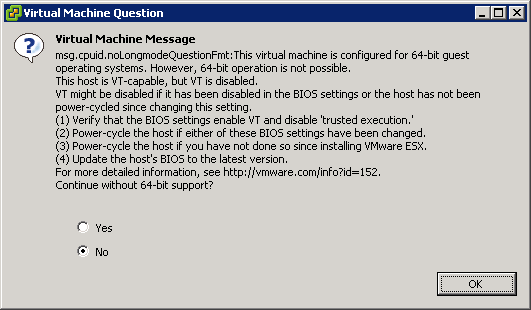
This is the warning that you get when starting an x64 VM, and you don’t have VT enabled:

[Window Title]
Virtual Machine Message
[Main Instruction]
Virtual Machine Message
msg.cpuid.noLongmodeQuestionFmt: This virtual machine is configured for 64-bit guest
operating systems. However, 64-bit operation is not possible.
This host is VT-capable, but VT is disabled.
VT might be disabled if it has been disabled in the BIOS settings or the host has not been
power-cycled since changing this setting.
(1) Verify that the BIOS settings enable VT and disable ‘trusted execution.’
(2) Power-cycle the host if either of these BIOS settings have been changed.
(3) Power-cycle the host if you have not done so since installing VMware ESX.
(4) Update the hosts’s BIOS to the latest version.
For more detailed information, see http://vmware.com/info?id=152
Continue without 64-bit support?
[Yes] [No] [OK]

Read the rest of this entry »

Posted in BIOS, Boot, ESXi4, Hardware, HP XW6600, Power User, Virtualization, VMware, VMware ESXi | 3 Comments »