


Somehow my Sharing Pulibicize at facebook.com broken since august 1st. Posts at Wiert.me were not published to my Facebook timeline.
This post is to see if the steps at Publicize to Facebook not working fixed my problem.
–jeroen
Posted by jpluimers on 2012/09/27
Somehow my Sharing Pulibicize at facebook.com broken since august 1st. Posts at Wiert.me were not published to my Facebook timeline.
This post is to see if the steps at Publicize to Facebook not working fixed my problem.
–jeroen

Posted in Facebook, LifeHacker, Power User, SocialMedia | Tagged: august 1st, facebook, social-media, timeline | Leave a Comment »
Posted by jpluimers on 2012/08/28
Dang; I thought this had long left the posting queue, but somehow it ended in the drafts (:
Since then, many more event videos made it to Channel 9, including Build 2011, and TechDays 2012.
Anyway, here it is:
Microsoft’s PDC 2010 was held at the end of October 2010 in Redmond, WA, USA.
For the people that could not attend, it is very nice to view the sessions using the PDC10 player (it seems still people didn’t learn and start stripping the century parts from years again!).
Even if you are not using Visual Studio, .NET Azure or other Microsoft Technologies, there are a lot of interesting sessions showing the directions that Microsoft is taking.
Comparing that to what you do today is always a good thing to do: it helps you reflect, an important part of your personal development.
A few things I found interesting (in no particular order):
Enjoy!
–jeroen
Posted in .NET, .NET 4.5, C#, C# 4.0, C# 5.0, Channel9, Cloud Development, Database Development, Delphi, Development, HTML, HTML5, Mobile Development, SilverLight, SocialMedia, Software Development, Visual Studio 11, Visual Studio 2010, Visual Studio and tools, Web Development, Windows Azure, Windows Phone Development, XNA | 2 Comments »
Posted by jpluimers on 2012/08/22
In Generating a WordPress posting categories page – part 1, you learned how to
This episode, you will learn how the data read from the XHTML can be transformed to a simple tree in HTML suited for a posting categories page like mine.
In the final post, the same data will be transferred into a real category cloud with font sizes indicating the frequency of the category usage.
From there, you can go into other directions (for instance generating squarified treemaps from the data).
That’s the cool thing about data: there are many ways to visualize, and this series was meant – next to some groundwork on how to get the data – as inspiration into some forms of visualization.
Hope you had fun reading it!
                StringBuilder outputHtml = new StringBuilder();
                string rootUrl = args[1];
                foreach (optionType item in select.option)
                {
                    if (item.Level == optionType.RootLevel)
                        continue;

                    // <a style="font-size: 100.3986332574%; padding: 1px; margin: 1px;" title="XML/XSD (23)" href="https://wiert.me/category/development/xmlxsd/">XML/XSD</a>
                    string url = String.Format("{0}/category{1}", rootUrl, item.HtmlPath);
                    string prefix = new string('.', item.Level * 5);// optionType.NbspEscaped.Repeat(item.Level);
                    outputHtml.AppendFormat("{0}<a title="{2}" href="{1}">{2} ({3})</a>", prefix, url, item.Category, item.Count);
                    outputHtml.AppendLine();
                }
One way of generating an HTML tree, is to prefix every node with a series of dots corresponding with the level of that node. Not the most pretty sight, but it will suffice for this episode.
Inside each node, I want to show the Category and Count.
Since the optionType as generated from the XSD only contains the below properties, a major portion on this posting is how to decode the Value so we can generate HTML like this:
...............<a href='https://wiert.me/category/development/software-development/net/c-' title='C#'>C# (118)</a> ....................<a href='https://wiert.me/category/development/software-development/net/c-/c--2-0' title='C# 2.0'>C# 2.0 (46)</a> ....................<a href='https://wiert.me/category/development/software-development/net/c-/c--3-0' title='C# 3.0'>C# 3.0 (33)</a> ....................<a href='https://wiert.me/category/development/software-development/net/c-/c--4-0' title='C# 4.0'>C# 4.0 (31)</a> ....................<a href='https://wiert.me/category/development/software-development/net/c-/c--5-0' title='C# 5.0'>C# 5.0 (2)</a>
optionType only contains the these properties:
Slug and Value without breaking the links between posts and categoriesThe extra properties needed for the HTML generation logic above are these:
Value undone from leading non breaking space character escapes, and the trailing count informationC# 5.0Value undone from leading non breaking space character escapes, Caption information, separator non breaking space character escapes, and surrounding parenthesis2class undone from the level- prefix4c--5-0 (it consists of lowercase letters and hyphens derived from the Category)/category in the category url/development/software-development/net/c-/c--5-0 that points to https://wiert.me/category/development/software-development/net/c-/c–5-0The really cool thing about XSD2Code is that it generated the optionType C# code as a partial class.
Which means we can extend the generated partial classes in a seperate C# file like the code fragments below (you can download it from the WordPressCategoriesDropDown.cs file at BeSharp.CodePlex.com)
partial class optionType
{
public const int RootLevel = -1;
private const string slash = "/";
private const char hyphen = '-';
public const string NbspEscaped = " ";
private const string emptyCountInParenthesis = "(-1)";
public optionType parent { get; set; }
public string Category
{
get
{
string result;
string countInParenthesis;
splitValue(out result, out countInParenthesis);
return result;
}
}
public int Count
{
get
{
string category;
string countInParenthesis;
splitValue(out category, out countInParenthesis);
string count = countInParenthesis.Substring(1, countInParenthesis.Length - 2);
int result = int.Parse(count);
return result;
}
}
public int Level
{
get
{
if (string.IsNullOrWhiteSpace(@class))
return RootLevel;
string[] split = @class.Split(hyphen);
string number = split[1];
int result = int.Parse(number);
return result;
}
}
/// <summary>
/// This is the HTML part that WordPress uses to reference a Category
/// </summary>
public string Slug
{
get
{
StringBuilder result = new StringBuilder();
foreach (char item in Category)
{
if (char.IsLetterOrDigit(item))
result.Append(item.ToString().ToLower());
else
if (result.Length > 0)
result.Append(hyphen);
}
return result.ToString();
}
}
public string HtmlPath
{
get
{
if (RootLevel == Level)
return string.Empty;
string result = Slug;
if (null != parent)
result = parent.HtmlPath + slash + result;
return result;
}
}
private void splitValue(out string category, out string countInParenthesis)
{
// might want to do this using RegEx, but that is a write-only language https://wiert.me/category/development/software-development/regex/
string result = Value;
int nbspCountToStripFromLeftOfValue = Level * 3; // strip 3 for each Level
for (int i = 0; i < nbspCountToStripFromLeftOfValue; i++)
{
int nbspEscapedLength = NbspEscaped.Length;
if (result.StartsWith(NbspEscaped))
result = result.Substring(nbspEscapedLength, result.Length - nbspEscapedLength);
}
string doubleNbspEscaped = NbspEscaped + NbspEscaped;
if (result.Contains(doubleNbspEscaped))
{
string[] separators = new string[] { doubleNbspEscaped };
string[] split = result.Split(separators, StringSplitOptions.None);
category = split[0];
countInParenthesis = split[1];
}
else
{
category = result;
countInParenthesis = emptyCountInParenthesis;
}
}
public override string ToString()
{
string result = string.Format("Level {0}, Count {1}, Slug {2}, HtmlPath {3}, Category '{4}'", Level, Count, Slug, HtmlPath, Category);
return result;
}
}
The bulk of the above code is in the splitValue method (that could have used RegEx, but I try to avoid RegEx when I can do without it).
Note that the HtmlPath propererty uses the parent property. Without it, the HtmlPath code would have been very complex. The value of the parent properties for all optionType instances is generated in the selectType.FixParents method below since the selectType instance contains all the optionType instances in its’ option property.
    partial class selectType
    {
        public void FixParents()
        {
            Stack<optionType> itemStack = new Stack<optionType>();
            optionType parent = null;
            int previousLevel = optionType.RootLevel;

            foreach (optionType item in option)
            {
                int itemLevel = item.Level;
                if (itemLevel == previousLevel)
                {
                    if (optionType.RootLevel != itemLevel)
                    {
                        itemStack.Pop();
                        item.parent = parent;
                    }
                    itemStack.Push(item);
                }
                else
                {
                    if (itemLevel > previousLevel)
                    {
                        parent = itemStack.Peek();
                    }
                    else
                    {
                        do
                        {
                            itemStack.Pop();
                            parent = itemStack.Peek();
                            previousLevel = parent.Level;
                        }
                        while (previousLevel >= itemLevel);
                    }
                    itemStack.Push(item);
                    item.parent = parent;
                    previousLevel = itemLevel;
                }
            }
        }
    }
–jeroen
Posted in .NET, C#, C# 4.0, C# 5.0, Development, LINQ, Software Development, Usability, User Experience (ux), Web Development, WordPress, WordPress, XML, XML escapes, XML/XSD, XSD | 4 Comments »
Posted by jpluimers on 2012/08/13
When you have a WordPress.com account, articles can have multiple links, one of which is a shortlink in the WP.me domain.
For instance, this article has these links:
When it gets published, and you publicize through Twitter, the WP.me shortcut gets appended to your Tweet.
Since WP.me shortlinks are 22 characters long, you loose 23 characters (an extra space is needed for separation) of Tweet size.
Which means your blog title should be nog longer than 117 characters (i.e. shorter than 118 characters). Read the rest of this entry »
Posted in LifeHacker, Power User, SocialMedia, WordPress | Leave a Comment »
Posted by jpluimers on 2012/08/10
With more and more stuff being linked together in the cloud, getting hacked becomes increasingly more simple.
This time, it involved Amazon, Apple and GMail, some good knowledge on how the system works, and social engineering to sound trustworthy.
The goal was to get access to a 3-letter Twitter account, the collateral was someones digital life.
Lessons to learn from how Mat Homan got hacked:
Applause for Mat for coming forward on this. I know lots of people that wouldn’t.
–jeroen
via:
Posted in GMail, Google, LifeHacker, Power User, SocialMedia | Leave a Comment »
Posted by jpluimers on 2012/08/01
I still see many people post screen shots as JPEG images.
JPEG images introduce distortion, and usually are bigger than PNG images.
The PNG images are more crisp, and have more vibrant colors.
So dear fellow social media users: please post screen shots as PNG images.
Comparison: the JPEG on the left is 120 kilobyte, the PNG on the right only 60 kilobyte and looks much better.
 JPEG PNG

Posted in G+: GooglePlus, LinkedIn, Power User, SocialMedia, Twitter, WordPress | 4 Comments »
Posted by jpluimers on 2012/07/31
From the category cloud it is hard to see that the categories are organized as a hierarchy. The combobox on the right shows that, but does not have room to properly show the hierarchy. Since WordPress.com does not allow you to deploy your own code, I worked around it in this way using a small .NET C# console program:
Future posts will show more logic on how to handle the imported information, and generate nice category overviews. Preliminary source code is at the BeSharp.net source repository.
The HTML is not fully accurate (see my post on HTML and XML escapes from last week), but it is fairly easy to extract. Most web browsers allow you to view the source of your web page. Do that, then search for “All Categories”. Now you see HTML like this:
</pre>
<h2 class="widgettitle">All categories</h2>
<pre><select class="postform" name="cat"><option value="-1">Select Category</option></select><select class="postform" name="cat"><option class="level-0" value="256">About  (66)</option></select><select class="postform" name="cat"><option class="level-1" value="64">   Personal  (60)</option></select><select class="postform" name="cat"><option class="level-2" value="20254983">      Adest Musica  (7)</option></select><select class="postform" name="cat"><option class="level-2" value="32122">      Certifications  (2)</option></select><select class="postform" name="cat">...</select><select class="postform" name="cat"><option class="level-0" value="756">Comics  (3)</option></select><select class="postform" name="cat"><option class="level-0" value="780">Development  (473)</option></select><select class="postform" name="cat"><option class="level-1" value="872460">   Database Development  (55)</option></select><select class="postform" name="cat">...</select><select class="postform" name="cat"><option class="level-0" value="9280">User Experience  (3)</option></select>
I don’t need the H2 heading line, but the rest I do need to generate XML from. I saved the HTML into a text file for processing by the console app.
The HTML contains loads of , but XML does not allow for that entity. So the & ampersand needs to be escaped into &This also solves other uses of & in the HTML. The rest of the HTML is XHTML compliant, so does not require change, which results into this C# conversion method:
        private static string toXml(string inputHtml)
        {
            string result = inputHtml.Replace("&", "&");
            return result;
        }
Given my comparison of tools for generating XSD from XML, so I used the XmlForAsp XML Schema generator, with the “Separate Complex Types” option. (Note: I will link to the XSD before/after, as WordPress – yet again – screws the XSD sourcecode in the post; this should do for now). That gives me XSD like this (XML is also at pastebin):
<?xml version="1.0" encoding="utf-8"?>
<xsd:schema attributeFormDefault="unqualified" elementFormDefault="qualified" version="1.0" xmlns:xsd="http://www.w3.org/2001/XMLSchema">
 <xsd:element name="select" type="selectType" />
 <xsd:complexType name="selectType">
  <xsd:sequence>
   <xsd:element maxOccurs="unbounded" name="option" type="optionType" />
  </xsd:sequence>
  <xsd:attribute name="name" type="xsd:string" />
  <xsd:attribute name="id" type="xsd:string" />
  <xsd:attribute name="class" type="xsd:string" />
 </xsd:complexType>
 <xsd:complexType name="optionType">
  <xsd:attribute name="value" type="xsd:int" />
 </xsd:complexType>
</xsd:schema>
Which is not complete, but gives a good start. The actual XSD it needs to be like this with a more elaborate optionType complex type that also defines it’s own content as deriving from xsd:string, and adds the class attribute (XML is also at pastebin):
<?xml version="1.0" encoding="utf-8"?>
<xsd:schema attributeFormDefault="unqualified" elementFormDefault="qualified" version="1.0" xmlns:xsd="http://www.w3.org/2001/XMLSchema">
 <xsd:element name="select" type="selectType" />
 <xsd:complexType name="selectType">
  <xsd:sequence>
   <xsd:element maxOccurs="unbounded" name="option" type="optionType" />
  </xsd:sequence>
  <xsd:attribute name="name" type="xsd:string" />
  <xsd:attribute name="id" type="xsd:string" />
  <xsd:attribute name="class" type="xsd:string" />
 </xsd:complexType>
 <xsd:complexType name="optionType">
  <xsd:simpleContent>
  <xsd:extension base="xsd:string">
   <xsd:attribute name="class" type="xsd:string" />
   <xsd:attribute name="value" type="xsd:int" />
  </xsd:extension>
 </xsd:simpleContent>
 </xsd:complexType>
</xsd:schema>
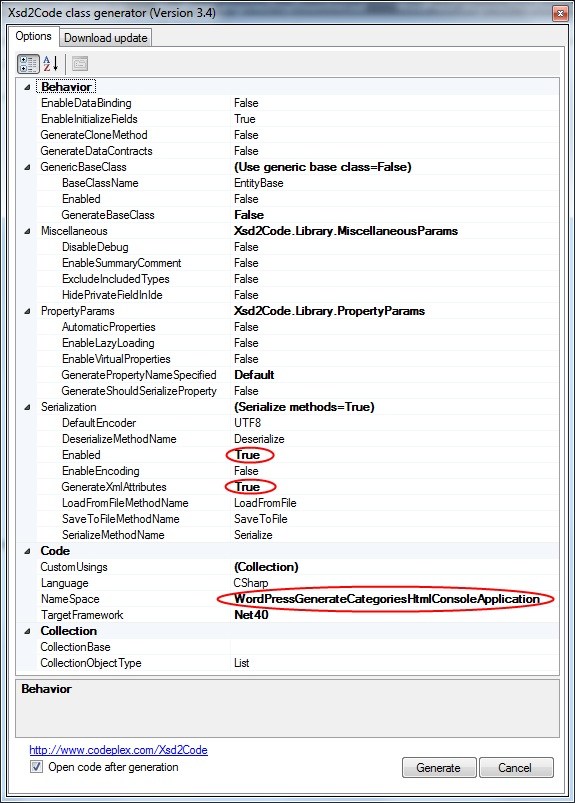
You can generate C# wrapper classes using the XSD.exe tool that ships with Visual Studio, but XSD.exe is hard to use, is hard to integrate into Visual Studio (despite Microsoft Connect request for it), the XSD.exe generated code still needs work for deserializing, and XSD.exe has very limited generation options (heck, after it changed from .NET 1.x to 2.0, it hasn’t been updated for about a decade). XSD2Code has some great reviews, to I used that in stead. And indeed, very well integrates into Visual Studio 2010, and generates very nice C#, especially when you use the options (see also the screenshot on the right):
That way, loading the HTML, converting it to XML, then deserializing it into object instances is as simple as this:
                string inputFileName = args[0];
                string inputHtml = getHtml(inputFileName);
                string xml = toXml(inputHtml);
                selectType select = selectType.Deserialize(xml);
More on actually working with the loaded instances in the next episode, including the great benefit of XSD2Code: it generates C# code as partial classes.
–jeroen

Posted in .NET, C#, C# 4.0, C# 5.0, Development, SocialMedia, Software Development, Usability, User Experience (ux), Web Development, WordPress, WordPress, XML, XML escapes, XML/XSD, XSD | 2 Comments »
Posted by jpluimers on 2012/07/26
While reviewing some client’s code, I noticed they were generating and parsing XML and HTML by hand (do not ever do that yourself!).
Before refactoring this into something that uses libraries that properly understand XML and HTML, I needed to assess some of the risks.
A major risk is to get the escaping (and unescaping) of XML and HTML right.
Time to finally organize some of my links on escaping HTML and XML that I had in my favourites list.
The starting point is the List of XML and HTML character entity references on Wikipedia. It is readable, complete and lists both kinds of escapes.
The official W3C text that describes XML escaping is hard to read.
There are only 5 predefined XML entities for characters that can (some must) be escaped. This table is derived from the Wikipedia article.
| Name | Character | Unicode code point (decimal) |
Standard | When to escape (from the XML 1.0 standard) | Description |
|---|---|---|---|---|---|
| quot | “ | U+0022 (34) | XML 1.0 | To allow attribute values to contain both single and double quotes | double quotation mark |
| amp | & | U+0026 (38) | XML 1.0 | Outside comment, a processing instruction, or a CDATA section | ampersand |
| apos | ‘ | U+0027 (39) | XML 1.0 | To allow attribute values to contain both single and double quotes | apostrophe (= apostrophe-quote) |
| lt | < | U+003C (60) | XML 1.0 | Outside comment, a processing instruction, or a CDATA section | less-than sign |
| gt | > | U+003E (62) | XML 1.0 | in content, when that string is not marking the end of a CDATA section | greater-than sign |
Posted in " quot, & amp, > gt, < lt, ' apos, ASCII, Development, Encoding, HTML, Power User, SocialMedia, Software Development, Unicode, Web Development, WordPress, XML, XML escapes, XML/XSD | 1 Comment »
Posted by jpluimers on 2012/07/23
It seems LinkedIn doesn’t react to my tweet for help, so maybe you can provide me (paid) with a custom build of Contact Remover Plus.
This is my problem: https://twitter.com/jpluimers/status/225625536976793600
The LinkedIn Android app has created dozens of LinkedIn links and photo links to many of my contacts.
This renders many functions on my phone unusable:
I tried to count this for one particular contact with the “Contact Remover” App: His contact has so many pages of photos and LinkedIn links that I cannot count them any more. They are at least dozens, probably more than 100 of each.
I’m using an HTC Sensation phone with a regular Android 4 firmware.
With Android development, I haven’t don’t anything yet with the Contacts API yet, and don’t have the time to do so in short term.
I’m willing to pay for an App that:
Anyone?
–jeroen
Posted in About, Android Devices, Development, LinkedIn, Personal, Power User, SocialMedia, Software Development | 6 Comments »
Posted by jpluimers on 2012/07/23
A couple of months ago, I created a nice post listing all #WordPress Editor #keyboard #shortcuts for both Windows and Mac OS X.
As of a few days ago, WordPress.com changed their Alt-Shift shortcuts into Alt shortcuts.
For instance, Alt-Shift-d (strike through) is now Alt-d, thereby blocking the original Alt-d (which for most browsers on Windows brings you to the address bar).
They violate one of the basic GUI principles: keep existing keyboard shortcuts as they are.
On Windows based browsers that means: keep Alt and Ctrl based shortcuts. Alt-Shift, Ctrl-Shift and Ctrl-Alt-Shift shortcuts are OK.
I haven’t tested WordPress on my MacBook air yet (as I don’t think the end-users should be the WordPress.com beta testers, though they probably think the world at large is a big beta-test garden).
I have asked WordPress.com to change the shortcuts back to what they were.
–jeroen
via: #WordPress Editor #keyboard #shortcuts « The Wiert Corner – irregular stream of Wiert stuff.
Posted in Keyboards and Keyboard Shortcuts, Power User, SocialMedia, WordPress | Leave a Comment »
 The Wiert Corner - irregular stream of stuff