The Wiert Corner – irregular stream of stuff

Jeroen W. Pluimers on .NET, C#, Delphi, databases, and personal interests

  • My badges

  • Twitter Updates

  • My Flickr Stream

  • Pages

  • All categories

  • Enter your email address to subscribe to this blog and receive notifications of new posts by email.

    Join 1,861 other subscribers

Archive for the ‘Visual Studio 2010’ Category

“tfpt treeclean /exclude:*.suo,*.user” is what I use most (and recommend this thread: Does any tool exist to help Sync a directory with TFS? – Stack Overflow)

Posted by jpluimers on 2012/09/20

This post describes the TFS workspace cleanup features Treeclean and Scorch.

Both are not in the Visual Studio UI nor TFS tool, but are available form the ftpt command from the optional Team Foundation Power Tools package.

The main reason you need these two features is that TFS does not always clean up after it self when you perform get latest. For instance renamed directories, as well as bin and obj directories are not automatically removed.

The tfpt command I most often use this this one:

tfpt treeclean /exclude:*.suo,*.user

This deletes files from your local TFS workspace directory tree that are not in the source control system, but skips the *.suo and *.user files.

Tfpt also allows you to scorch files from your TFS.

So my second most used tfpt command is scorch in either of the two below forms:

tfpt scorch /recursive /diff
tfpt scorch /recursive /diff /exclude:*.suo,*.user

The first form is for the automatic build environment, the second for my normal development workspace.

Below is the explanation of treeclean and scorch.

First some other great commands from this StackOverflow answer by Martin Woodward:

Not quite, however you might want to download the TFS Power Tools and check out the command line utility tfpt.exe.

The “tfpt online” and “tfpt treeclean” might be most useful to you when working outside of an integrated TFS client. tfpt online will look for files in your local directory that are not under version control, treeclean will show you files in your local directory that are not under version control so that you can remove then if they are not required.

Scorch versus Treeclean

Scorch does more than Treeclean.

I use Treeclean for 90% of my normal workspace work, Scorch (with exclude) for about 10% of the time in my regular workspace.
For my CCnet build integration workspace, I only use Scorch (without exclude).

Treeclean just cleans the tree of stuff that is not in TFS:

B:\MasterWorkingDir>tfpt treeclean /?
tfpt treeclean - Delete files and folders not under version control

Usage: tfpt treeclean [/exclude:filespec1,filespec2,...] [filespec...]
[/recursive] [/batchsize:num] [/noprompt [/preview]]

Scorch does more work: at the end, both source control and the local disk situation are identical.

B:\MasterWorkingDir>tfpt scorch /?
tfpt scorch - Ensure source control and the local disk are identical

Your local disk will be scanned for:
 (1) items that are not in source control
 (2) items which are different on disk from the workspace version
 (3) items which are in the workspace but are missing on disk
Items not in source control will be deleted from disk, just as with the
 tfpt treeclean command. Items determined to be different on disk from the
 workspace version will be redownloaded from the server. Items missing on
 disk will also be redownloaded. Items with pending changes are exempted.

By default, items deleted from your local disk (#3 above) will not be
scanned for, and local items are determined to be identical/different from
the workspace version *solely by examining the read-only bit on the file*.

To redownload items deleted from your local disk (#3 above), supply the
/deletes option. To detect items which are different from the workspace
version but still have their read-only bit set (+R), supply the /diff option.
When using either or both of these options, tfpt scorch runs more slowly.

Usage: tfpt scorch [/exclude:filespec1,filespec2,...] [filespec...]
[/recursive] [/batchsize:num] [/noprompt [/preview]]
[/deletes] [/diff]

The commandline options are also different.

Scorch has these extra when compared to Treeclean:

/batchsize:num Set the batch size for server calls (default 500)
/deletes Detect and replace items missing from the local disk
/diff Use MD5 hashes to compare items with source control

Treeclean can have these options:

/noprompt Operate in command-line mode only
/exclude:filespec[,..] Files and directories matching a filespec in this list
are excluded from processing
/preview Do not make changes; only list the potential actions
/recursive Switch from one level of recursion to full recursion
/batchsize:num Set the batch size for server calls (default 500)
filespec... Only files and directories matching these filespecs
are processed

Scorch can have these options:

/noprompt Operate in command-line mode only
/exclude:filespec[,..] Files and directories matching a filespec in this list
are excluded from processing
/preview Do not make changes; only list the potential actions
/recursive Switch from one level of recursion to full recursion
/batchsize:num Set the batch size for server calls (default 500)
filespec... Only files and directories matching these filespecs
are processed

–jeroen

via:

Posted in CodePlex, Development, Software Development, Source Code Management, TFS (Team Foundation System), Visual Studio 11, Visual Studio 2002, Visual Studio 2003, Visual Studio 2005, Visual Studio 2008, Visual Studio 2010, Visual Studio and tools | 4 Comments »

Creating a blank Visual Studio solution without a directory, and sln Format Version numbers

Posted by jpluimers on 2012/09/06

A while ago, I blew quite a few Visual Studio Solution and Project builds because I was experimenting in a suite of solutions with the Configuration Manager adding other Solution Configurations than Release and Debug, and mixing x86/AnyCPU platforms to facilitate Debug & Continue.

Lesson learned: don’t do that!

Keep it simple:

  1. Keep your Solution Configurations at Release and Debug,
  2. Perform conditional defines in your automated build server,
  3. Limit the mixing your platforms to a minimum.

We noted the anomalies a little late in the process (in retrospect, when taking over the solution suite, we should have started with setting up and Build Automation right at the beginning, then fix all the solutions that came from Visual Source Shredder, but alas: you are never too old to learn from your mistakes).

The anomalies were spurious (and hard to reproduce) build failures at developer workstations, wrong builds of assemblies ending up on the final build directories and more. And best of all: Visual Studio not failing, warning or hinting upon most issues.

Fixing projects and solutions from wrong Solution Configurations

The history in the version control system was not helpful enough to assist in fixing it, so the fix was this:

  1. Manually edit the .csproj files, and remove the PropertyGroup elements other than “Debug|AnyCPU” and “Release”AnyCPU”.
    This is easy to do inside Visual Studio and with automatic checkout from TFS of the project files:

    1. In the Solution Explorer, select all the projects
    2. Right click on a project
    3. Choose “Unload Project”
      (because you selected all the projects, it is the second menu item from the bottom, and way easier to find when you do this per project)
    4. For each project
      1. Right click the project
      2. Choose “Edit ….”
      3. Remove the PropertyGroup elemts you don’t need
      4. Save and close the file
      5. Right click the project
      6. Choose “Reload Project”
  2. Fix the solution files

The last step is a lot more complex, because of a couple of reasons:

My workaround was as follows:

  1. Start with an empty solution in the same directory as the original solution
  2. Add all the Solution Folders, Solution Items, and projects to it that  were in the original solution
    (having two copies of Visual Studio next to each other on a dual monitor setup is of great help)
  3. Compare the .sln files to each other
  4. Check out the original .sln file
  5. Merge any changes into the original .sln file
  6. Build it
  7. Check in
  8. Run a build on the CruiseControl.net automated build server
  9. Fix build errors
  10. Delete the temporary local .sln file

Creating an empty solution in a directory

Finally, I get to the title of this blog entry: Visual Studio will always generate a directory when creating a Blank Solution, and does not support creating an Empty Solution in a directory.

There are many posts describing how to workaround this, but the actual downloads are usually gone because of link rot (Jakob Nielsen’s alert from 1998 still is totally right about it). Thanks to they webarchive.org WayBackMachine though for keeping some of them alive.

So I went with Peter Provost’s solution, and amended it from Visual Studio 2005 to all Visual Studio versions that support .NET that I have used or still use: 2002, 2003, 2005, 2008, 2010 and 2012 a.k.a. VS11.

All files are in Change set 89386 on BeSharp.CodePlex.com.

His solution uses the ShellNew command for .sln file extensions that is stored in the registry:

  1. Create an empty solution file for the Visual Studio version you are using
  2. Copy that as a template file to %Windir%\ShellNew
    (you need to be administrator for that)
  3. Import a small .reg file binding that template file to the ShellNew command for .sln files

ShellNew is versatile, so you can also embed the fresh solution file into the .reg file, see this ShellNew article for a few nice examples.

Note that generating a new ShellNew verb for .sln is something other than loading a .sln (loading a .sln is done through VisualStudioLauncher).

Back to the .sln file: this one is different for any version of Visual Studio. Historically, the basic format is the same though (and I think this – in combination with VisualStudioLauncher – is the main reason it is not XML).

An empty solution file looks like this (note the empty line at the beginning), as described in Hack the Project and Solution Files:


Microsoft Visual Studio Solution File, Format Version 12.00
# Visual Studio 11
Global
	GlobalSection(SolutionProperties) = preSolution
		HideSolutionNode = FALSE
	EndGlobalSection
EndGlobal

The accompanying .reg file like this:

Windows Registry Editor Version 5.00

[HKEY_CLASSES_ROOT\.sln\ShellNew]
"FileName"="Visual Studio Solution - VS11.sln"

When you look at the Format Version inside the .sln version, you see that it (12) is one bigger than the internal Visual Studio Version (11).

That is because Microsoft stepped up the internal version from Visual Studio .NET (2002) and Visual Studio 2003 from 7.0 to 7.1, but the solution file format version from 7.00 to 8.00 as the table below shows.

Note that the .NET 1.x versions of Visual Studio (2002 for .NET 1.0, 2003 for .NET 1.1) don’t have the GlobalSection/HideSolutionNode/EndGlobalSection part and the # Visual Studio xx line.

With a little bit of querying, I got at this table:

Visual Studio version Internal version Solution file format version
Visual Studio .NET (2002) 7.0 Microsoft Visual Studio Solution File, Format Version 7.00
Visual Studio 2003 7.1 Microsoft Visual Studio Solution File, Format Version 8.00
Visual Studio 2005 8.0 Microsoft Visual Studio Solution File, Format Version 9.00
Visual Studio 2008 9.0 Microsoft Visual Studio Solution File, Format Version 10.00
Visual Studio 2010 10.0 Microsoft Visual Studio Solution File, Format Version 11.00
Visual Studio 2012 (a.k.a. VS11) 11.0 Microsoft Visual Studio Solution File, Format Version 12.00

All files to get you going are in Change set 89386 on BeSharp.CodePlex.com.

It was a bit hard to get all those version numbers, so here are the sources I used:

–jeroen

Posted in .NET, C#, C# 1.0, C# 2.0, C# 3.0, C# 4.0, C# 5.0, Development, Internet, link rot, Power User, Software Development, Visual Studio 11, Visual Studio 2002, Visual Studio 2003, Visual Studio 2005, Visual Studio 2008, Visual Studio 2010, Visual Studio and tools, WWW - the World Wide Web of information | Leave a Comment »

If a program you wrote can’t start becuase MSVCR*.dll is missing, then you forgot to ship the Visual C++ runtime…

Posted by jpluimers on 2012/08/30

Too often I see quesions like the one below on software that people distribute:

The Program can’t start becuase MSVCR100.dll is missing from your computer. Try reinstalling the program to fix this problem.

I am getting follwing error when i am trying to open Computer management in windows 7,the error is as follows ,

The Program can’t start becuase MSVCR100.dll is missing from your computer. Try reinstalling the program to fix this problem.

Where can i found this dll file, and help me to download and install.

The reason is that many programmers and companies still fail to ship the correct Visual C++ run-time.

Even for a one-off, you should need to get your installation set right. And writing stuff in a version of Visual C++ almost always means you need to ship the run-time for that particular version of Visual C++ with your application (though sometimes you can get away by putting the DLLs in the directory of your application, this is not recommended, as that way you won’t receive security updates).

User Marilyn O was so kind to sum up most of the download locations (I did a bit of post-editing, added all the non-“FamilyID” links, all naming differences are from the MS site):

I would install the Microsoft Visual C++ Redistributable dll that is needed for projects built with Visual Studio 2010.

Download the files below depending on your operating system version. […] Check in Programs and Features, do you show that you have installed Microsoft Visual C++ … Redistributable? If not, download from the links here.

–jeroen

via: The Program can’t start becuase MSVCR100.dll is missing from your – Microsoft Answers.

Posted in C++, Development, Power User, Software Development, Visual Studio 2005, Visual Studio 2008, Visual Studio 2010, Visual Studio and tools, Windows, Windows 7, Windows 8, Windows Server 2000, Windows Server 2003, Windows Server 2003 R2, Windows Server 2008, Windows Server 2008 R2, Windows Vista, Windows XP | 3 Comments »

VS2010 Workfold Command: allows moving a local working folder for a WorkSpace, but not unmapping it when you have multiple workspaces with the same name

Posted by jpluimers on 2012/08/29

Just found a glitch in the unmap support for tf workfold (and found out it has already been reported).

First what I tried to do:

  1. move D:\develop.TFS02 into D:\develop\CodePlex\TFS02 using tf map (which BTW allows you to do in place branch switching).
  2. unmap D:\develop.TFS02\besharp from TFS

First a few things; the first one succeeded (as it implicitly uses the /map command), the last ones failed because /unmap is ambivalent on the /collection parameter: on the one hand it wants to do without, but when it discovers it cannot do without, it wrongly indicates it requires it.

D:\develop.TFS02\besharp>tf workfold /collection:https://tfs.codeplex.com/tfs/tfs02 /workspace:%COMPUTERNAME% $/ D:\develop\CodePlex\TFS02

D:\develop.TFS02\besharp>tf workfold /collection:https://tfs.codeplex.com/tfs/tfs02 /workspace:%COMPUTERNAME% /unmap $BeSharp
The option collection is not allowed.

D:\develop.TFS02\besharp>tf workfold /unmap /collection:https://tfs.codeplex.com/tfs/tfs02 /workspace:%COMPUTERNAME% D:\develop.TFS02\besharp
The option collection is not allowed.

D:\develop.TFS02\besharp>tf workfold /unmap D:\develop.TFS02\besharp
Unable to determine the workspace. You may be able to correct this by running 'tf workspaces /collection:TeamProjectCollectionUrl'.

D:\develop.TFS02\besharp>tf workfold /unmap /workspace:%COMPUTERNAME% D:\develop.TFS02\besharp
Multiple workspaces exist with the name T61PJWP.
Please specify the Team Foundation Server or qualify the name with the owner.

Workaround

The workaround is to

  1. start Visual Studio,
  2. unmap $/,
  3. recursively map $/ to D:\develop\CodePlex\TFS02,
  4. perform a get latest.

–jeroen

Via:

Posted in .NET, Development, Software Development, Source Code Management, TFS (Team Foundation System), Visual Studio 2010, Visual Studio and tools | Leave a Comment »

Many more event videos available at Channel 9 (was: PDC10 – view Microsoft PDC 2010 sessions on your PC)

Posted by jpluimers on 2012/08/28

Dang; I thought this had long left the posting queue, but somehow it ended in the drafts (:

Since then, many more event videos made it to Channel 9, including Build 2011, and TechDays 2012.

Anyway, here it is:

Microsoft’s PDC 2010 was held at the end of October 2010 in Redmond, WA, USA.

For the people that could not attend, it is very nice to view the sessions using the PDC10 player (it seems still people didn’t learn and start stripping the century parts from years again!).

Even if you are not using Visual Studio, .NET Azure or other Microsoft Technologies, there are a lot of interesting sessions showing the directions that Microsoft is taking.
Comparing that to what you do today is always a good thing to do: it helps you reflect, an important part of your personal development.

A few things I found interesting (in no particular order):

  • Asynchrony support in C# 5 and VB.NET 11 based on the Task Parallel Library
  • The choice to favour HTML 5 over SilverLight, even though Internet Explorer 9 and Microsoft’s HTML 5 authoring/development tools are far from ready
  • Azure reporting: is reporting the next big thing on clouds?
  • Offline versus online in the cloud world
  • NuPack – does it bring package management to the same level as Ruby or *nix?
  • XNA for XBox, Windows and Windows Phone

Enjoy!

–jeroen

Posted in .NET, .NET 4.5, C#, C# 4.0, C# 5.0, Channel9, Cloud Development, Database Development, Delphi, Development, HTML, HTML5, Mobile Development, SilverLight, SocialMedia, Software Development, Visual Studio 11, Visual Studio 2010, Visual Studio and tools, Web Development, Windows Azure, Windows Phone Development, XNA | 2 Comments »

Solving the “Some projects have been bound to server locations that may be incorrect.” in Visual Studio 2010 when using Team Foundation System 2010 #VS2010 #TFS2010

Posted by jpluimers on 2012/08/23

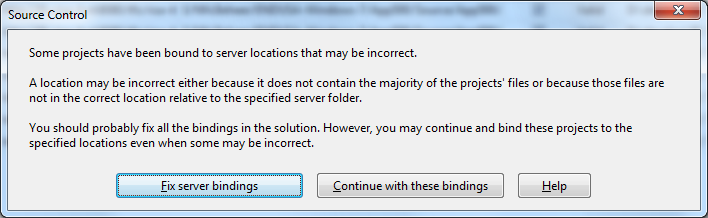
A while ago, I inherited a bunch of C# and VB.NET projects. One of them always generated the below error when including it in Team Foundation System (yes, the original projects were salvaged from Visual Source Shredder version 6.0c):

[Source Control]
Some projects have been bound to server locations that may be incorrect.
A location may be incorrect either because it does not contain the majority of the projects' files or because those files are not in the correct location relative to the specified server folder.
You should probably fix all the bindings in the solution. However, you may continue and bind these projects to the specified locations even when some may be incorrect.
[Fix server bindings] [Continue with these bindings] [Help]

First I tried the Help button: it links to a Help page on MSDN explaining the error can be cause with some statistics on projects not being in the source control system. Since all projects were, there, I looked for more information.

I tried finding a “Fix Server Bindings” or a 2010 “Some projects have been bound to server locations that may be incorrect” link that fitted my use case (getting projects from VSS into TFS), but the solutions I tried eventually all led to the same issue.

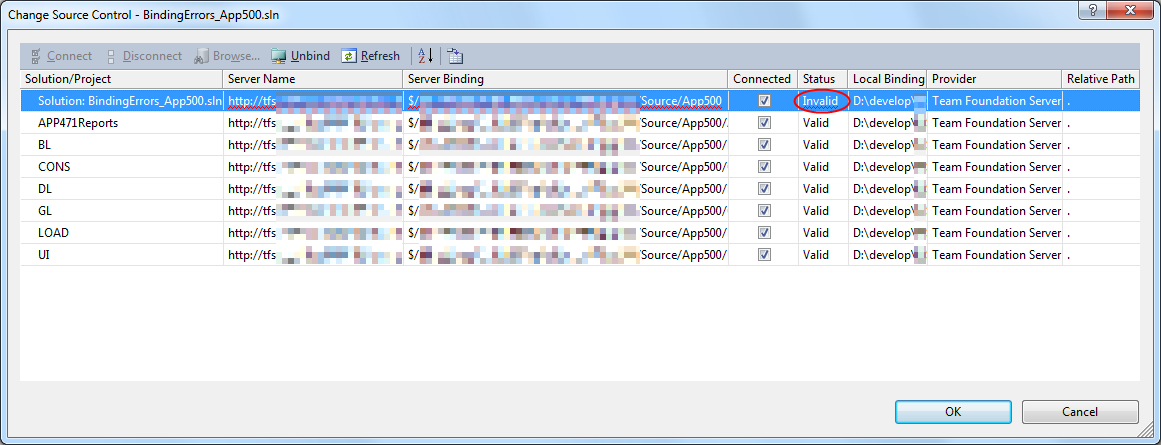
Fixing the server bindings would always fail: the solution (which itself is also a project) would get the status Invalid.

The next steps were these:

  1. add an empty solution in the same directory as the original one,
  2. add that solution to TFS
  3. add the projects from the original solution to this solution one by one
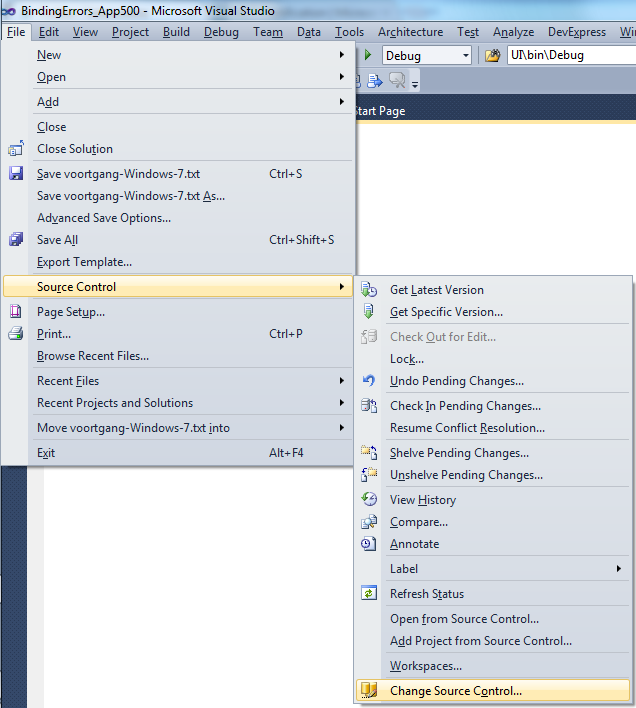
  4. check after each addition of the bindings were still OK using the “File”, “Source Control”, “Change Source Control” sequence on the right.
    (note that you don’t always see “Change Source Control”, if you don’t select the solution in the Solution Explorer before going to the File menu).
  5. text compare both .SLN solution files
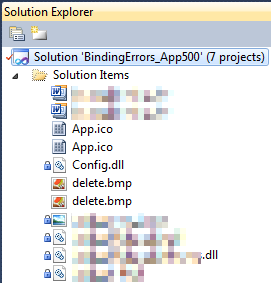
  6. observe that “Solution Items” actually is a project just like the others:
    Project("{2150E333-8FDC-42A3-9474-1A3956D46DE8}") = "Solution Items", "Solution Items", "{8D9964D4-6129-4B8F-9238-F9161A02B968}"
    ProjectSection(SolutionItems) = preProject
    ...
    Framework\Config.dll = Framework\Config.dll
    ...
    EndProjectSection
    EndProject
  7. add the existing solution item from the original solution to this solution one by one, check
  8. check after each addition of the bindings were still OK using the “File”, “Source Control”, “Change Source Control” sequence on the right.
    (note that you don’t always see “Change Source Control”, if you don’t select the solution in the Solution Explorer before going to the File menu).
  9. copy the non-existing solution items to the solution one by one using the text compare tool (yes, a lot of the projects are dirty and contain references to files that are not in the version control system)
    save after every copy, then reload the project in Visual Studio
  10. check after each addition of the bindings were still OK using the “File”, “Source Control”, “Change Source Control” sequence on the right.
    (note that you don’t always see “Change Source Control”, if you don’t select the solution in the Solution Explorer before going to the File menu).
  11. after a few files, suddenly the “Invalid” appeared, so the issue has to do with missing files.

Reading the Help more carefully, with in the back of my mind keeping “Solution Items” all as projects, I finally got the cause:

When some percentage of Solution Items cannot be found locally, and are not in the version control system, Visual Studio marks the solution binding to the version control system as “Invalid”.

The temporary solution is to ignore the error, until I have found all the missing files (they are scattered around some network shares), or made sure they are not needed at all.
There are many of those (you recognize them from the missing padlock icon in the Solution Explorer).

Version control rot is just like link rot, that’s why one of the high priority action items is to introduce for build automation at this client, then deploy those as clean builds into the Develop and Test stages of the DTAP, then verify if the solutions still work).

–jeroen

Posted in .NET, C#, C# 1.0, C# 2.0, C# 3.0, C# 4.0, C# 5.0, Development, Internet, link rot, Power User, Software Development, Source Code Management, TFS (Team Foundation System), VB.NET, Visual Studio 2010, Visual Studio and tools, WWW - the World Wide Web of information | Leave a Comment »

registry editing: How do you clear your MRU list in Visual Studio? – Stack Overflow

Posted by jpluimers on 2012/08/18

A question like How do you clear your MRU list in Visual Studio? is why I still like Stack Overflow.

The answers explain how to solve this in a version neutral way, including other MRU lists, and as a bonus point you to handy Visual Studio tools.

–jeroen

via: registry – How do you clear your MRU list in Visual Studio? – Stack Overflow.

Posted in Development, Software Development, Visual Studio 11, Visual Studio 2002, Visual Studio 2003, Visual Studio 2005, Visual Studio 2008, Visual Studio 2010, Visual Studio and tools | Leave a Comment »

Great session on how to prevent SQL Injection Myths and Fallacies

Posted by jpluimers on 2012/08/15

A few weeks ago, Bill Karwin did a must watch webinar on the prevention SQL Injection titled  “SQL Injection Myths and Fallacies“.

Bill Karwin (twitter, new blog, old blog, Amazon) is famous for much work in the SQL database community, including InterBase/Firebird, mySQL, Oracle and many more.

He also:

Anyway, his webinar is awesome. Be sure to get the slides, watch the replay, and read the questions follow up.

Watching it you’ll get a better understanding of defending against SQL injection.

A few very valuable points he made: Read the rest of this entry »

Posted in .NET, .NET 3.5, .NET 4.5, .NET ORM, ASP.NET, Batch-Files, C#, C# 1.0, C# 2.0, C# 3.0, C# 4.0, C# 5.0, C++, Cloud Development, COBOL, CommandLine, Database Development, Delphi, Delphi for PHP, Delphi x64, Delphi XE2, Development, EF Entity Framework, F#, Firebird, FireMonkey, History, InterBase, iSeries, Java, JavaScript/ECMAScript, Jet OLE DB, LINQ, LLBLGen, MEF, Microsoft Surface, Mobile Development, PHP, PowerShell, Prism, Scripting, SharePoint, SilverLight, Software Development, SQL, SQL Server, SQL Server 2000, SQL Server 2005, SQL Server 2008, SQL Server 2008 R2, SQL Server 2012, SQL Server 7, VB.NET, VBS, Visual Studio 11, Visual Studio 2002, Visual Studio 2003, Visual Studio 2005, Visual Studio 2008, Visual Studio 2010, Visual Studio and tools, Web Development, Windows Azure, WinForms, WPF, XAML, xCode/Mac/iPad/iPhone/iOS/cocoa | 1 Comment »

Clearing the CodeRush SolutionCache directory from your roaming profile @CodeRush (via: The Curly Brace: How to Clear DevExpress CodeRush Assembly and Solution Cache)

Posted by jpluimers on 2012/08/02

Your CodeRush SolutionCache folder (which is in your roaming profile, how bad!) can grow to multi-gigabyte proportions as it is not auto-cleaned.

This can lead to very long times for doing logon/logoff in a corporate network.

Mike Christian describes how to clean it.

Note that as of a few versions ago, the AssemblyCache is now a subfolder inside the SolutionCache folder.

Another reason to clean it is when CodeRush starts acting weird.

–jeroen

via: The Curly Brace: How to Clear DevExpress CodeRush Assembly and Solution Cache.

Posted in .NET, C#, Development, Software Development, VB.NET, Visual Studio 11, Visual Studio 2005, Visual Studio 2008, Visual Studio 2010, Visual Studio and tools | Leave a Comment »

.NET/Visual Studio: disable “Step over properties and operators” – one of the settings I always change for a new Visual Studio Installation

Posted by jpluimers on 2012/07/25

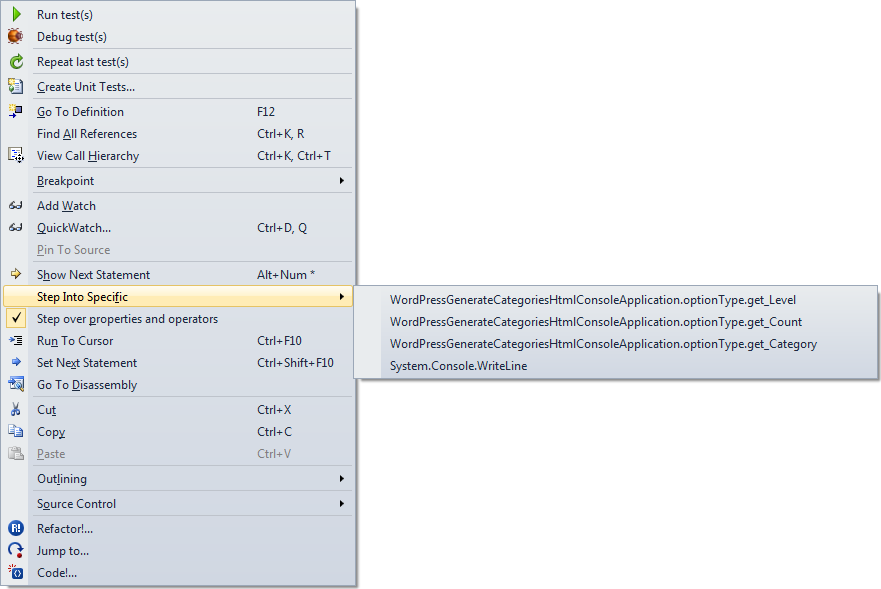
Boy I wish Visual Studio had a “Step into first property or operator” command. You can only do this through the context menu, and that is awfully cumbersome to use.

Just look at the context menu at the end of the post to see why.

Luckily, the option below it is “Step over properties and operators”, which you can easily disable. I usually have it disabled, so for me it is the way to temporarily enable it when I want to skip properties and operators.

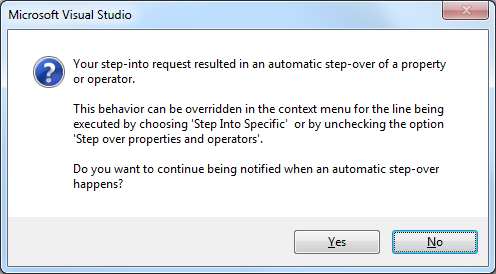
If you don’t then you get this message when tracing into properties (or operators):

[Microsoft Visual Studio]
Your step-into request resulted in an automatic step-over of a property or operator.
This behavior can be overridden in the context menu for the line being executed by choosing 'Step Into Specific' or by unchecking the option 'Step over properties and operators'.
Do you want to continue being notified when an automatic step-over happens?
[Yes] [No]

–jeroen

Posted in .NET, Development, Software Development, Visual Studio 11, Visual Studio 2005, Visual Studio 2008, Visual Studio 2010, Visual Studio and tools | Leave a Comment »