Archive for the ‘Web Development’ Category
Posted by jpluimers on 2014/09/22
A while ago, i came across this interesting question: Are there optimal days/hours to post questions in order to get visibility and answers? – Meta Super User.
The recommended time 1400 UTC is related to my blog post scheduling behaviour.
Virtually all my blog posts are either (when both apply at the same time, that is pure coincidence):
I schedule posts on Monday through Friday:
Difference between 0600 UTC and 1400 UTC
So why the time difference of about 8 hours between 0600 UTC and 1400 UTC?
That has to do with the public I generally interact with: software developers speaking English, mainly living in European and USA, with a minority in India, Asia and down-under.
- At 0600 UTC, most Europeans are about to wake up or just arrived at work, so they get fresh content. Still quite a few people from India and Asia are up (returning from work) can read it the same day it was posted. And virtually everyone in the USA is still sleeping, so they get fresh content too.
- At 1400 UTC, most Europeans are at work, people at the USA East Coast just started working and the rest of the USA is waking up and (hopefully) going to work. So you get a huge group of on-line people online with a high chance if comment/answer interaction on your question: great for getting answers on the same day.
Posted in Facebook, G+: GooglePlus, LifeHacker, LinkedIn, Power User, SocialMedia, Twitter, WordPress | Leave a Comment »
Posted by jpluimers on 2014/09/10
Yesterday I posted this question on StackOverflow and G+: Is there a url or site like example.org which always produces a 404 error?
Soon after that, I found out three links that produce predictable HTTP status codes:
They also work for https:
Edit 20241223: these also return a 404: http://www.google.com/undefined and https://www.google.com/undefined
On StackOverflow very few people even noticed the question, probably wondering “why?”.
I’m using these links for positive and negative testing of some http / https handling code that needs to be good at coping with positive and negative responses.
In my testing life, I’ve learned the hard way that both negative and positive tests are core part of your suite, hence the question.
–jeroen
via: Is there a url or site like example.org which always produces a 404 error?. Read the rest of this entry »
Posted in .NET, .NET 2.0, .NET 3.0, .NET 3.5, .NET 4.0, .NET 4.5, Chrome, Communications Development, Development, HTTP, Internet protocol suite, Power User, REST, Software Development, TCP, Web Browsers, Web Development | Leave a Comment »
Posted by jpluimers on 2014/07/15
Any web developer should know how to capture and trace HTTP traffic.
I’ve written about Fiddler before, but that’s a Windows specific tool.
Time to have a small list of posts and links to tools that work on various platforms.
I’ve left out Java based tools as there have been too many security issues with Java over the last couple of years.
Tools: Read the rest of this entry »
Posted in *nix, Apple, Development, Fiddler, Linux, Mac, Mac OS X / OS X / MacOS, Mac OS X 10.4 Tiger, Mac OS X 10.5 Leopard, Mac OS X 10.6 Snow Leopard, Mac OS X 10.7 Lion, MacBook, MacBook Retina, MacBook-Air, MacBook-Pro, OS X 10.8 Mountain Lion, Power User, SOAP/WebServices, Software Development, SuSE Linux, Web Development, Windows, Windows 7, Windows 8, Windows Server 2000, Windows Server 2003, Windows Server 2003 R2, Windows Server 2008, Windows Server 2008 R2, Windows Vista, Windows XP | 2 Comments »
Posted by jpluimers on 2014/05/06
Interesting, as this opens LDAP server to a lot more tools and development environments: ADAP Open Source REST API Layer For LDAP | Dr Dobb’s.
–jeroen
Posted in Communications Development, Development, HTTP, Internet protocol suite, JavaScript/ECMAScript, JSON, LDAP, Power User, REST, Scripting, Security, Software Development, TCP, Web Development | Leave a Comment »
Posted by jpluimers on 2014/04/30
Every once in a while, you have a domain but the hosting is at another party that does not allow setting the “Host header” for name based virtual hosting.
So then you want to redirect the page to the hosting party, preferably with keeping the URL in the address bar.
Some how, when searching how to do this (I do it once every couple of years), I always miss the WikiPedia entry at the bottom of this post.
Basically, there are a couple of ways for this:
- frameset
- head meta refresh
- JavaScript window.location.href (which is different from top.location.href)
Only the first one keeps the current URL in the address bar of the browser. The other ones will show the new target url in the address bar.
Notes:
- in HTML5, the noframes part is not allowed any more.
- the meta refresh has no extra quotes around the URL, the quotes are around the full text of “0; url=http://TARGET.URL/PATH”
Examples:
Read the rest of this entry »
Posted in Development, HTML, HTML5, Software Development, Web Development | Leave a Comment »
Posted by jpluimers on 2014/04/17
+This is why I Code has pointed me to a really nice app called CSS Vocabulary which interactively shows you what is what in CSS.
Click on the CSS code or the column with CSS syntax elements on the right to see their correspondence.
The app is written by About Ville – Foolproof by design and source code is at the sakamies/css-vocabulary · GitHub repository.
The blog entry is at CSS Vocabulary – Foolproof by design.
–jeroen
via: This is why I Code – Google+ – “A small app to browse through which is what in css. Has….
Posted in CSS, Development, Software Development, Web Development | Tagged: CSS syntax elements | Leave a Comment »
Posted by jpluimers on 2014/04/16
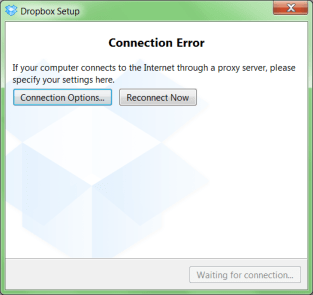
A while ago, I was working with a not so cooperative corporate firewall. All web browsers would work fine, but most other applications would not go through the proxy in a nice way.
For instance, DropBox would show the dreadfull “Connection Error” dialog shown on the right.
That dialog basically means “Dropbox has no clue what happens, try fiddling with your proxy or account settings, then press Reconnect Now” to retry.
Many other applications had issues (for instance Visual Studio connecting to Team Foundation System was very unreliable and the workarounds clumsy).
CNTLM: not the solution
I got inspired by the [WayBack] I code and code: Tutorial: How to use Dropbox behind a corporate proxy server using CNTLM, even though I was pretty sure the corporate firewall was not NTLM based.
And indeed, CNTLM -v -M http://google.com -c CNTLM.INI would give errors like this:
cntlm: Proxy returning invalid challenge!

headers_send: fd 4 warning -999 (connection closed)

Connection closed
HTTP Fiddler: looks promising
So I fired up my old buddy [WayBack] Fiddler 2 HTTP debugging proxy.
Further on, you will learn that Fiddler2 is much more, but right now it is enough to know that it basically sits as a local proxy between your applications and the outside world. Read the rest of this entry »
Posted in .NET, .NET 2.0, .NET 3.0, .NET 3.5, .NET 4.0, .NET 4.5, base64, Cntlm, Development, DropBox, Encoding, Fiddler, JavaScript/ECMAScript, NTLM, Power User, Scripting, SocialMedia, Software Development, Web Development, Windows, Windows 7, Windows 8, Windows Server 2000, Windows Server 2003, Windows Server 2003 R2, Windows Server 2008, Windows Server 2008 R2, Windows Vista, Windows XP, Windows-Http-Proxy | Leave a Comment »


 The Wiert Corner - irregular stream of stuff