Posts Tagged ‘software’
Posted by jpluimers on 2013/01/26
Back in the days I started programming, Micro Cornucopia was a wonderful magazine, so I’m glad that BitSavers scanned a few more issues and put them online today, a week after some great PDF scans: Turbo Assembler/Debugger (1993/1994), Borland C++/Object Windows Library (1993):
They covered a lot of languages (x86 and 68k assembly, C, C++, Turbo Pascal and many more), and very interesting hardware designs.
–jeroen
via: Index of /pdf/microCornucopia.
Posted in Assembly Language, BitSavers.org, C, C++, Delphi, Development, History, Pascal, Software Development, Turbo Assembler, Turbo Pascal, x86 | Tagged: computer, software, technology, wonderful magazine | 2 Comments »
Posted by jpluimers on 2013/01/24
Very distracting: 404.
Thanks Julian (I just found out you also own a Dutch domain jmbk.nl/) for pointing to it (boy, some unproductive days ahead) and the cheat (in your browser, Open the JavaScript console, then paste and run the cheat code).
Thanks Romain for developing it.
When you read through his java script code files, remember that these french-english translations:
- etat == state
- tombe == fall
- paraOpen == opened parachute
- mort == dead
- flocon == flake
- taille == size
- vitesse == speed
- écrase == crash
- marche == walk
- neige == snow
--jeroen
via: Développeur Web sur Lille (59), Romain Brasier.
Posted in Development, JavaScript/ECMAScript, Power User, Scripting, Software Development, Web Development | Tagged: cheat code, french english translations, java script code, julian, software, technology, unproductive days | Leave a Comment »
Posted by jpluimers on 2013/01/19
I love Google:
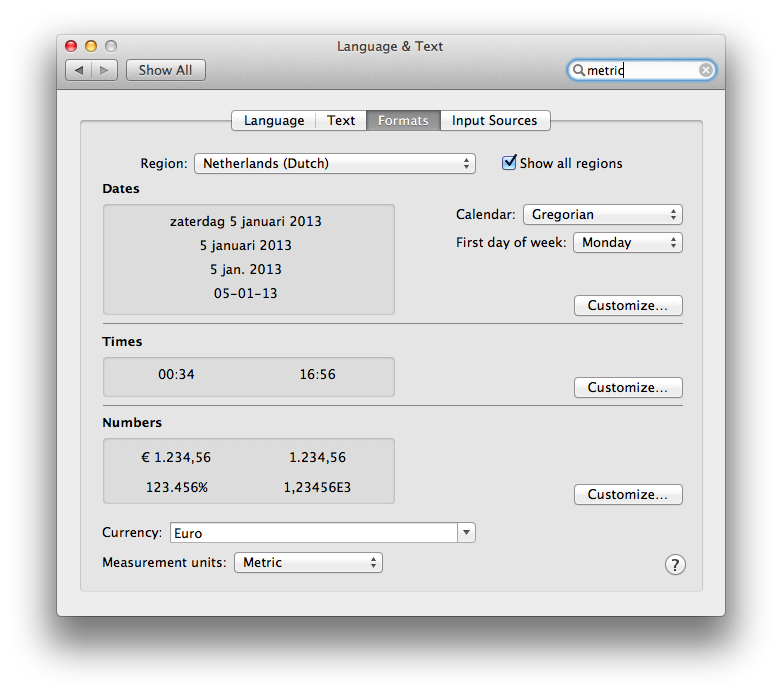
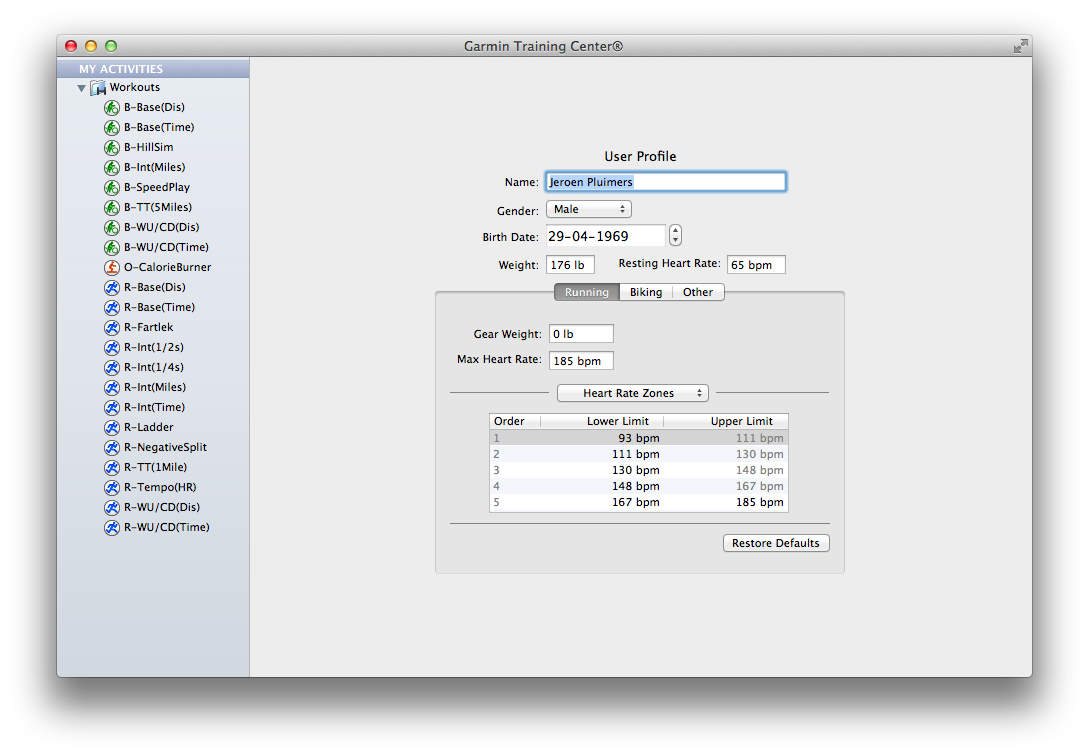
Especially since there is still software like Garmin Training Center for Mac on Mac OS X with – in the System Preferences – the Measurement Units set as Metric, insists on entering weight as lb, and workout distance in miles.
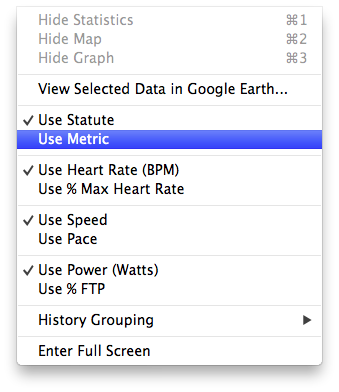
The reason is that Garmin Training Center on Mac OS X has its own “Measurement Units” settings. Where Mac OS lets the system wide setting be either “Metric” or ” US”, Garmin choose between “Metric” and “Statute” (the latter is default, not the OS X setting).
The problem is twofold:
Garmin has head offices and most of their customers outside the USA, so why insist on US units being default, and why not link the setting to the Mac OS X Preference?
UX #fail.
Oh BTW: if you connect your Garmin device, and GTC still indicates “no fitness device was found”, then use a different USB Cable and don’t connect it through a hub: the device is very picky on talking over USB (charging over USB works with virtually any USB cable).

Garmin Training Center on Mac OS X insists in imperial units, even though the system is configured as metric.

Garmin Training Center on Mac OS X has its own “Measurement Units” settings. Where Mac OS lets the system wide setting be either “Metric” or ” US”, Garmin choose between “Metric” and “Statute” (the latter is default, not the OS X setting).

Even after setting the Garmin Training Center to “Metric”, it still lists “Miles” in your workouts.
–jeroen
Posted in Google, GoogleSearch, Opinions, Power User, User Experience (ux) | Tagged: gadgets, garmin, google, imperial units, kg, mac os x, measurement units, metric, os x, software, system preferences, technology, workout | Leave a Comment »
Posted by jpluimers on 2013/01/17
Last year, I missed this tiny sentence:
So in plain English, any VM that was generated on VMware ESX Server 3.5 or later can run atop ESXi 5.1 unchanged.
Which means it is a snap to move your VMs from older ESX / ESXi / vSphere versions as long as they are ESX 3.x or later.
In fact hardware version 7 has the widest compatibility amongst ESX/ESXi/vSphere/Fusion/Workstation/Player versions (see the table at the bottom).
The free version still has a 32 gigabyte physical RAM limit (people are still confused by the vRAM / Physical RAM distinction, especially since vRAM is not limited any more). Read the rest of this entry »
Posted in ESXi4, ESXi5, ESXi5.1, Excel, Fusion, Power User, VMware, VMware ESXi, VMware Workstation, Word | Tagged: computer, hardware version, hardware versions, machine hardware, physical ram, software, technology, version compatibility, virtual hardware, virtual machine, virtual machines, vm, vms | Leave a Comment »
Posted by jpluimers on 2013/01/17
Even though the JavaRa tool is Windows-only, it is a tremendous help scraping old vulnerable versions of the Java Runtime Environment (JRE) from your systems and keeping only the fixed versions.
Regular JRE installs from Oracle/Sun will keep the old-and-vulnerable JRE versions.
(note that it seems the recent JRE update did not actually fix the vulnerability, just the exploit, and that a new Java vulnerability might already be exploited. Be sure to keep a watch upcoming Java updates for these).
JavaRa
JavaRa is an effective way to deploy, update and remove the Java Runtime Environment (JRE). Its most significant feature is the JRE Removal tool; which forcibly deletes files, directories and registry keys associated with the JRE. This can assist in repairing or removing Java when other methods fail.
JavaRa 2.1 (released 20130116) Read the rest of this entry »
Posted in Development, Java, Power User, Software Development, Windows, Windows 7, Windows 8, Windows Server 2000, Windows Server 2003, Windows Server 2003 R2, Windows Server 2008, Windows Server 2008 R2, Windows Vista, Windows XP | Tagged: commandline arguments, internet, java jre, java runtime environment, java updates, java version, java vulnerability, software, technology | 1 Comment »
Posted by jpluimers on 2013/01/17
The PDF Archive at bitsavers.org has recently put online these raster image PDF scans from Turbo Assembler/Debugger (1993/1994) and Borland C++/Object Windows Library (1993)
Remnants of the past, usefull for RAD Studio, Delphi and C++ Builder developers wanting to know a bit of history (: Read the rest of this entry »
Posted in Assembly Language, BitSavers.org, Borland C++, C, C++, Delphi, Development, History, Pascal, Software Development, Turbo Assembler, Turbo Pascal, x86 | Tagged: assembler version, borland C++, computer, object windows library, programmers guide, software, technology, turbo assembler | 2 Comments »
Posted by jpluimers on 2013/01/05
A small quote from the very interesting TURKTRUST Incident Raises Renewed Questions About CA System | threatpost article:
“Subordinate certificates have long been identified as a point of weakness in the CA system. They are typically granted unconstrained power to issue certificates for any domain name. Thus, a leak of one subordinate certificate is seen as equivalent to a leak of authority equivalent to all CAs combined. Worse, subordinate certificates need not be explicitly trusted by the software that authenticates encrypted SSL connections typically your web browser. They inherit their trust from the explicitly trusted CAs that have been vetted by your browser vendor,” Steve Schultze, associate director of the Center for Information Technology Policy at Princeton University, wrote in an analysis of the TURKTRUST incident.
A CA (Certificate Authority) issues certificates, most of which are used for domain validation by web-browsers, email and applications. This allows you to make sure when you communicate with your bank (through a web browser or banking app on your phone) to verify the server of the bank is in fact the server of your bank. Or your email program really talks to the server of your email provider and not some intermediate that spoofs your mails.
If fraudulent certificates get issued for certain domains (sometimes specific like http://www.google.com, sometimes generic like *.yahoo.com, or *.*.com), then you cannot trust those domains any more, nor your communication with them. So communication with your bank could be intercepted and changed, thereby loosing money.
That’s exactly what happened in 2011 and late 2012:
The heart of the problem is twofold:
- if a CA somehow (by mistake, hacking or whatever) issues a rogue certificate, it takes a relatively long time to find out it is rogue. In the mean time, everyone trust the rogue certificate, and a lot of damage can be done.
- it takes a relatively long time for people to patch their systems making the window of opportunity even bigger (heck, I regularly see systems that have not been patched for months or years).
While a IETF proposal to log all intermediate and end-entity certificates tries to fix 1., make sure you fix 2. by keeping your systems patched.
–jeroen
via TURKTRUST Incident Raises Renewed Questions About CA System | threatpost.
Posted in Opinions | Tagged: browser vendor, ca certificate, ca certificates, certificate authority, domain validation, email provider, fake certificates, google, internet, software, ssl connections, technology, web browsers | Leave a Comment »
Posted by jpluimers on 2012/12/30
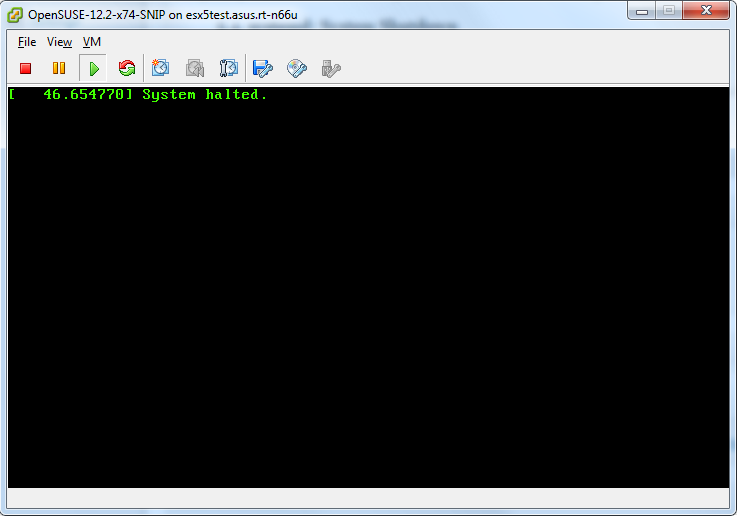
 Just noticed that in openSUSE 12.x, A plain halt will not shutdown the system properly.
On my system, it would leave the screen as shown on the right:
Only halt -p works, none of the other hints in the shutdown does not power off thread work, nor the acpi=off or acpi=oldboot settings.
The odd thing: a plain reboot still works properly.
If someone knows a better workaround: please let me know in the comments.
I hope they will fix this in a future openSUSE version; at least for 12.1 they have a “CHECKIT” marker in the documentation, but it has disappeared as of the 2.3 docs, but still fails:
5.4. systemd: System Shutdown
CHECKIT for 12.3. Is this entry still required?
To halt and poweroff the system when using systemd, issue halt -p or shutdown -h now on the command-line or use the shutdown button provided by your desktop environment.
Note: A plain halt will not shutdown the system properly.
Luckily, my openSUSE is a VM, which I can reboot from the ESXi host.
On a physical system, you will end up without any option to resurrect the system.
Later
After installing antivir, a plain halt works sort of: it says it is halted, but ESXi still thinks it is not:

After installing antivir, a plain halt appears to work, but it doesn’t.

ESXi is sure the system didn’t actually power down.
–jeroen
Posted in *nix, Linux, openSuSE, Power User, SuSE Linux | Tagged: acpi, computer, desktop environment, documentation, odd, openSUSE, reboot, shutdown button, software, SUSE, system shutdown, technology, thread work, vm | 4 Comments »
Posted by jpluimers on 2012/12/29
WordPress.com silently restored the Please restore the tab order the way it worked 2 weeks ago problem.
I wished they’d send update notifications on those fixes (it seems the underlying ticket 21340 was fixed about 2 months ago in changeset 22250 when I was on a long holiday), so I’m glad to announce it works again.
Even better: you don’t need the tab key to go from “Edit” next to “Publish immediately” into the Month field:
When you press “Edit” the focus automagically shifts to the Month field.
Thanks!
–jeroen
Posted in SocialMedia, WordPress | Tagged: computer, focus, notifications, software, technology, wordpress | Leave a Comment »





 The Wiert Corner - irregular stream of stuff