Archive for the ‘Pascal’ Category
Posted by jpluimers on 2014/03/12
Edit 20250102: added various “[Wayback/Archive]” archival links, VMware information, amended TUWA location, and added alternative csboot.zip download location on the Internet Archive (the Wayback Machine download is broken and the original gone)
A really long time ago, I posted in [Wayback/Archive] history – What features contributed to the evolution of Pascal? – Programmers indicating there was a [Wayback/Archive] Hard Disk Image of MS-DOS 6.22 with Pascal for Computer Studies. In fact, that is an IMG file of a DOS hard disk. And this posts shows how to use it with VMware Fusion on Mac OS X. The is a hard disk image contains:
- A full version of MS-DOS 6.22 (MSDN Original)
- Borland Turbo Pascal 7.0 (main)
- Borland Turbo Pascal 6.0
- Borland Turbo Pascal 5.5
- Microsoft QuickPascal 1.0
Edit 20250102: does not work under VMware Fusion when you run Apple Silicon. Not figured out a performant alternative yet. Will try figuring out later.
DOS on a Mac
Read the rest of this entry »
Posted in Borland Pascal, Development, Fusion, Pascal, Power User, Quick Pascal, Software Development, Turbo Pascal, Virtualization, VMware, VMware Workstation | 1 Comment »
Posted by jpluimers on 2014/03/07
Nice video when using either of the RemObjects Elements (Oxygene or Hydrogene): for creating a UI UINavigationController – remobjects.
–jeroen
Posted in .NET, C#, C# 1.0, C# 2.0, C# 3.0, C# 4.0, C# 5.0, Development, Oxygene, Pascal, RemObjects C#, Software Development | Leave a Comment »
Posted by jpluimers on 2014/03/06

The @appmethod secret.
Wow. Out of the blue, I just read Embarcadero Launches AppMethod, A New Multi-Device Development Platform For Native Apps | TechCrunch. And I’m impressed.
In short:
At SXSW 2014 (which is running now, its agenda has a schedule from March 7th till March 16th), Embarcadero announces appmethod, to be released in beta on March 18th, 2014 for building native cross platform applications. Many have found out you can apply for the beta at www.appmethod.com.
More and more people are bumping into the appmethod link, for instance on FaceBook, on Google Plus, at Delphi Bistro and #Appmethod starting with the @appmethod secret by Joy Ruff.
Below are a few my observations from following all of the above links. Read them, especially the TechCrunch. I expect interesting posts from others to follow really soon now (:.
I’m only a few hours ahead of you readers, but I’m having a positive vibe just for these reasons: Read the rest of this entry »
Posted in Android, C++, Delphi, Delphi XE5, Development, iOS Development, JSON, Mobile Development, Object Pascal, OS X FMX, Pascal, SOAP/WebServices, Software Development | Tagged: embarcadero, Multi-Device, TechCrunch | 15 Comments »
Posted by jpluimers on 2014/02/25
This post lists a lot of links related to the history of Pascal / Object Pascal / Delphi Language / FreePascal / etc.
No mentioning of Pascal should start without Niklaus Wirth. At the time of writing he is still alive, hopefully he still is a the time of publication.
Link clearance.
Read the rest of this entry »
Posted in Apple Pascal, BitSavers.org, Borland Pascal, DEC Pascal, Delphi, Development, FreePascal, History, Object Pascal, Pascal, Software Development, Think Pascal, Turbo Pascal, UCSD Pascal | 7 Comments »
Posted by jpluimers on 2014/02/18
About a year ago, I wrote about Delphi: you should avoid the with statement as it makes your code less future proof. Then I already tweeted I would follow up. Time to do it now (:
Besides my first post, these links inspired me most:
Posts about the with statement usually cause a stir: people either like or dislike it with passion.
Starting with some history and examples, this posts lists a few DOs and DON’Ts when using the with statement, shows advantages and drawbacks, and shows you tools to eliminate with statements. Read the rest of this entry »
Posted in Borland Pascal, Delphi, Delphi 1, Delphi 2005, Delphi 2006, Delphi 2007, Delphi 2009, Delphi 2010, Delphi 3, Delphi 4, Delphi 5, Delphi 6, Delphi 7, Delphi 8, Delphi x64, Delphi XE, Delphi XE2, Delphi XE3, Delphi XE4, Development, Pascal, Software Development, Turbo Pascal, With statement | 9 Comments »
Posted by jpluimers on 2014/02/13
Summary: Always try to avoid sharing .DCU files between projects.
I see a lot of projects at clients that do not have their individual DCU directories set (therefore having the DCU files in the same directory as the PAS files causing shared units to share the DCU files), or share DCU files among different projects.
Both are a very bad idea, as the compiler does not always understand when the DCU file does not match the combination of PAS file and compiler options.
The result is the occasional use of the DCU file in stead of the PAS file causing wrong code to be used, or wrong debugger information to be included.
Danny Thorpe phrased it on Stack Overflow: Read the rest of this entry »
Posted in Borland Pascal, Delphi, Delphi 1, Delphi 2005, Delphi 2006, Delphi 2007, Delphi 2009, Delphi 2010, Delphi 3, Delphi 4, Delphi 5, Delphi 6, Delphi 7, Delphi 8, Delphi x64, Delphi XE, Delphi XE2, Delphi XE3, Delphi XE4, Development, FreePascal, Lazarus, Pascal, Turbo Pascal | 9 Comments »
Posted by jpluimers on 2014/02/03
With a more decent internet connection during our trip, it is time to catch up on some recent news.
The first that caught my eye was that the Chromecast API now is open to all developers.
Developer information is available through Casting Your Content to the Big Screen – Google Cast — Google Developers.
You need to pay a one-time USD 5 fee per development account (how’s that Apple?) for the Google Cast SDK Developer Console.
After that, you will have to register your Chromecast device(s) and custom or styled media receiver apps.
Interesting. Fun.
I hope this can be combined with the new Smart Mobile Studio 2.0 release or the Delphi for Android support.
Will get back on that as soon as I’m back home.
Resources:
More links:
–jeroen
via: Chromium Blog: Ready to cast: Chromecast now open to developers with the Google Cast SDK.
Posted in Chrome, Chromecast, Delphi, Delphi XE5, Development, Google, JavaScript/ECMAScript, Pascal, Power User, Scripting, Smart Mobile Studio, Software Development | 1 Comment »
Posted by jpluimers on 2014/01/24
Being away from a computer sometimes means you forget about events.
So before I forget: happy 30th birthday Mac!
For me, real programming started 31 years ago on an Apple II at high school, soon followed by a II+ and a //e. At first, I was programming in both Integer Basic and AppleSoft Basic, then with Apple Pascal (which was based on UCSD Pascal, but way too slow), and finally with Turbo Pascal 1.0 (after they installed a Microsoft Z-80 softcard in a few of the machines which allowed it to run CP/M).
Back then me, nor my parents could afford a computer like a Mac, but I was lucky enough to keep on people at the “close by” (30 minutes by bicycle) University to use one and program in hyper card and various Pascal dialects (and later Delphi).
Now I own a few Macs (most more portable than the //c) bought a //e and //c last summer and collecting some extension cards to make life easier.
Just look at the B&N magazine rack how popular the Apple stuff is today:
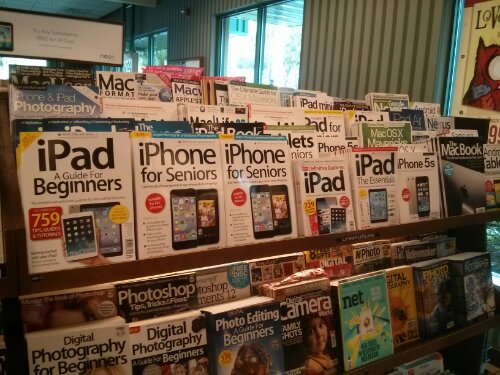
So again: happy 30th birthday Mac!
Without you, I wouldn’t be a software developer.
–jeroen
via: Apple bracht eerste Mac-computer 30 jaar geleden uit – Computer – Nieuws – Tweakers.
Posted in //e, Apple, Apple Pascal, Delphi, Development, Mac, Mac OS X / OS X / MacOS, Mac OS X 10.4 Tiger, Mac OS X 10.5 Leopard, Mac OS X 10.6 Snow Leopard, Mac OS X 10.7 Lion, MacBook, MacBook Retina, MacBook-Air, MacBook-Pro, Object Pascal, OS X 10.8 Mountain Lion, OS X 10.9 Mavericks, Pascal, Power User, Software Development, Think Pascal, Turbo Pascal, UCSD Pascal | 1 Comment »
Posted by jpluimers on 2014/01/21
I remember doing this in DOS ages ago (in the Turbo Pascal 5 era) for exactly the same reason: flash the keyboard LEDs to indicate some event was happening, but I’ve yet to find back the source code.
Here is how to do it in Windows using either C# or C: Faking num lock, caps lock and scroll lock leds – About My Code.
–jeroen
via: c# – Way to turn on keyboard’s caps-lock light without actually turning on caps-lock? – Stack Overflow.
Posted in .NET, .NET 1.x, .NET 2.0, .NET 3.0, .NET 3.5, .NET 4.0, .NET 4.5, C, C#, C# 1.0, C# 2.0, C# 3.0, C# 4.0, C# 5.0, C++, Development, Pascal, Software Development, Turbo Pascal | Leave a Comment »


 The Wiert Corner - irregular stream of stuff