The Wiert Corner – irregular stream of stuff

Jeroen W. Pluimers on .NET, C#, Delphi, databases, and personal interests

  • My badges

  • Twitter Updates

  • My Flickr Stream

  • Pages

  • All categories

  • Enter your email address to subscribe to this blog and receive notifications of new posts by email.

    Join 1,861 other subscribers

Archive for the ‘History’ Category

Wiskas -> Snorharen, Gardena -> Tuinierder en andere gekke merknamen

Posted by jpluimers on 2021/12/06

Grappig tweet boompje:

er zijn er vast veel meer dan deze:

  • Wiskas -> Snorharen
  • Gardena -> Tuinierder
  • Pampers -> Verwenners
  • Q8 -> Koeweit

–jeroen

Posted in Fun, History | Leave a Comment »

Remembering Werner Heiliger

Posted by jpluimers on 2021/12/05

In September 2019, I wrote about Kornelia Esser : Traueranzeige

For my memory; I hope to contemplate more about this later. But right now, with 10 medically related appointments in 2 weeks time, my head is too full. Today I found out that earlier this year, one…

In it, I briefly mentioned Werner Heiliger as he was an important person for me while growing up.

Back then I didn’t know the consequences of the medical appointments. Long story short, I got diagnosed with rectum cancer, I spent more than a year with treatments as right before the first surgery metastases were discovered. Most of 2021 I spent recovering and getting through backlogs of many things including writing this post.

That blog post had this small excerpt:

Werner Heiliger

The above dates are correct, but I think the places are wrong. This is what my research and memory combined got me to:

  • Born 1934-10-07 in Zülpich
  • Ordained as priest on 1961-02-02 (not sure where, but likely Köln)
  • Died 2018-12-05 in Bad Neuenahr-Ahrweiler
  • Burried on 2018-12-13 in Düsseldorf-Benrath

My dad (who died in 2004) met him in the late 1940’s, early 1950’s when going on biking holidays from Markelo into Germany. Werner was son of a miller (if memory serves me right, it was a flour mill near Zülpich), but later became a priest and spent part of his youth and most of his working life in Bad Münstereifel leading (7 years as rector, 20 years as director) the catholic boys dormitory (Erzbischöfliches Konvikt Collegium Josephinum), provided all the pastoral care for the adjacent gymnasium (new location of the Erzbischöfliches St.-Angela-Gymnasium) and was the priest of the catholic church behind the dormitory (which now houses the city’s Committee for Environment, Tourism and Mobility [Wayback]).

The dormitory and chapel were both located at Trierer Straße 16, 53902 Bad Münstereifel which is now the address of a public school and the above committee. The gymnasium is in the street behind the former Konvikt: Sittardweg 8 53902 Bad Münstereifel.

It looks like the chapel’s function got taken over by the 2005 inaugurated [Wayback] chapel part of the St.-Angela Gymnasium of which you can architectural information about at [Wayback/Archive.is] St. Angela Gymnasium – Kapelle, Bad Münstereifel  – Ernst Architekten, Zülpich.

Towards the end of promoting from rector to director, he co-authored the book [Wayback/Archive.is] Zur Pastoral der geistlichen Berufe. Heft 8 März 1970 Hrsg. Päpstliches Werk für Geistliche Berufe in den Diözesen Deutschlands in Zsarb. mit dem Katholischen Missionsrat und der Vereinigung Deutscher Ordensobern von Schroer, Hans, Werner Heiliger Marianne Dirksen u. a.:: (1970) | Versandantiquariat Ottomar Köhler

He was instrumental in getting the new gymnasium built (it opened in 1977) and managing the aftermath of the big disaster in the 1979 fire of the “large house” part of the Konvikt. That was the part the age 12-18 old lived, and had so much water damage that all children had to moved into the “small house”, and the “big house” had to be partially re-built based on a re-design to fit more modern standards.

Before the new location of the gymnasium was opened however, he also played a big role in the 1970s integrating the boys education into the old location of the gynmasium at Linnerijstraße 25 53902 Bad Münstereifel  (see [Wayback] Margaretha Linnerij: Mädchenbildung in Münstereifel and [Archive.is] Nachwuchssorgen: Die Nonnen verlassen die Kurstadt | Kölner Stadt-Anzeiger).

Being an avid sporter (he was quite good at soccer) and putting a lot of emphasis on sport for the boys, he had a 25-meter swimming pool built behind the Konvikt in the 1960s. In the 1980s or maybe early 1990s, an earthquake cracked tiles in the swimming pool causing it to close until assessment of the fundament proved it was safe (it might have been the 1992 Roermond earthquake – Wikipedia).

Werner knew everyone who ever lived at the Konvikt by heart and most of those people were very fond of him. During and after his time at the Konvikt, he married many many couples of which the men had lived in the Konvikt, regularly traveling hundreds of kilometers one way to get this all done.

He left the Konvikt moving to Benrath to work for 12 years as a priest there and in Urdenbach, then in 2004 he sort of retired in Bad Neuenahr-Ahrweiler, but still kept very active until his death in 2018.

During all his years of service, he was both so much feeling at home where he lived and so busy caring for the people he met, that he never took holidays. He also slept very short nights as for him duty was around the clock. In 1997, when the Konvikt closed down and Kornelia Esser retired too, they still kept in touch. She was really really worried about him, as he kept busy for so long and never took rest. In retrospect, it is amazing that he was fit for so long.

I do need to mention that when doing a [Wayback] Erzbischöfliches Konvikt Collegium Josephinum – Google Search, you will find entries about mental, physical and sexual abuse at the Konvikt, even during the times when Werner was leading it. The documentation has moved from pro-cj.de (see Archive.is: Projekt Collegium Josephinum – Eine Aufarbeitung and Archive.is: Projekt Collegium Josephinum – Links) to [Wayback] Projekt zum Collegium Josephinum Bad Münstereifel (2015-2017) | Erzbistum Köln. Wayback: Abschlussbericht-Collegium-Josephinum-Originalfassung-224-Seiten.pdf has moved from the old domain to [Wayback] Abschlussbericht-Collegium-Josephinum-Originalfassung.pdf on the new domain and available as book at [Wayback] Sexueller Missbrauch, physische und psychische Gewalt am Collegium Josephinum, Bad Münstereifel: Eine wissenschaftliche Aufarbeitung mit und für Betroffene – Endbericht Köln im Juli 2017.

Press coverage of the abuse is at these links:

Though I never noticed the abuse, I feel very sorry for the people affected. What happened is very bad, and I feel that Werner was at least in part and maybe even in full responsible as it was happening under his supervision. It doesn’t change how I feel about Werner as a very caring person though, and many others feel and felt the same.

Doing research for this blog post, I found out that slightly more than a year for his death, he lead a ceremony in the new chapel of the for the Konvikt alumni: [Archive.is] Predigt Werner Heiliger vom 2. September 2017 – YouTube (shortlink www.tinyurl.com/WernerHeiliger) which you can view below the signature. Below the signature as some drawings and a photograph of Werner as well.

The link is from a book about his life that got published earlier this year: [Wayback] Msgr. Werner Heiliger (1934-2018) – Erinnerungen seiner Schüler, Mitarbeiter, Freunde und Pfarrangehörigen sowie ausgewählte Beiträge (ISBN 978-3-7534-2093-6) which in part is viewable at Msgr. Werner Heiliger (1934-2018): Erinnerungen seiner Schüler, Mitarbeiter … – Horst A. Wessel – Google Books.

Der Verein Alter Münstereifeler e.V. (VAMÜ) veröffentlicht in dankbarer Erinnerung an sein Ehrenmitglied Msgr. Werner Heiliger (1934-2018) Beiträge von Mitschülern, ihm anvertraut gewesener Konviktoristen und deren Eltern, Mitarbeitern und Kollegen sowie Pfarrangehörigen und Vorgesetzten. Der Anhang enthält einige ausgewählte Texte von Werner Heiliger und Presseveröffentlichungen. Beiträge und Anhang zeigen Werner Heiliger als eine ganz “ungewöhnliche” Persönlichkeit. Werner Heiliger war 27 Jahre lang, von 1965 bis 1992, erst als Rektor, dann als Direktor Leiter des Erzb. Konvikts in Bad Münstereifel, einer Einrichtung, in der er neun Jahre als Schüler des St. Michael-Gymnasiums gelebt hatte. Er war entscheidend am Aufbau des St.-Angela-Gymnasiums, an dem er auch als Seelsorger tätig war, beteiligt und gliederte das vorher von den Ursulinen geführte Mädcheninternat ein. Nach seiner Versetzung war er zwölf Jahre Pfarrer an St. Cäcilia in Düsseldorf-Benrath und an Herz Jesu in Düsseldorf-Urdenbach. Nach seinem Eintritt in den Ruhestand betreute er die Schwestern des Klarissenklosters in Bad Neuenahr seelsorgerisch und wirkte, als Vertreter des Bischofs, bei der Ausübung der Gerichtsbarkeit im Offizialat mit. Er starb am 5. Dezember 2018 nach kurzer, schwerer Krankheit. Seine letzte Ruhestätte fand er im Priestergrab auf dem Friedhof von St. Cäcilia in Düsseldorf-Benrath.

The abstract pretty much describes Werner as I knew him.

–jeroen

Read the rest of this entry »

Posted in About, History, Personal | 2 Comments »

Apple retrocomputing link clearance

Posted by jpluimers on 2021/11/29

For my archive:

–jeroen

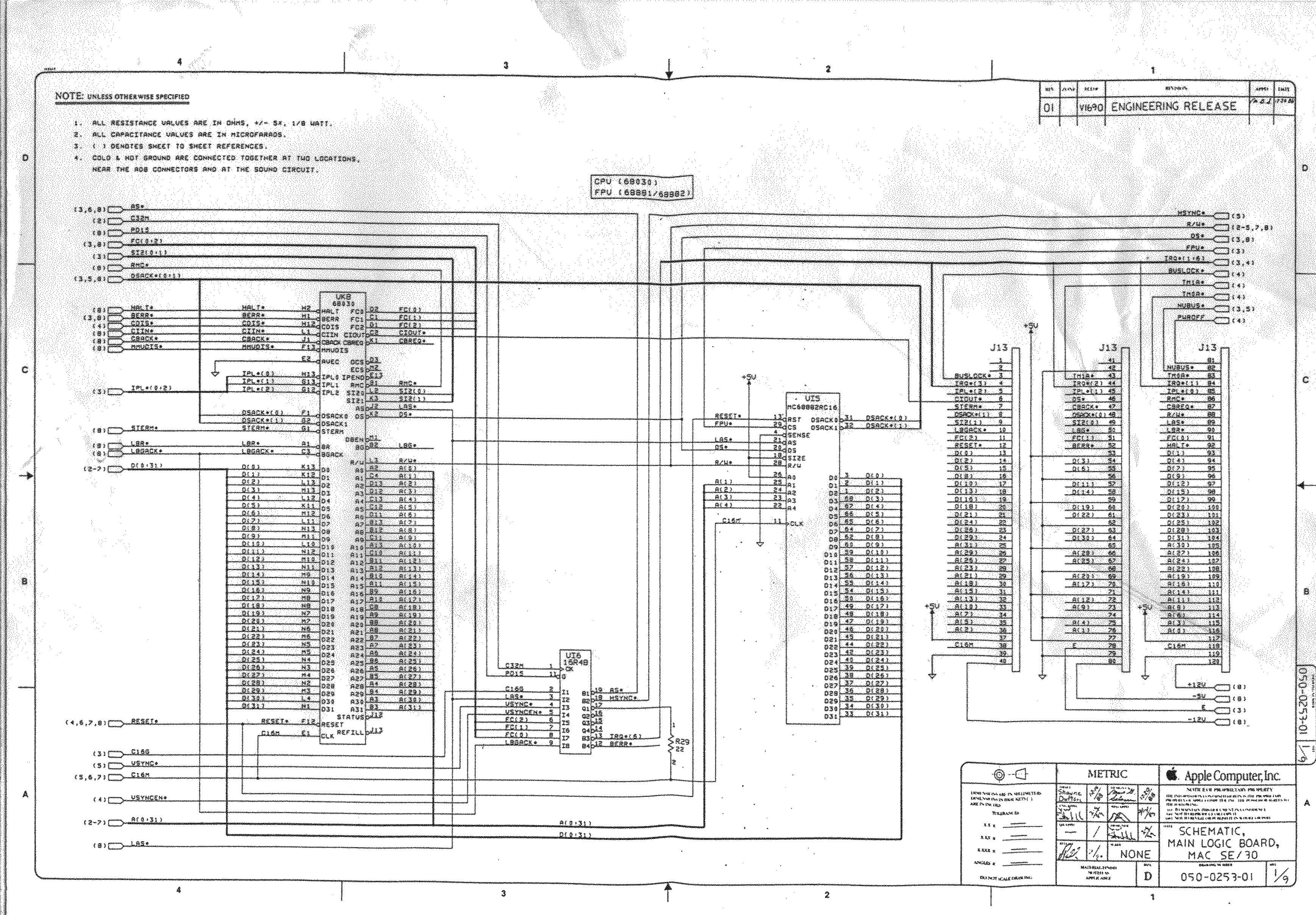
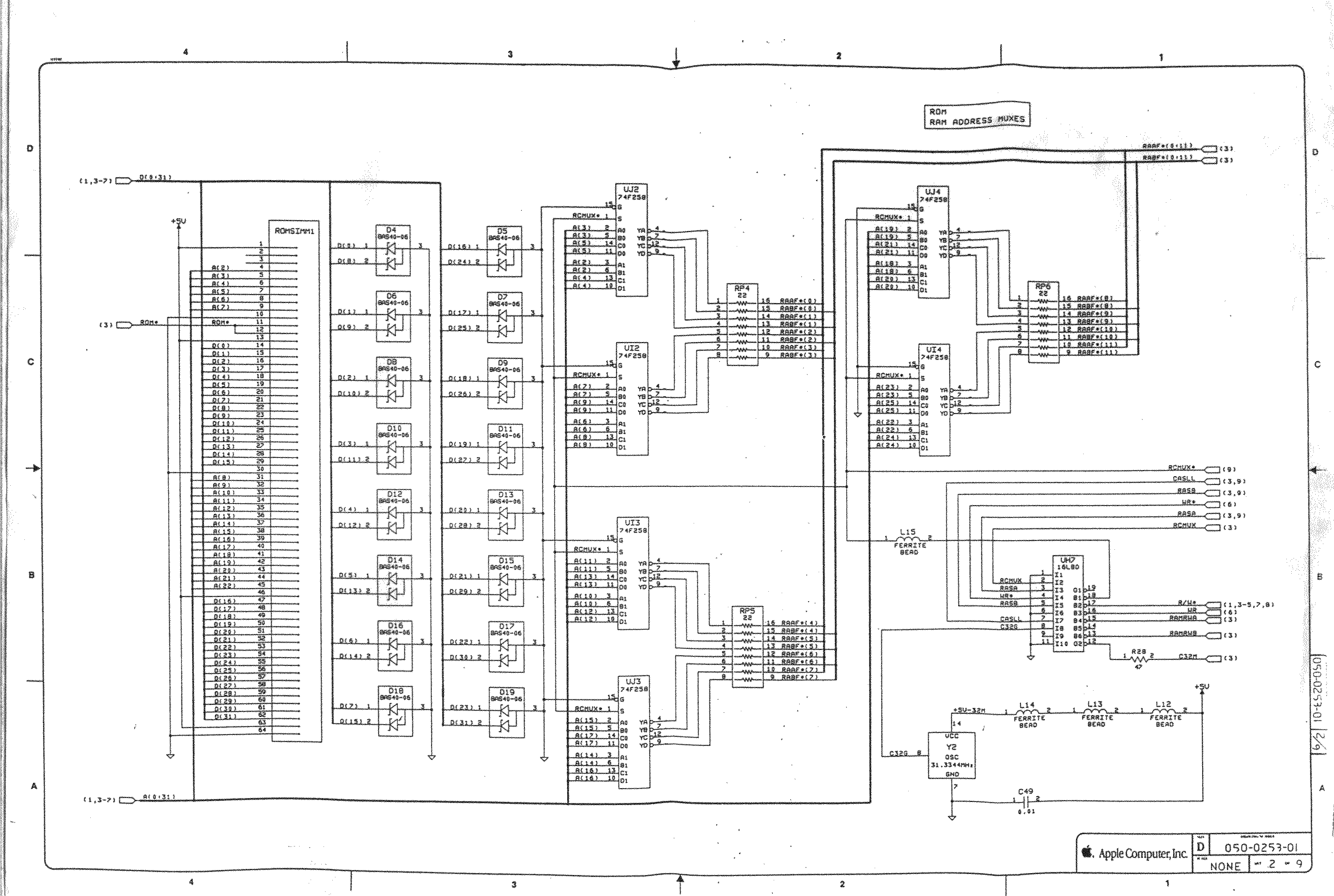
Posted in 68k, Apple, Classic Macintosh, History, Macintosh SE/30, Power User | Leave a Comment »

Is it a battery or a DNS record?

Posted by jpluimers on 2021/11/05

Somehow naming of DNS resource record types and cylindrical battery types might seem for most parts mutually exclusive:

But the A and AAAA battery types, though uncommon, do exist.

–jeroen

Read the rest of this entry »

Posted in DNS, History, Internet, Power User | Leave a Comment »

Happy 20th birthday WayBack machine and thanks Brewster for starting Internet Archive almost 25 years ago

Posted by jpluimers on 2021/10/24

Today, 20 years ago, the Wayback Machine started to unlock the archived content that the Internet Archive had been crawling since 1996 and make it accessible for the public at large.

Thanks Brewster Kahle for making all of this possible for such a long time!

Read the rest of this entry »

Posted in History, Internet, InternetArchive, Power User, WayBack machine | Leave a Comment »

“This does not compute”: Mac SE/30 repair

Posted by jpluimers on 2021/09/21

A while ago, This does not compute had a few nice videos on a Mac SE/30 and it’s repair, including the recap process of replacing the electrolytic capacitors (or condensators in some other languages), and cleaning the board (some wash it with hot water and soap, others with isopropyl-alcohol, often called rubbing alcohol).

Note the simasimac can have many causes: bad capacitors in main board are the most common, but it can also be bad memory.

White lithium grease can make the floppy work again (see also [WayBack] Lithium soap – Wikipedia and [WayBack] Grease (lubricant) – Wikipedia).

He also added some links to which I added some quotes and WayBack links:

Notes

Desolder can be tricky, especially for surface mount. This helps:

  • Add some fresh 60/40 solder to the joints with a solder gun (as modern solder is lead free, whereas past solder contained lead)
  • Carefully heat up the component and surrounding area with a heat-gun

Choosing capacitors:

Soldering: always add some fresh solder on the pads before soldering surface mount (SMD) capacitors.

–jeroen

Read the rest of this entry »

Posted in 68k, Apple, Classic Macintosh, Development, Hardware Development, History, Macintosh SE/30, Power User, Soldering | Leave a Comment »

Unix and NTFS file systems, hardlinks, inodes, files, directories, dot directories, bugs and implementation details

Posted by jpluimers on 2021/09/21

Lots of interesting tidbits on unix and NTFS file systems.

If you want to blow up your tooling, try creating a recursive hardlink…, which is likely one of the reasons that nx file systems do not support them.

Covered and related topics:

Read the rest of this entry »

Posted in *nix, Development, File-Systems, History, NTFS, Power User, Software Development, Windows, Windows Development | Leave a Comment »

Favourite Shortcut Key? (Soundcheck Question) – Computerphile – YouTube

Posted by jpluimers on 2021/08/20

Still a cool video. Many shortcuts for various operating systems and machines, including BBC B, Linux, Windows, and MacOS.

–jeroen

Read the rest of this entry »

Posted in *nix, 6502, Apple, BBC Micro B, History, Linux, Mac OS X / OS X / MacOS, Power User, Windows | Leave a Comment »

A storage history thread by @Foone: from USB Floppy drive back to Shugart via UFI/ATAPI/SCSI and everything in between

Posted by jpluimers on 2021/08/19

Quite some interesting bits in [WayBack] Thread by @Foone: “So if you want to use a USB floppy drive, you use a USB protocol called the UFI: Uniform Floppy Interface. What’s UFI? A way to embed ATAPI […]”

Via [WayBack] Kristian Köhntopp on Twitter: “PC Hard drive and floppy disk interfaces, and the people and companies that made them.”

https://twitter.com/isotopp/status/1174609922316783616

–jeroen

Read the rest of this entry »

Posted in Development, Hardware Development, History, Power User | Leave a Comment »

Delphi: some notes on HModule while tracking down an access violation in TRegGroups.UnregisterModuleClasses

Posted by jpluimers on 2021/06/08

Too bad the whole mechanism involving TRegGroups.UnregisterModuleClasses is not documented anywhere

It is the underlying storage to support TClassFinder, which was introduced in Delphi 6, documented on-line in Delphi 2007, documented slightly in Delphi 2009, and since Delphi 2010 only one line of documentation was added (including the unchanged “instatiated”):

  • Delphi 2007: [WayBack] TClassFinder Class

    This is class Classes.TClassFinder.

  • Delphi 2009:[WayBack] TClassFinder Class

    The TClassFinder allows the list of registered persistent classes to be retrieved. Objects instatiated from persistent classes are those that can be stored (serialised) beyond the operation of the current application.

  • Delphi 2010:[WayBack] Classes.TClassFinder – RAD Studio VCL Reference

    TClassFinder allows registered persistent classes to be retrieved.

    The TClassFinder allows the list of registered persistent classes to be retrieved. Objects instatiated from persistent classes are those that can be stored (serialised) beyond the operation of the current application.

Back to TRegGroups.UnregisterModuleClasses: it takes a HMODULE parameter and ultimately gets called through the (since Delphi 2007) on-line documented [WayBack] Classes.UnRegisterModuleClasses Function

procedure UnRegisterModuleClasses(Module: HMODULE);

Call UnRegisterModuleClasses to unregister all object classes that were registered by the module with the handle specified by the Module parameter. When a class is unregistered, it can’t be loaded or saved by the component streaming system.

After unregistering a class, its name can be reused to register another object class.

To get more context about the access violation, I used both the stack trace and a debugging watch for GetModuleName(Module) (using the [WayBack] SysUtils.GetModuleName Function).

In order to see which classes were registered by what module, I set a breakpoint at in TRegGroup.AddClass (which can be called through various code paths):

procedure TRegGroup.AddClass(AClass: TPersistentClass);
begin
  FGroupClasses.Add(AClass);
end;

HModule

That gave me the class, but I also needed the HModule for a class, so I did a windows get module of currently executing code – Google Search, giving me these links, all C/C++ related:

Here you already see some confusion: there is HINSTANCE and HMODULE. That’s a historic thing, as described by Raymond Chen in [WayBack] What is the difference between HINSTANCE and HMODULE? | The Old New Thing:

They mean the same thing today, but at one time they were quite different.
It all comes from 16-bit Windows.
In those days, a “module” represented a file on disk that had been loaded into memory, and the module “handle” was a handle to a data structure that described the parts of the file, where they come from, and where they had been loaded into memory (if at all). On the other hand an “instance” represented a “set of variables”.
One analogy that might (or might not) make sense is that a “module” is like the code for a C++ class – it describes how to construct an object, it implements the methods, it describes how the objects of the class behave. On the other hand, an “instance” is like a C++ object that belongs to that class – it describes the state of a particular instance of that object.
In C# terms, a “module” is like a “type” and an instance is like an “object”. (Except that modules don’t have things like “static members”, but it was a weak analogy anyway.)

GetModuleName

Searching for delphi “__ImageBase” – Google Search then got me [WayBack] c++ – Get DLL path at runtime – Stack Overflow with a nice Delphi related answer by [WayBack] Ian Boyd:

For Delphi users:

SysUtils.GetModuleName(hInstance);              //Works; hInstance is a special global variable
SysUtils.GetModuleName(0);                      //Fails; returns the name of the host exe process
SysUtils.GetModuleName(GetModuleFilename(nil)); //Fails; returns the name of the host exe process

In case your Delphi doesn’t have SysUtils.GetModuleName, it is declared as:

...

This reassured my use of [WayBack] SysUtils.GetModuleName code was OK:

function GetModuleName(Module: HMODULE): string; 
var
  ModName: array[0..MAX_PATH] of Char; 
begin
  SetString(Result, ModName, GetModuleFileName(Module, ModName, Length(ModName))); 
end;

HInstance in Delphi

The example from Ian Boyd also brought back memories from long ago about the [WayBack] HInstance Variable – Delphi in a Nutshell [Book]:

Read the rest of this entry »

Posted in Conference Topics, Conferences, Delphi, Development, Event, History, Software Development | Leave a Comment »