Archive for the ‘EPS/PostScript’ Category
Posted by jpluimers on 2026/03/03
A few years back I tweeted [Wayback/Archive] Jeroen Wiert Pluimers @wiert@mastodon.social on Twitter: “@b0rk @jilles_com Acids vs bases.”

It was a kind of tongue-in-cheek reaction (with a way better picture below) to a very valuable post by b0rk (Julia Evans) on both Twitter and Mastodon [Wayback/Archive] Julia Evans on Twitter: “bases” / [Wayback/Archive] Julia Evans: “bases title: bases # we usually…” – Mastodon for two reasons:
- There are various interpretations of bases
- Octal is very important to educate as errors introduced by its support are hard to spot even if you do know about octal.
Back to Julia’s post:
Read the rest of this entry »
Posted in *nix, *nix-tools, 68k, 8086, Assembly Language, bash, bash, C, C++, Chemistry, Conference Topics, Conferences, Development, EPS/PostScript, Event, Haskell, History, Java, Java Platform, JavaScript/ECMAScript, Jon Skeet, LifeHacker, Mathematics, PDP-11, Perl, PHP, Power User, Python, science, Scripting, Software Development, x86 | Leave a Comment »
Posted by jpluimers on 2025/05/29
Het overkomt te vaak dat barcodes beschadigd of overplakt zijn (hallo Too Good to Go, hallo “samen minder verspillen” van Jumbo en vergelijkbare acties)
Daarom wat barcodes van producten die je er overheen kunt plakken:
Gerelateerd: Generating EAN-13 barcode EPS files for your article numbers – die had ik al eerder bijgewerkt met gearchiveerde links.
--jeroen
Posted in Barcode, Development, EAN, EPS/PostScript, LifeHacker, Power User, Software Development | Leave a Comment »
Posted by jpluimers on 2022/09/28
When writing Some links on PostScript books and online content, back from the days, I archived [Wayback] Index of /RESOURCES from the site hosting the [Wayback/Archive.is] LPRng Web Page (see also LPRng on Wikipedia):
The LPRng software is an enhanced, extended, and portable implementation of the Berkeley LPR print spooler functionality. While providing the same interface and meeting RFC1179 requirements, the implementation is completely new and provides support for the following features: lightweight (no databases needed) lpr, lpc, and lprm programs; dynamic redirection of print queues; automatic job holding; highly verbose diagnostics; multiple printers serving a single queue; client programs do not need to run SUID root; greatly enhanced security checks; and a greatly improved permission and authorization mechanism.
The source software compiles and runs on a wide variety of UNIX systems, and is compatible with other print spoolers and network printers that use the LPR interface and meet RFC1179 requirements.
Subdirectories (the PPD one goes one level deeper with both files and directories; XEROX just has a subdirectory with one file):
–jeroen
Posted in Development, EPS/PostScript, Hardware, HP Printer Drivers, Power User, Printer drivers, Printers, Software Development, Windows | Leave a Comment »
Posted by jpluimers on 2022/06/09
Like me, [Archive.is] Kristian Köhntopp is a nerd.
Unlike me, Kris bumped into character encoding issues for just about all his digital life. That started about the same time as mine, but again unlike me: he was way more involved in the technical aspects of it.
First a series of Tweets:
Read the rest of this entry »
Posted in ASCII, C++, Development, Encoding, EPS/PostScript, Font, ISO-8859, ISO8859, Power User, Software Development, Times New Roman | Leave a Comment »
Posted by jpluimers on 2022/05/23
Printing on MacOS can be less Plug&Play than one hopes for.
For default printer drivers on MacOS for the same printer:
- Postscript allows colour and monochrome (black & white / grayscale)
- PCL only allows monochrome (black & white / grayscale)
One solution for my OKI MC363 is to use the HP PCL driver and fake it as a HP Colour LaserJet 9500 (which provides a similar amount of memory, and colour duplex A4 printing):
Read the rest of this entry »
Posted in Apple, Development, EPS/PostScript, Hardware, Mac OS X / OS X / MacOS, MC342 printer/scanner, OKI C332, OKI MC363/MC363DNW, OKI Printers, Power User, Printers | Leave a Comment »
Posted by jpluimers on 2020/06/30
The first hit of pdf binary to text – Google Search was [WayBack] binaryfiles – How to convert PDF binary parts into ASCII/ANSI so I can look at it in a text editor? – Stack Overflow has many options including:
Since I have qpdf installed on most systems:
Another useful tool to transform a PDF into an internal format that enables text editor access is qpdf. It is a “command-line program that does structural, content-preserving transformations on PDF files”.
Example usage:
 qpdf                                  \
   --qdf                               \
   --object-streams=disable            \
     input-with-compressed-objects.pdf \
     output-with-expanded-objects.pdf
- The output of the
QDF-mode enforced by the --qdf switch organizes and re-orders the objects neatly. It adds comments to track the original object IDs and page content streams. All object dictionaries are written into a “normalized” standard format for easier parsing.
- The
--object-streams=disable causes the extraction of (otherwise not recognizable) individual objects that are compressed into another object’s stream data.
The recompress is easy as per [WayBack] QPDF Manual:
qpdf /tmp/uncompressed.pdf /tmp/compressed.pdf
The answer is by [WayBack] User Kurt Pfeifle – Stack Overflow who has many other interesting PDF related answers at:
Stackoverflow.com:
Superuser.com:
Serverfault.com:
–jeroen
Posted in Development, EPS/PostScript, PDF, Power User | Leave a Comment »
Posted by jpluimers on 2020/03/05
A while ago, I wanted to analyse the difference of some PDF documents: why they had suddenly grown to twice their size.
[WayBack] Jeroen Pluimers en Twitter: “dat genereren kun je overigens zien als je dezelfde downloads doet, maar dan een fikse periode uit elkaar.…”

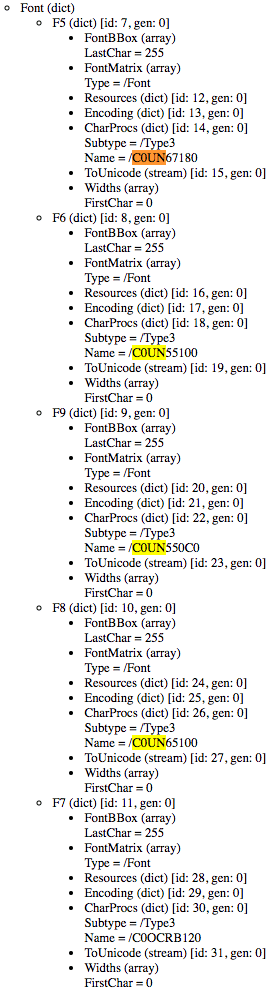
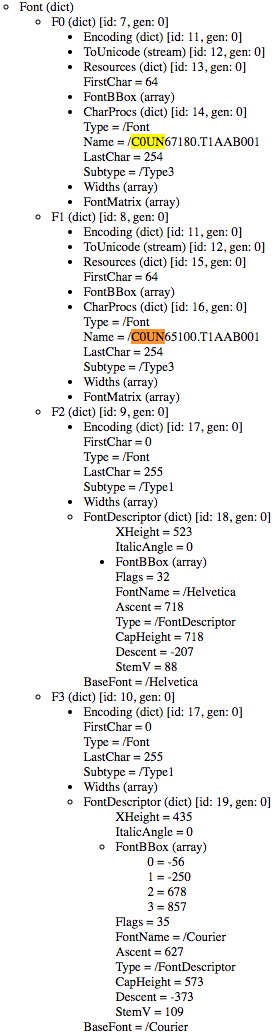 There are quite a few tools on [WayBack] Browse Internal PDF Structure – Super User and [WayBack] Best tool for inspecting PDF files? – Stack Overflow, including:
They also made me discover [WayBack] GitHub – pipwerks/PDFObject: A lightweight JavaScript utility for dynamically embedding PDFs in HTML documents documented at [WayBack] PDFObject: A JavaScript utility for embedding PDFs 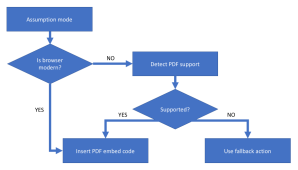
This particular case
The quickest way to analyse these for me was [WayBack] PDF Object Browser based on [WayBack] GitHub – brendandahl/pdf.js.utils: PDF.js Utility Files which is also the foundation of [WayBack] Test PDF Creator.
It runs in your web browser as local JavaScript, so it is pretty OK to load a PDF file into it: it does no “phone home”.
In this case, for generating PDF files with the same content, ABN AMRO added five Type 3 fonts of which one font was not used at all, and two others used to be Type 1 fonts.
Type 1 fonts (wikipedia)
Type 1 (also known as PostScript, PostScript Type 1, PS1, T1or Adobe Type 1) is the font format for single-byte digital fonts for use with Adobe Type Manager software and with PostScript printers. It can support font hinting.
It was originally a proprietary specification, but Adobe released the specification to third-party font manufacturers provided that all Type 1 fonts adhere to it.
Type 1 fonts are natively supported in Mac OS X, and in Windows 2000 and later via the GDI API.[2] (They are not supported in the Windows GDI+, WPF or DirectWrite APIs.)
Type 3 fonts (wikipedia)
Type 3 font (also known as PostScript Type 3 or PS3, T3 or Adobe Type 3) consists of glyphs defined using the full PostScript language, rather than just a subset. Because of this, a Type 3 font can do some things that Type 1 fonts cannot do, such as specify shading, color, and fill patterns. However, it does not support hinting. Adobe Type Manager did not support Type 3 fonts, and they are not supported as native WYSIWYG fonts on any version of Mac OS or Windows.
So far for optimised PDF rendering…
Being in software development for this long, I am constantly reminded that The inmates are running the asylum – Wikipedia. I can definitely recommend reading “The Inmates Are Running the Asylum: Why High Tech Products Drive Us Crazy and How to Restore the Sanity”, by Alan Cooper:
–jeroen
Posted in Development, EPS/PostScript, PDF, Power User, Software Development | Leave a Comment »
Posted by jpluimers on 2017/11/02
Quoted in full because even 2.5 years later, it’s just too funny:
- Python: What if everything was a dict?
- Java: What if everything was an object?
- JavaScript: What if everything was a dict *and* an object?
- C: What if everything was a pointer?
- APL: What if everything was an array?
- Tcl: What if everything was a string?
- Prolog: What if everything was a term?
- LISP: What if everything was a pair?
- Scheme: What if everything was a function?
- Haskell: What if everything was a monad?
- Assembly: What if everything was a register?
- Coq: What if everything was a type/proposition?
- COBOL: WHAT IF EVERYTHING WAS UPPERCASE?
- C#: What if everything was like Java, but different?
- Ruby: What if everything was monkey patched?
- Pascal: BEGIN What if everything was structured? END
- C++: What if we added everything to the language?
- C++11: What if we forgot to stop adding stuff?
- Rust: What if garbage collection didn’t exist?
- Go: What if we tried designing C a second time?
- Perl: What if shell, sed, and awk were one language?
- Perl6: What if we took the joke too far?
- PHP: What if we wanted to make SQL injection easier?
- VB: What if we wanted to allow anyone to program?
- VB.NET: What if we wanted to stop them again?
- Forth: What if everything was a stack?
- ColorForth: What if the stack was green?
- PostScript: What if everything was printed at 600dpi?
- XSLT: What if everything was an XML element?
- Make: What if everything was a dependency?
- m4: What if everything was incomprehensibly quoted?
- Scala: What if Haskell ran on the JVM?
- Clojure: What if LISP ran on the JVM?
- Lua: What if game developers got tired of C++?
- Mathematica: What if Stephen Wolfram invented everything?
- Malbolge: What if there is no god?
–jeroen
Read the rest of this entry »
Posted in .NET, APL, Assembly Language, BASIC, C, C#, C++, COBOL, Development, EPS/PostScript, Fun, Go (golang), Java, Java Platform, JavaScript/ECMAScript, LISP, Makefile, Pascal, Perl, PHP, Python, Quotes, Ruby, Rust, Scala, Scripting, Smalltalk, Software Development, T-Shirt quotes, TCL, Turbo Prolog, VB.NET, Visual BASIC, XML/XSD, XSLT | Leave a Comment »
Posted by jpluimers on 2017/06/27
It’s a while ago I saw this first, but recently I bumped into it again and found out I never posted a link, so here it goes:
A game to help you master the pen tool
Source: The Bézier Game
–jeroen
Posted in Development, EPS/PostScript, Font, Power User, Software Development | Leave a Comment »


 The Wiert Corner - irregular stream of stuff