Archive for the ‘Java’ Category
Posted by jpluimers on 2020/08/06
Sometimes you cannot avoid handling passwords in your application. When you do,
- keep them around as short as possible
- store them in data types that are not garbage collected
- wipe the storage as soon as you are done
In practice, this usually comes down to storing them as arrays (character or byte arrays), not strings.
This holds for many other platforms outside Java as well: strings are usually managed in one way or the other, so they cannot be wiped
References:
For actual storage of passwords, you always have the risk of retrieval: when a “bad guy” gets physical access to a device, it is basically hosed.
A KeyStore can only do so much against it: if your APK can be downloaded, it can be reverse-engineered revealing the exact steps how the store is accessed, reproducing the steps needed to hack into the underlying protected data/functionality.
The keystore can be forgetful…
You’ve just moved in to a new house and have been given the master key for the front door. You only have one of these so you know you need to keep it safe. Your really paranoid so you hire an armed guard, whose sole job is to protect this key, in fact, this is all he has been trained to do and has a catchy slogan of “need to protect a key, its what I was born to do!”. You install an extra lock on your front door as you feel the bodyguard isn’t enough, this is a rough area anyway and who’s going to make sure no-ones about to break in and steal all your crap. You return to your key guard only to be informed he has thrown the key away. You shout and scream at him but he just blankly says “I don’t have it anymore, I didn’t think it was important”. You can’t contain your anger “What the hell, your a jerk! You had one thing to do and you failed, this causes me a lot of problems, why didn’t you tell me you might do this?! What do I do now?!”
[WayBack] Android Security: The Forgetful Keystore – SystemDotRun – Dorian Cussen’s Super Blog
–jeroen
Posted in Android, Development, Java, Java Platform, Mobile Development, Power User, Security, Software Development | Leave a Comment »
Posted by jpluimers on 2020/05/13
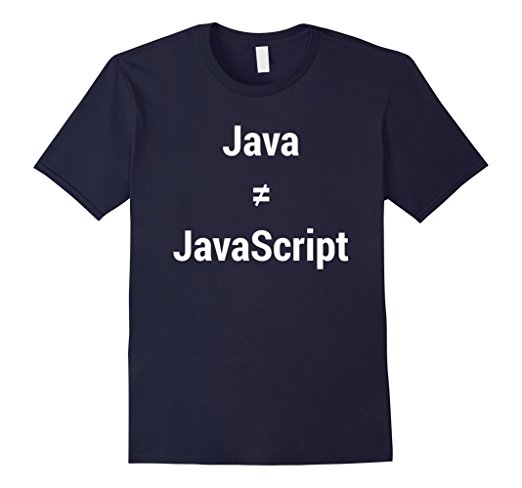 Though the shirt is not available on Amazon [WayBack] any more, still – after 25 years – so many recruiters still get it wrong.
Not just recruiters, so: [WayBack] Why is JavaScript called JavaScript, since it has nothing to do with Java? – Stack Overflow, thanks to CMS [WayBack]:
From an interview made to its creator Brendan Eich:
InfoWorld: As I understand it, JavaScript started out as Mocha, then became LiveScript and then became JavaScript when Netscape and Sun got together. But it actually has nothing to do with Java or not much to do with it, correct?
Eich: That’s right. It was all within six months from May till December (1995) that it was Mocha and then LiveScript. And then in early December, Netscape and Sun did a license agreement and it became JavaScript. And the idea was to make it a complementary scripting language to go with Java, with the compiled language.
he continues on the relation of ECMAScript based languages:
JavaScript, was originally named Mocha, later it was renamed to LiveScript, and then to JavaScript.
The LiveScript to JavaScript name change came because Netscape and Sun did a license agreement.
The language was then submitted for standarization to the ECMA International Organization. By that time, Netscape didn’t allow the use of the “JavaScript” name, so the standarized language is named ECMAScript.
JavaScript isn’t actually an open name. Now it’s a trademark of Sun (now Oracle).
There still a lot of confusion, some people still think that JavaScript, JScript, and ECMAScript are three different languages.
ECMAScript is the “standards” name for the language.
JavaScript is technically a “dialect” of ECMAScript, the Mozilla Foundation can use “JavaScript” as the name of their implementations (currently present on the Rhino and SpiderMonkey engines).
In the early days, Microsoft decided also to do what Netscape was doing on their own browser, and they developed JScript, which is also an ECMAScript dialect, but was named in this way to avoid trademark issues.
–jeroen
via: [WayBack] Does it bug you when people say Java when they actually mean JavaScript? https://www.amazon.com/dp/B06Y3XK69B – Jeroen Wiert Pluimers – Google+
Posted in Development, History, Java, Java Platform, JavaScript/ECMAScript, Scripting, Software Development | Leave a Comment »
Posted by jpluimers on 2020/02/26
This post is a reminder to myself that not all mappings from XSD to programming languages are possible.
There are many impossible cases, so this is just a general reminder.
A Delphi specific case for instance is the mapping of enumerations: one reason is that XSD enumerations are case sensitive, but the Delphi language is not: [WayBack] Using XML Enumerations with Delphi XML Data Binding Wizard – Stack Overflow.
More generic examples from my answer to the above question:
- In XSD you can derive from an existing type in two ways: extending it and limiting it. Object Oriented languages only allow you extend when deriving.
- Delphi is not alone in these kinds of limitations. Generating wrappers from XSD schema’s is the field of specialized tools, even in the Java or .NET world.
I’ve seen horrible things with wildcards that are sort of mappable to Java, but not to C#. This could likely go on for much longer…
–jeroen
Posted in C#, Delphi, Development, Java, Java Platform, Software Development, XML, XML/XSD, XSD | 2 Comments »
Posted by jpluimers on 2019/08/07
When it was at the age natural people are allowed to drive in the USA, the .NET framework behaved far less brain dead handling various (especially long or strange) paths: [WayBack] More on new .NET path handling – Jeremy Kuhne’s Blog.
Path handling has frustrated me in many development environments, so I wonder if ones that are beyond the (USA) legal age of drinking follow.
–jeroen
via: [WayBack] Some time ago, the .net developers finally saw sense and removed path normalization and long path limit code in System.IO… Does anybody know if Embarcadero have come to their senses… – David Heffernan – Google+
Posted in .NET, Delphi, Development, Java, Java Platform, Software Development | Leave a Comment »
Posted by jpluimers on 2019/07/16
Design Patterns and Refactoring articles and guides. Design Patterns video tutorials for newbies. Simple descriptions and full source code examples in Java, C++, C#, PHP and Delphi.
Source: [WayBack] Design Patterns & Refactoring.
And indeed a lot of examples in Delphi too; few sites have that: Delphi site:sourcemaking.com.
–jeroen
Via: [WayBack] I stumbled upon this yesterday, very informative, accessible and also with Delphi examples – among other languages. – Steffen Nyeland – Google+
Posted in .NET, C, C#, C++, Delphi, Design Patterns, Development, Java, Java Platform, PHP, Scripting, Software Development | Leave a Comment »
Posted by jpluimers on 2019/04/03
This is so cool: [WayBack] paulcbetts/refit: The automatic type-safe REST library for Xamarin and .NET. It’s inspired by Square’s [WayBack] Retrofit library which does the same for Java.
They basically allow you to use attributes on interfaces to define a type-safe wrapper around any REST interface, then instantiate a connection to it for making calls.
No more manual HttpClient fiddling!
Since it requires only .NET 1.4, you can basically run it on any platform as it’s supported covered by the implementations .NET Core, Mono and the full .NET Framework.
Quite a lot of projects already use it; I got there via the first link:
–jeroen
Via: [WayBack] Exploring refit, an automatic type-safe REST library for .NET Standard https://www.hanselman.com/blog/ExploringRefit… – Jeroen Wiert Pluimers – Google+
Posted in .NET, C#, Development, Java, Java Platform, Software Development | Leave a Comment »
Posted by jpluimers on 2017/12/07
Ah, C. The best lingua franca we have… because we have no other lingua francas. Linguae franca. Surgeons general? C is fairly old — 44 years, now! — and comes from a time when there were possibly more architectures than programming languages. It works well for what it is, and what it is is a relatively simple layer of indirection atop assembly. Alas, the popularity of C has led to a number of programming languages’ taking significant cues from its design, and parts of its design are… slightly questionable. I’ve gone through some common features that probably should’ve stayed in C and my justification for saying so. The features are listed in rough order from (I hope) least to most controversial. The idea is that C fans will give up when I call it “weakly typed” and not even get to the part where I rag on braces. Wait, crap, I gave it away.
Great re-read towards the end of the year: [WayBack] Let’s stop copying C / fuzzy notepad
Via: [WayBack] Old and busted: emacs vs vi. New and hot: Language war, everybody against everybody else. – Kristian Köhntopp – Google+
–jeroen
Posted in .NET, APL, Awk, bash, BASIC, C, C#, C++, COBOL, CoffeeScript, CommandLine, D, Delphi, Development, F#, Fortran, Go (golang), Java, Java Platform, JavaScript/ECMAScript, Pascal, Perl, PHP, PowerShell, PowerShell, Python, Ruby, Scala, Scripting, Software Development, TypeScript, VB.NET, VBScript | 3 Comments »
Posted by jpluimers on 2017/11/30
Interesting: https://github.com/MinBZK/OperatieBRP
[WayBack] The Netherlands saw a big I.T. project meant to deliver a new citizen registry system fail. So they did one thing right. All the source code is now on github… – Jan Wildeboer – Google+
It includes both documentation and source code.
A bit of browsing reveals at least some of the technologies used:
Most of the SQL code seems to be generated.
There are truckloads of .XML configuration files, typical for a Java environment. Some configuration is in .properties files.
–jeroen
Posted in ActiveMQ, Development, Java, Java Platform, MQ Message Queueing/Queuing, Open Source, PostgreSQL, Software Development | Leave a Comment »
Posted by jpluimers on 2017/11/03
Via [WayBack] Graph of programming languages influence poster – nice gift idea for programmers… – This is why I Code – Google+:
A network graph with more than a thousand programming languages connected by influence relations. Highly influential languages like Lisp, Smalltalk, C, Java, Pascal, C++, Haskel or Python are shown as larger circles as compared to languages with little influence on others like PHP or Argh!. / The influence relation data was retrieved from Freebase in 2013. This design available on posters and other products. An awesome gift for programmers who are into digital art. • Also buy this artwork on wall prints, apparel, kids clothes, and more.
[WayBack] “Network Graph of Programming Language Influence – White Background” Posters by ramiro | Redbubble
I wonder how they drew the relations and why certain languages are in certain places.
--jeroen
Read the rest of this entry »
Posted in C, C++, COBOL, Development, Haskell, Java, Java Platform, JavaScript/ECMAScript, LISP, Pascal, Perl, PHP, Python, Ruby, Scripting, Smalltalk, Software Development, Turbo Prolog | Leave a Comment »
Posted by jpluimers on 2017/11/02
Quoted in full because even 2.5 years later, it’s just too funny:
- Python: What if everything was a dict?
- Java: What if everything was an object?
- JavaScript: What if everything was a dict *and* an object?
- C: What if everything was a pointer?
- APL: What if everything was an array?
- Tcl: What if everything was a string?
- Prolog: What if everything was a term?
- LISP: What if everything was a pair?
- Scheme: What if everything was a function?
- Haskell: What if everything was a monad?
- Assembly: What if everything was a register?
- Coq: What if everything was a type/proposition?
- COBOL: WHAT IF EVERYTHING WAS UPPERCASE?
- C#: What if everything was like Java, but different?
- Ruby: What if everything was monkey patched?
- Pascal: BEGIN What if everything was structured? END
- C++: What if we added everything to the language?
- C++11: What if we forgot to stop adding stuff?
- Rust: What if garbage collection didn’t exist?
- Go: What if we tried designing C a second time?
- Perl: What if shell, sed, and awk were one language?
- Perl6: What if we took the joke too far?
- PHP: What if we wanted to make SQL injection easier?
- VB: What if we wanted to allow anyone to program?
- VB.NET: What if we wanted to stop them again?
- Forth: What if everything was a stack?
- ColorForth: What if the stack was green?
- PostScript: What if everything was printed at 600dpi?
- XSLT: What if everything was an XML element?
- Make: What if everything was a dependency?
- m4: What if everything was incomprehensibly quoted?
- Scala: What if Haskell ran on the JVM?
- Clojure: What if LISP ran on the JVM?
- Lua: What if game developers got tired of C++?
- Mathematica: What if Stephen Wolfram invented everything?
- Malbolge: What if there is no god?
–jeroen
Read the rest of this entry »
Posted in .NET, APL, Assembly Language, BASIC, C, C#, C++, COBOL, Development, EPS/PostScript, Fun, Go (golang), Java, Java Platform, JavaScript/ECMAScript, LISP, Makefile, Pascal, Perl, PHP, Python, Quotes, Ruby, Rust, Scala, Scripting, Smalltalk, Software Development, T-Shirt quotes, TCL, Turbo Prolog, VB.NET, Visual BASIC, XML/XSD, XSLT | Leave a Comment »


 The Wiert Corner - irregular stream of stuff